Managing OCD symptoms can be difficult, especially when unwanted thoughts or repetitive behaviors begin to take over your day.
The good news is that obsessive-compulsive disorder (OCD) can be treated, and many people learn to manage their symptoms and take back control of their daily lives. The main evidence-based psychological treatment for OCD is cognitive behavioral therapy (CBT), especially a form called exposure and response prevention (ERP). Some people may also use medication.
Self-help strategies can also support treatment. These may include learning how the OCD cycle works, noticing compulsive behaviors, improving sleep, exercising regularly, staying connected with supportive people, and practicing skills recommended by a qualified professional.
This guide explains practical strategies for managing OCD symptoms, including what you can do at home and when you may need professional help.
Table of Contents
What Is OCD?
OCD is a mental health condition that involves obsessions, compulsions, or both.
Obsessions
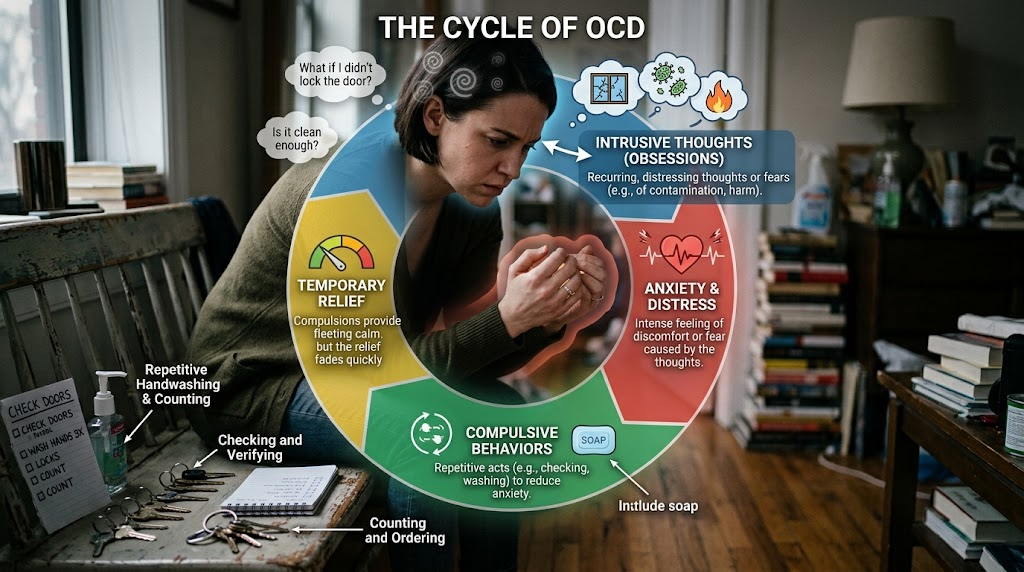
Obsessions are unwanted and repeated thoughts, images, urges, or doubts that cause distress.
For example, a person may worry:
- “What if I accidentally hurt someone?”
- “What if I become sick from this?”
- “What if I made a serious mistake?”
- “What if something bad happens to my family?”
- “What if I am not completely sure?”
These thoughts can feel very real and frightening. However, having an intrusive thought does not mean you want it to happen or that it will happen.
Compulsions
Compulsions are behaviors or mental acts a person feels driven to perform to reduce anxiety or deal with an obsession.
They may include:
- Repeatedly washing your hands
- Checking locks many times
- Asking other people for reassurance
- Repeating words or phrases in your mind
- Searching online for answers
- Mentally reviewing something that happened
- Avoiding situations that trigger fear
- Repeating an action until it feels “just right”
Compulsions may provide short-term relief, but the relief often does not last.
The OCD cycle
A simple way to understand OCD is:
Trigger → obsession or intrusive thought → anxiety or uncertainty → compulsion → short-term relief → cycle starts again
The goal of treatment is not necessarily to make every unwanted thought disappear.
Instead, treatment helps a person respond differently to the thought without automatically performing the compulsion.
What Is the Best Way of Managing OCD Symptoms?
The most established psychological approach for Obsessive Compulsive Disorder (OCD) is cognitive behavioral therapy (CBT) that includes exposure and response prevention (ERP).
The National Institute of Mental Health identifies CBT and ERP as effective treatments for OCD. NICE guidance also recommends CBT with ERP for people with OCD, with treatment intensity depending on symptom severity and how much OCD affects daily life.
Treatment may also include medication, particularly selective serotonin reuptake inhibitors (SSRIs), depending on the person’s situation. A healthcare professional can help decide which treatment is appropriate.
How CBT Helps With OCD
CBT is a type of talking therapy that looks at the relationship between thoughts, feelings, and behaviors.
For OCD, CBT is adapted to address the specific patterns that keep OCD going.
One important part of this approach is learning that:
An intrusive thought is not the same as an intention, fact, or prediction.
For example, thinking:
“What if I hurt someone?”
does not mean:
“I want to hurt someone.”
A person with OCD may feel an urgent need to prove that the thought is untrue. They may check their feelings, ask someone for reassurance, search online, or mentally review the thought.
Unfortunately, these actions can become compulsions.
CBT and ERP help people learn to tolerate uncertainty instead of constantly trying to obtain complete certainty.
NICE specifically notes that CBT for OCD can include exposure to obsessive thoughts and preventing mental rituals or other neutralizing strategies.
Exposure and Response Prevention (ERP)
Exposure and response prevention, or ERP, is a specialized form of CBT used to treat OCD.
ERP has two main parts.
1. Exposure
Exposure means gradually facing a situation, thought, image, or feeling that triggers OCD.
2. Response prevention
Response prevention means resisting the usual compulsion or ritual that would normally follow the trigger.
For example, someone with contamination-related OCD may feel an intense urge to wash their hands after touching something they consider dirty.
In ERP, under appropriate guidance, the person may gradually practice facing the trigger while delaying or avoiding the compulsive washing.
The purpose is not to prove that nothing bad will ever happen.
Instead, the person learns:
- Anxiety can be tolerated.
- Uncertainty can exist without needing an answer.
- An intrusive thought does not require a response.
- The urge to perform a compulsion can pass.
- Life can continue even when the person does not feel completely certain.
ERP can feel uncomfortable at first. That is why working with a therapist who understands OCD and ERP can be especially helpful. NIMH describes ERP as gradually exposing people to triggers while preventing the usual compulsive response.
Tips for Managing OCD Symptoms
No single trick makes OCD disappear. However, several habits can support treatment and make it easier to respond to symptoms.
1. Learn to recognize your OCD cycle
Start by noticing what happens before a compulsion.
Ask yourself:
- What triggered me?
- What thought or feeling appeared?
- What did I feel the urge to do?
- Did I perform a compulsion?
- Did I feel temporary relief afterward?
This can help you see patterns instead of feeling controlled by them.
However, avoid turning tracking into another form of checking. The purpose is to understand the pattern, not to analyze every thought perfectly.
2. Notice reassurance seeking
Reassurance can feel helpful for a few minutes.
You might ask:
- “Are you sure I didn’t do anything wrong?”
- “Do you think this thought means something?”
- “Can you promise that everything will be okay?”
But repeated reassurance can sometimes become part of the OCD cycle.
Instead of repeatedly seeking certainty, treatment often teaches people to become more comfortable with uncertainty.
3. Avoid treating every intrusive thought as important
Everyone can experience strange, unwanted, or upsetting thoughts.
With OCD, the person may believe the thought needs to be solved, controlled, or understood.
Try to notice:
“This is an intrusive thought. I do not have to solve it right now.”
The goal is not to force the thought away.
Trying desperately to remove a thought can sometimes make you pay even more attention to it.
4. Practice skills from your treatment plan
If you are working with an OCD therapist, practice the skills they recommend between sessions.
CBT and ERP often include exercises outside therapy sessions. NHS guidance notes that people receiving CBT for OCD may have exercises to complete at home between sessions.
Consistency is usually more useful than trying to do everything perfectly.
5. Take care of your sleep
Poor sleep can make it harder to manage stress and daily challenges.
Try to:
- Keep a regular sleep schedule.
- Give yourself enough time to sleep.
- Reduce activities that keep you awake late at night.
- Create a calm bedtime routine.
Good sleep is not a treatment for OCD by itself, but it is an important part of general mental and physical health.
The International OCD Foundation also recommends healthy sleep, exercise, nutrition, and other basic self-care habits.
6. Stay physically active
Regular physical activity can support overall mental health.
You might:
- Walk
- Stretch
- Ride a bicycle
- Exercise at home
- Play a sport
- Spend time outdoors
Exercise should be viewed as a supportive habit, not a replacement for OCD treatment.
Research on lifestyle interventions for OCD and related disorders is still limited, so lifestyle changes should not be presented as a cure.
7. Stay connected with supportive people
OCD can make people feel alone.
Talking with a trusted friend or family member can provide emotional support.
However, loved ones should be careful not to become part of repeated reassurance or rituals.
For example, repeatedly checking something for a loved one or answering the same reassurance question many times may unintentionally strengthen the OCD cycle.
In some cases, family members can work with a mental health professional to learn how to provide support without reinforcing compulsions.
Managing OCD Symptoms at Home
Many people want to know how they can start managing OCD symptoms at home. Understanding Common OCD patterns, such as repeated checking, excessive cleaning, reassurance seeking, and unwanted intrusive thoughts, can be a helpful first step.
There are useful things you can do at home, but self-help should support, not replace, appropriate professional treatment when OCD is significantly affecting your life.
You can start by:
1. Learn about OCD
Understanding obsessions, compulsions, avoidance, reassurance seeking, and mental rituals can help you recognize your own patterns.
2. Follow your treatment plan
If you have an OCD therapist, complete the exercises they recommend.
3. Reduce compulsive reassurance
Notice when you are repeatedly asking others or searching online for certainty.
4. Keep a healthy routine
Try to maintain regular sleep, meals, movement, work, study, and social activities.
5. Practice tolerating uncertainty
Instead of trying to answer every “What if?” question, learn to accept that some uncertainty is part of everyday life.
6. Do not create your own extreme ERP exercises
ERP is powerful, but it can be difficult to apply correctly. If your OCD is severe, or an exposure involves significant risk, speak with an OCD-trained professional rather than attempting it alone.
NICE recommends guided self-help and lower-intensity CBT/ERP in some cases of mild OCD, while people with greater impairment may need more intensive treatment.
Self-Help Strategies for Managing OCD Symptoms
Some self-help strategies for managing OCD symptoms can be useful between therapy sessions.
Here are some simple principles.
Name the OCD pattern
When an intrusive thought appears, you can remind yourself:
“This may be my OCD asking me for certainty.”
This does not mean every thought is caused by OCD. It simply helps you notice the pattern.
Delay the compulsion
If your treatment plan supports it, you may practice creating a small gap between the urge and the compulsive behavior.
For example:
Urge → pause → notice the discomfort → follow your treatment plan
A therapist can help you decide how to do this safely and effectively.
Continue with normal activities
OCD can encourage avoidance.
You may start avoiding places, people, objects, or activities because they trigger anxiety.
Treatment often focuses on gradually returning to meaningful activities rather than allowing OCD to control your life.
Accept discomfort
The goal is not:
“I must feel calm before I continue.”
A more helpful treatment goal can be:
“I can feel uncomfortable and continue with my day.”
What Role Does Diet Play in Managing OCD Symptoms?
At present, there is no specific diet proven to treat or cure OCD. Eating regular, balanced meals and getting adequate nutrition can support general health, but diet should not replace evidence-based OCD treatment. People looking for professional support may also explore options such as OCD treatment in Massachusetts through qualified mental health providers.
Research into lifestyle approaches for OCD including diet, exercise, sleep, and stress management—is still developing, and the evidence for lifestyle interventions specifically reducing OCD symptoms remains limited.
A practical approach is to:
- Eat a balanced diet.
- Drink enough water.
- Avoid skipping meals when possible.
- Include a variety of nutritious foods.
- Notice whether caffeine or other foods seem to make your anxiety worse.
- Avoid restrictive diets unless medically necessary or recommended by a qualified professional.
Be careful with online claims that certain foods, supplements, vitamins, or special diets can “cure” OCD. Strong claims require strong evidence.
If you are considering supplements for OCD, discuss them with a healthcare professional, especially if you take medication.
Can Mindfulness Help With OCD?
Mindfulness can be a useful supportive skill, but it should not become another way to check whether your thoughts or feelings are “right.”
Mindfulness means noticing what is happening in the present moment without automatically reacting to it.
For example, you might notice:
“I am having an uncomfortable thought.”
Then return your attention to what you were doing.
The goal is not to force the thought away.
This difference matters because trying to make an intrusive thought disappear can itself become a mental ritual.
Mindfulness may be included as part of broader self-care, but ERP remains a central evidence-based psychological treatment for OCD.
What About Mental Compulsions?
Not every compulsion is visible.
Some people with OCD perform rituals entirely in their minds.
These can include:
- Replaying an event repeatedly
- Mentally checking whether you feel something
- Repeating certain words in your head
- Trying to “cancel out” a bad thought
- Reviewing memories again and again
- Trying to prove that an intrusive thought is impossible
- Repeatedly analyzing what a thought means
These behaviors may be difficult for other people to notice.
However, they can still maintain the OCD cycle.
NICE specifically recognizes the importance of preventing mental rituals and neutralizing strategies when treating OCD.
When Should You Seek Professional Help for OCD?
Consider seeking professional help when OCD:
- Takes up a lot of your time
- Interferes with work or school
- Makes relationships difficult
- Causes significant distress
- Causes you to avoid normal activities
- Leads to repeated reassurance seeking
- Makes it difficult to leave home
- Interferes with sleep
- Causes you to perform many rituals
- Continues despite your attempts to manage it
You do not have to wait until OCD becomes severe before asking for help.
A mental health professional can assess your symptoms and help you choose an appropriate treatment.
What Treatment Is Available for OCD?
Treatment depends on the person’s symptoms, severity, preferences, and other health needs.
Common treatment approaches include:
CBT with ERP
This is one of the main psychological treatments for OCD.
Medication
SSRIs are commonly used to treat OCD. Make medication decisions with a qualified healthcare professional.
CBT and medication together
Some people may benefit from both psychological treatment and medication.
NICE recommends treatment based partly on how much OCD affects a person’s daily functioning. People with more severe impairment may need more intensive treatment or combined approaches.
Specialist OCD treatment
If OCD does not improve enough with initial treatment, a specialist with experience treating OCD may be helpful.
How to Find an OCD Therapist
When looking for a therapist, ask whether they have specific experience treating OCD.
You can ask:
- Do you provide CBT for OCD?
- Do you use exposure and response prevention?
- How often do you treat people with OCD?
- How do you work with mental compulsions?
- How do you involve family members when needed?
- What happens if symptoms do not improve?
Finding someone who understands OCD is important because general anxiety treatment is not always the same as specialized OCD treatment.
How to Support Someone With OCD
If someone you love has OCD, you may want to make their anxiety disappear.
That is understandable.
But repeatedly providing reassurance or helping with rituals can sometimes strengthen the OCD cycle.
Instead, you can:
- Listen without judging.
- Encourage professional treatment.
- Learn about OCD.
- Ask how you can support them.
- Avoid making fun of their symptoms.
- Avoid forcing them into frightening situations.
- Work with a professional if family accommodation has become a major problem.
Your role is to provide support, not to become the person’s therapist.
Managing OCD Symptoms Is a Process
OCD does not always improve in a straight line.
You may have good days and difficult days.
A difficult day does not mean that treatment has failed.
The goal is not to control every thought.
Instead, treatment focuses on helping you:
- Recognize OCD patterns
- Reduce compulsive responses
- Tolerate uncertainty
- Face situations you have been avoiding
- Return to meaningful activities
- Build confidence in your ability to handle discomfort
With appropriate treatment and support, many people with OCD learn to manage their symptoms and live active, meaningful lives.
Final Thoughts
Managing OCD symptoms is possible, but it usually takes practice and patience.
CBT, especially exposure and response prevention (ERP), is an important evidence-based treatment for OCD. Self-help habits such as regular sleep, exercise, healthy nutrition, social support, and learning to recognize compulsions can also support recovery.
If OCD is interfering with your daily life, consider speaking with a mental health professional who has experience treating OCD.
You do not need to solve every intrusive thought.
You can learn to respond to OCD differently and keep moving forward with your life.
Frequently Asked Questions
1. What is the best way to manage OCD symptoms?
The main evidence-based psychological treatment for OCD is CBT with exposure and response prevention (ERP). Some people also benefit from medication, such as SSRIs. A qualified healthcare professional can help determine the right treatment for your symptoms.
2. Can I manage OCD symptoms at home?
Some people with mild OCD may benefit from guided self-help and CBT/ERP-based strategies. Healthy sleep, exercise, nutrition, and reducing reassurance seeking can also support treatment. However, severe or persistent OCD often requires professional care.
3. What are some self-help strategies for managing OCD symptoms?
Useful strategies can include learning how the OCD cycle works, recognizing compulsions, reducing reassurance seeking, following a therapist’s treatment plan, maintaining healthy routines, and practicing tolerance of uncertainty. Self-help should not replace professional treatment when OCD significantly affects daily life.
4. What role does diet play in managing OCD symptoms?
There is currently no specific diet proven to cure OCD. A balanced diet supports general health, but diet should not replace evidence-based OCD treatment. Research into lifestyle approaches for OCD is still developing.
5. Can OCD symptoms go away?
OCD symptoms can improve significantly with appropriate treatment. OCD may be a long-term condition for some people, so the goal is often effective symptom management rather than promising a permanent cure. CBT with ERP and, when appropriate, medication can help many people manage OCD and improve daily functioning.

Shaista specializes in Personality Psychology and Organizational Behaviour, with a deep interest in how people think, grow, and interact within systems. She writes for multiple websites, bringing clarity and insight to topics across human behavior, mental health, and workplace psychology.