Is the Oedipus Complex Real?
The short answer is: not in the way Sigmund Freud originally described it.
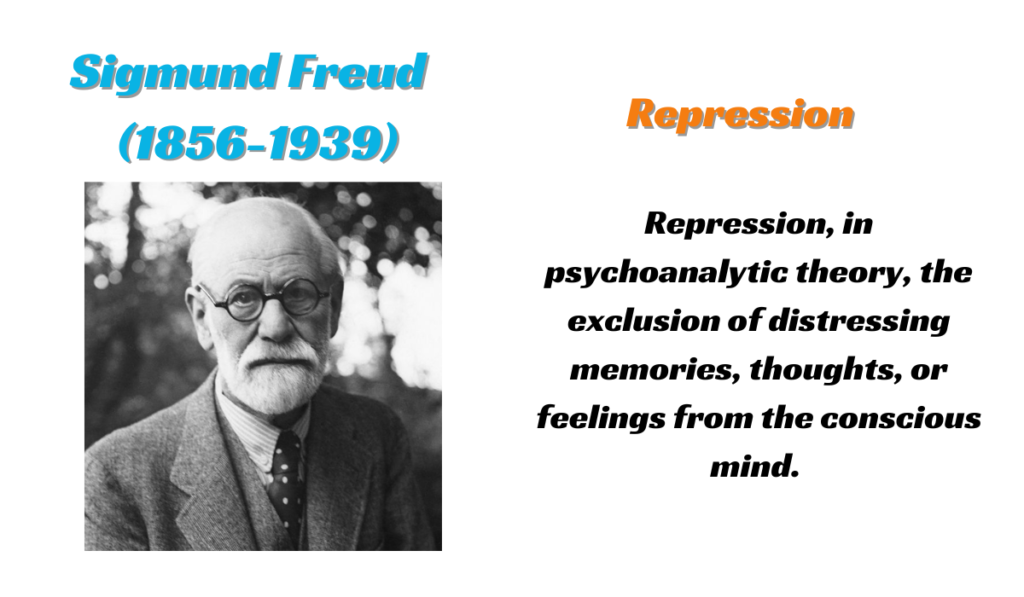
The Oedipus complex is one of the most famous ideas in psychology. It was introduced by Sigmund Freud, the founder of psychoanalysis, more than 100 years ago. Freud believed that young children go through a stage where they develop unconscious romantic feelings for the opposite-sex parent and feel jealous of the same-sex parent.
Today, however, most psychologists do not accept the Oedipus complex as a scientifically proven explanation of child development. While Freud’s theory played an important role in the history of psychology, modern research points to other explanations for how children develop emotional bonds with their parents.
Instead of focusing on unconscious desires, today’s psychologists study child development through attachment, learning, parenting, brain development, emotions, and social experiences.
Even though the theory is widely debated, the Oedipus complex is still taught in psychology because it helped shape the early study of the human mind.
In this article, you’ll learn
Table of Contents
What Is an Oedipus Complex?
The Oedipus complex is a theory created by Sigmund Freud. It describes a stage of early childhood when a child is believed to have unconscious emotional conflict involving both parents.
According to Freud:
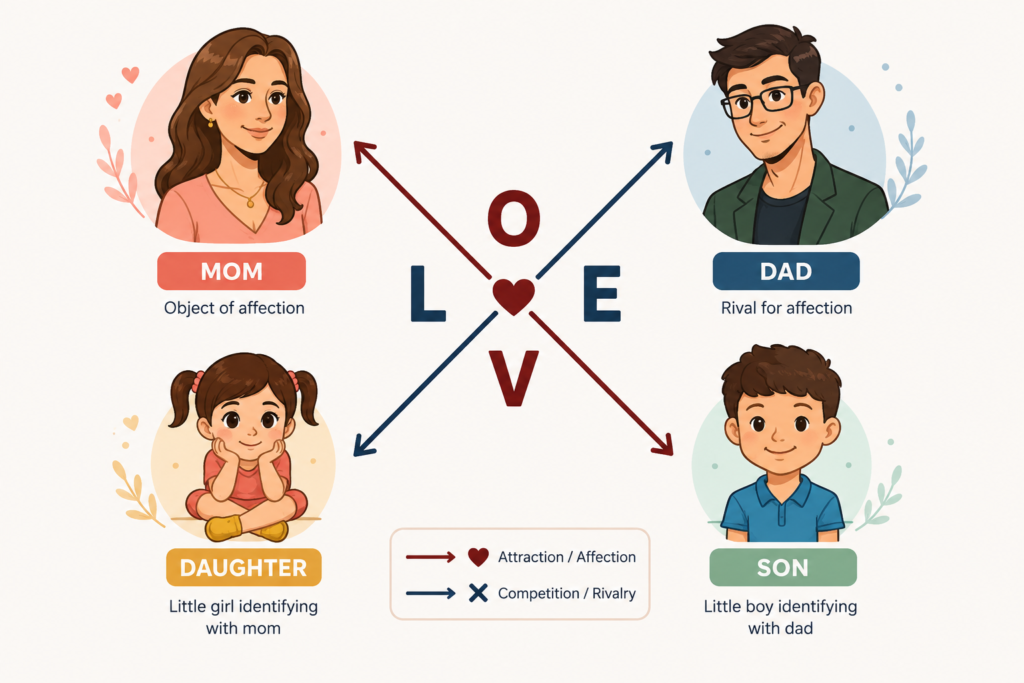
- A young boy unconsciously wants all of his mother’s attention and love.
- At the same time, he sees his father as a rival for that attention.
- Over time, the child begins to identify with his father instead of competing with him.
- This process helps shape the child’s personality and sense of identity.
Freud believed this stage usually happened between three and six years of age, during what he called the phallic stage of development.
It is important to remember that Freud believed these feelings were unconscious. He did not mean that children have adult romantic thoughts or make conscious choices about their parents.
Oedipus Complex Definition
In simple words, the Oedipus complex is Freud’s idea that a young child experiences unconscious emotional conflict involving love for one parent and rivalry with the other parent during early childhood.
Today, many psychologists view this definition as part of the history of psychology rather than a proven scientific fact.
What Does Oedipus Complex Mean?
Many people hear the term “Oedipus complex” and think it simply means a boy who loves his mother too much.
That is not what Freud originally meant.
Freud believed the Oedipus complex was an unconscious stage of psychological development, not a behavior that children intentionally choose.
In modern everyday language, people sometimes use the phrase to describe someone who seems unusually dependent on or emotionally attached to their mother. However, psychologists are careful not to use the term this way because it oversimplifies Freud’s theory and may incorrectly label normal family relationships.
In reality, most children naturally feel close to their parents, especially during their early years. A strong bond with a parent is usually a healthy part of development, not evidence of an Oedipus complex.
Where Did the Name “Oedipus Complex” Come From?
The theory gets its name from Oedipus, a famous character in Greek mythology.
According to the ancient story:
- Oedipus was separated from his parents as a baby.
- As an adult, he unknowingly killed his father.
- Later, without realizing who she was, he married his mother.
- When the truth was revealed, the story ended in tragedy.
Freud used this myth as a symbol for the emotional conflicts he believed children experience during development.
It is important to understand that Freud did not claim children repeat the events of the myth. Instead, he used the story as a way to describe unconscious psychological conflicts.
How Did Freud Explain the Oedipus Complex?
Freud believed that personality develops through several stages during childhood. One of these stages is called the phallic stage, which usually occurs between the ages of three and six years.
According to Freud, children become more aware of differences between males and females during this stage. He believed boys unconsciously become emotionally attached to their mothers while seeing their fathers as competitors for their mother’s attention.
Freud also believed boys eventually become afraid of losing their father’s love and approval. Because of this fear, they stop competing with their father and begin to identify with him instead.
Freud thought this identification helped children learn:
- Family values
- Social rules
- Gender roles
- Moral behavior
This idea became one of the central parts of Freud’s theory of personality.
However, many of Freud’s conclusions came from observing patients and interpreting dreams rather than from scientific experiments. This is one reason why many psychologists question whether the theory accurately explains how children develop.
Did Freud Believe Every Child Experienced the Oedipus Complex?
Yes. Freud believed the Oedipus complex was a normal stage of development that every child experiences in some form.
He argued that successfully resolving this stage helped children:
- Build a healthy personality
- Develop a conscience
- Learn appropriate social behavior
- Form a stronger sense of identity
Freud also believed that unresolved conflicts during this stage could affect a person’s relationships later in life.
Today, however, researchers generally do not accept this idea because it has not been consistently supported by scientific evidence.
Is the Oedipus Complex Real?
The simple answer is no, not according to most modern psychologists.
Freud’s Oedipus complex is one of the best-known theories in psychology, but it is not considered scientifically proven. While the theory influenced psychology for many years, most experts today believe there is insufficient scientific evidence to show that all children experience the emotional conflict Freud described.
That does not mean Freud’s work has no value. His ideas encouraged psychologists to think about how early childhood experiences shape personality and behavior. Many of those ideas inspired later research, even if the Oedipus complex itself is no longer widely accepted.
Today, psychologists use research-based theories to explain child development. These include:
- Attachment theory
- Social learning theory
- Cognitive development
- Brain development
- Parenting and family relationships
- Emotional development
These theories are supported by years of scientific studies and are commonly taught in psychology today.
Why Do Many Psychologists Disagree With Freud?
Freud’s ideas were groundbreaking for their time, but psychology has changed a lot over the past century. As researchers developed better ways to study human behavior, many began questioning whether the Oedipus complex accurately explains how children grow and learn.
Here are some of the main reasons.
1. There Is Little Scientific Evidence
One of the biggest criticisms is that the Oedipus complex has not been proven through strong scientific research.
Modern psychology relies on studies that can be tested, repeated, and verified by other researchers. Freud’s theory was mostly based on his observations of patients rather than carefully controlled experiments.
Because of this, scientists have found it difficult to test whether the Oedipus complex truly happens in the way Freud described.
2. The Theory Is Difficult to Test
A good scientific theory should make predictions that researchers can measure.
The Oedipus complex focuses on unconscious thoughts and feelings, which are very difficult to observe directly. Since these thoughts cannot be easily measured, researchers cannot reliably prove or disprove many of Freud’s claims.
This is one reason why many psychologists do not consider it a strong scientific theory.
3. Children Usually Form Healthy Attachments
Research shows that young children naturally seek comfort, safety, and love from their parents or caregivers.
A child may prefer spending time with one parent during certain stages of life. They may even become jealous when that parent gives attention to someone else.
However, psychologists explain these behaviors as normal attachment, not as evidence of unconscious romantic feelings.
For example:
- A four-year-old may want only their mother to read a bedtime story.
- A young child may cry when a parent leaves for work.
- A child may become upset if a sibling receives more attention.
These behaviors are common parts of childhood and do not mean the child has an Oedipus complex.
4. Culture and Family Life Are Different
Freud developed his theories in the early 1900s while working mainly with adults in Europe.
Today’s families are much more diverse. Children grow up in many different family structures, cultures, and environments.
Modern psychologists believe that culture, parenting styles, education, friendships, and life experiences all influence development. Because of this, many experts think Freud’s theory is too narrow to explain every child’s experience.
What Does Modern Psychology Say?
Modern psychology still recognizes Freud as an important figure in history, but it does not treat the Oedipus complex as a proven explanation of child development.
Instead, psychologists believe children develop through many interacting factors, including:
- Secure relationships with caregivers
- Emotional support
- Positive learning experiences
- Healthy communication
- Brain development
- Social interactions
Rather than focusing on unconscious conflicts with parents, modern research looks at how everyday experiences shape children’s emotions, thinking, and behavior.
This approach is supported by decades of research from developmental psychology, neuroscience, and education.
What Is Attachment Theory?
One of the most accepted explanations of child development today is attachment theory.
Attachment theory suggests that children form emotional bonds with the adults who care for them.
These relationships help children feel:
- Safe
- Loved
- Protected
- Confident enough to explore the world
When children have secure attachments, they are more likely to develop healthy relationships, manage emotions well, and become independent over time.
Unlike the Oedipus complex, attachment theory has been supported by many scientific studies.
Oedipus Complex vs. Attachment Theory
| Oedipus Complex | Attachment Theory |
| Proposed by Sigmund Freud | Developed through decades of scientific research |
| Focuses on unconscious conflict | Focuses on emotional security and caregiving |
| Limited scientific evidence | Strong scientific support |
| Part of psychoanalytic theory | Widely accepted in developmental psychology |
| Difficult to test scientifically | Supported by many research studies |
This comparison helps explain why most psychologists rely on attachment theory instead of the Oedipus complex when studying children’s emotional development.
Is the Oedipus Complex a Mental Disorder?
No.
The Oedipus complex is not a mental illness or a medical diagnosis.
It does not appear in modern diagnostic manuals used by mental health professionals, and psychologists do not diagnose children or adults with an Oedipus complex.
Sometimes people use the term casually to describe someone who seems overly attached to a parent. However, this is not a professional diagnosis and should not be used to label someone’s behavior.
If a child or adult is experiencing emotional or relationship difficulties, psychologists look at many possible causes instead of assuming the Oedipus complex is responsible.
Can Adults Have an Oedipus Complex?
Some people wonder whether adults can have an Oedipus complex if they remain unusually dependent on a parent or struggle with relationships.
From a modern psychological perspective, there is no scientific evidence that adults experience the Oedipus complex in the way Freud described.
However, adults can develop unhealthy family relationships, emotional dependence, or difficulties forming independent relationships. These issues are usually explained through other psychological concepts, such as:
- Attachment patterns
- Family dynamics
- Childhood experiences
- Trauma
- Personality development
Mental health professionals focus on these evidence-based explanations rather than diagnosing an Oedipus complex.
Is There Any Scientific Evidence for the Oedipus Complex?
Researchers have debated Freud’s theory for more than a century.
Some studies have explored whether children show signs of preferring one parent over the other. However, these behaviors can usually be explained by normal attachment, personality differences, or everyday family relationships.
Overall, there is no strong scientific consensus that supports the Oedipus complex as Freud originally described it.
Today, most psychologists see it as an important historical theory rather than a proven explanation of child development.
That said, Freud’s work still influenced psychology by encouraging researchers to study childhood experiences, unconscious processes, and family relationships. Even when later research disagreed with some of his conclusions, it helped move the field forward.
Common Myths About the Oedipus Complex
Because the Oedipus complex is often mentioned in movies, TV shows, and everyday conversations, many people misunderstand what it actually means. Let’s clear up some common myths.
Myth 1: Every Boy Has an Oedipus Complex
Fact: No.
Freud believed every boy went through this stage, but modern psychology does not accept this idea as a proven fact. Most psychologists believe children develop in many different ways, and there is no evidence that every child experiences the same unconscious conflict Freud described.
Myth 2: Loving Your Mother Means You Have an Oedipus Complex
Fact: No.
Children naturally love their parents. Feeling close to your mother or father is a healthy and normal part of growing up.
A child who enjoys spending time with one parent, wants hugs, or prefers one parent at bedtime is not showing signs of an Oedipus complex.
Myth 3: The Oedipus Complex Is a Mental Illness
Fact: It is not.
The Oedipus complex is a psychological theory, not a medical condition.
Doctors and psychologists do not diagnose people with an Oedipus complex, and it is not listed as a mental disorder in modern diagnostic manuals.
Myth 4: Freud’s Theory Has Been Proven
Fact: No.
Freud’s theory is one of the most famous ideas in psychology, but it has not been scientifically proven. While it influenced the field of psychology, most experts today rely on research-supported theories to explain child development.
Behaviors People Often Mistake for an Oedipus Complex
Many normal childhood behaviors are sometimes incorrectly described as signs of an Oedipus complex.
These behaviors usually have much simpler explanations.
Wanting Attention From a Parent
Young children often want their parents’ full attention. They may become upset when a parent is busy or spends time with someone else.
This is usually a normal part of emotional development.
Feeling Jealous of a Brother or Sister
Children sometimes become jealous when a new baby arrives or when a sibling receives more attention.
This is called sibling rivalry, and it is common in many families.
Copying a Parent
Children often imitate the adults they admire.
For example, a child may:
- Wear shoes like their father.
- Pretend to cook like their mother.
- Copy the way a parent talks or works.
This helps children learn new skills and build their identity. It is a normal part of development.
Wanting to Stay Close to a Parent
Many young children feel safest when they are near a trusted caregiver.
This behavior is best explained by secure attachment, not by the Oedipus complex.
Why Is Freud’s Theory Still Taught?
If most psychologists no longer accept the Oedipus complex as a proven theory, why do students still learn about it?
There are several reasons.
It Changed the History of Psychology
Freud was one of the first psychologists to argue that childhood experiences shape adult personality.
This idea encouraged researchers to study how early life affects mental health and behavior.
Although many of Freud’s specific theories are debated today, his work helped psychology grow into a scientific field.
It Introduced New Ways of Thinking
Freud suggested that unconscious thoughts and emotions could influence behavior.
Modern psychology still studies unconscious mental processes, although researchers explain them differently than Freud did.
It Helps Students Understand the History of Psychology
Learning older theories helps students understand how psychological ideas have changed over time.
By comparing Freud’s work with modern research, students can see how science develops as new evidence becomes available.
The Oedipus Complex in Popular Culture
The term “Oedipus complex” appears in many books, films, television shows, and online discussions.
However, it is often used incorrectly.
For example, people may jokingly say someone has an Oedipus complex simply because they are very close to their mother.
In reality, psychologists do not use the term this way. Close family relationships are usually healthy and should not be confused with Freud’s theory.
When the term appears in popular culture, it is often used for humor or drama rather than as an accurate psychological explanation.
Key Takeaways
Here are the most important points to remember:
- The Oedipus complex was proposed by Sigmund Freud as part of his psychoanalytic theory.
- Freud believed young children experience unconscious emotional conflict involving their parents.
- Most modern psychologists do not consider the Oedipus complex a scientifically proven explanation of child development.
- Research today focuses on attachment, learning, parenting, emotions, and brain development.
- The Oedipus complex is not a mental disorder or medical diagnosis.
- Freud’s theory remains important because it influenced the history of psychology, even though many of its ideas are debated today.
Frequently Asked Questions
1. Is the Oedipus complex a mental illness?
No. The Oedipus complex is not a mental disorder, and mental health professionals do not diagnose people with it.
2. Does the DSM include the Oedipus complex?
No. The Diagnostic and Statistical Manual of Mental Disorders (DSM) does not list the Oedipus complex as a mental health condition or diagnosis.
3. What is the female version of the Oedipus complex?
Freud’s student Carl Jung introduced the term Electra complex to describe a similar idea involving girls and their fathers. Like the Oedipus complex, it is controversial and is not widely accepted as a scientifically proven theory in modern psychology.
4. Can adults have an Oedipus complex?
Modern psychology does not consider the Oedipus complex a valid diagnosis for adults. Relationship problems or strong emotional dependence on a parent are usually explained through attachment patterns, family dynamics, or other evidence-based psychological concepts.
Final Thoughts
The Oedipus complex is one of the most famous—and most misunderstood—ideas in psychology. Sigmund Freud believed it was a normal stage of childhood development, but more than a century of research has led many psychologists to question his explanation.
Today, experts generally agree that children’s emotional development is better understood through evidence-based theories such as attachment, learning, brain development, and family relationships. These approaches are supported by much stronger scientific research than Freud’s original proposal.
Even so, the Oedipus complex remains an important part of psychology because it reminds us how the field has evolved. Studying Freud’s work helps us appreciate how scientific ideas change over time as new evidence becomes available.
By understanding both Freud’s original theory and the findings of modern psychology, readers can gain a more balanced and accurate view of one of the most influential concepts in the history of psychology.
Works Cited
Bowlby, John. Attachment and Loss. Vol. 2, Separation. Anger and Anxiety. London, Pimlico, 1973.
ESCALONA, S. “Childhood and Society. Erik H. Erikson. New York: Norton, 1950. 397 Pp. $4.00.” Science, vol. 113, no. 2931, 2 Mar. 1951, pp. 253–253, science.sciencemag.org/content/113/2931/253.1, https://doi.org/10.1126/science.113.2931.253.
Sigmund Freud the Interpretation of Dreams Sigmund Freud (1900) the Interpretation of Dreams -Sigmund Freud.
“Stages of Psychosexual Development | Journal Psyche.” Journalpsyche.org, 2009, journalpsyche.org/tag/stages-of-psychosexual-development/. Accessed 5 Nov. 2019.
“What Is Psychoanalysis? – the Oedipus Complex.” Freud Museum London, www.freud.org.uk/education/resources/what-is-psychoanalysis-part-3-the-oedipus-complex/.
Strachey J, et al. (1961). The dissolution of the Oedipus complex. The standard edition of the complete psychological works of Sigmund Freud. London, England: The Hogarth Press.
https://www.sas.upenn.edu/~cavitch/pdf-library/Freud_Dissolution.pdf

Maria holds an MS in Psychology with a specialization in Social Psychology. She is a research-oriented writer with a strong academic background in psychological and behavioral sciences. Her work focuses on bridging academic research and public understanding by simplifying complex psychological theories and social dynamics. She writes about the relationship between society, mental health, and human behavior, making evidence-based ideas more accessible and practical for readers.