Do you ever find yourself stuck in a mental loop? You keep replaying a conversation from earlier today. You obsess over a mistake you made last week. You worry about something that might happen tomorrow. No matter how hard you try, your brain just won’t shut off. This pattern is called rumination. If you are searching for how to stop ruminating, you are not alone. Millions of people struggle with overthinking. The good news? Psychology offers practical tools to help you break free.
In this guide, you will learn exactly how to stop ruminating, why your brain gets stuck, and 10 psychology-based ways to stop overthinking.
What is Rumination? A Simple Definition
Rumination psychology defines this habit as repetitively going over the same negative thoughts in your mind. It is like a scratched record. Instead of music, you hear the same worries, regrets, or “what ifs” over and over again (Papageorgiou & Wells, 2004).
To stop rumination, you first need to spot it. People often confuse rumination with problem-solving. But there is a big difference.
Problem-solving looks for solutions. You think about an issue, make a decision, and move on.
Rumination just rehashes the problem. You think about it constantly but never take action (Watkins, 2016).
Researchers define it as a form of “perseverative cognition.” This means your thinking gets stuck on negative content, usually about the past or present, and it causes emotional distress (Borders, 2020).
Common Rumination Symptoms
How do you know if you are ruminating? Here are common rumination symptoms to watch for (Kuehner et al., 2023):
Your thoughts feel repetitive and unproductive. You keep circling the same issue.
You focus on problems instead of solutions.
You feel emotionally drained after a thinking session.
It interferes with your sleep, work, or relationships.
You feel trapped by past events.
If this sounds familiar, learning how to stop overthinking can change your life.
10 Psychology-Based Ways to Stop Ruminating
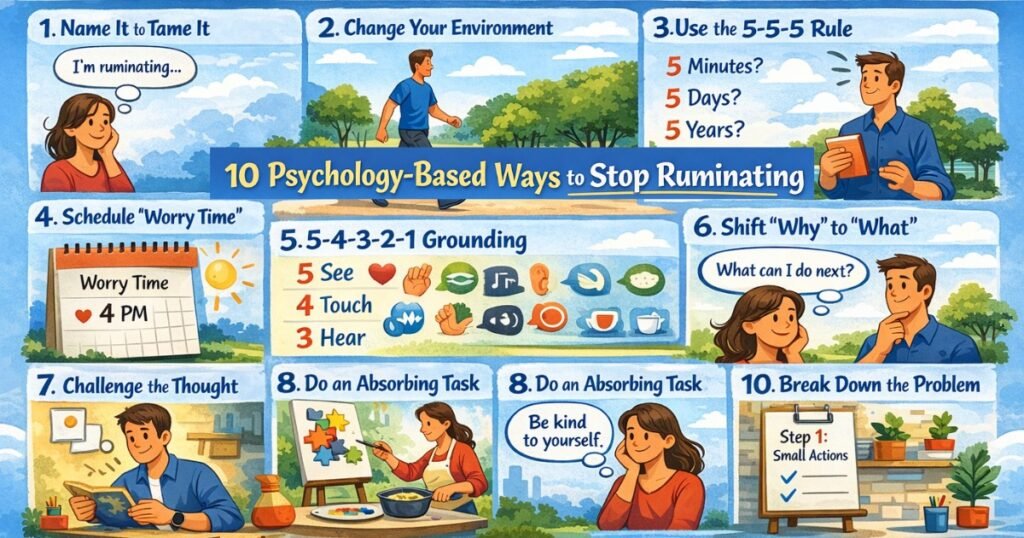
Here are powerful techniques you can use right now to break the rumination cycle.
- Name It to Tame It
The first step is awareness. When you catch yourself spiraling, pause. Silently label what is happening. Say to yourself, “Oh, I am ruminating right now,” or “I am replaying that conversation again.”
Why does this work? Brain scans show that labeling your emotions calms the amygdala (the fear center) and activates the prefrontal cortex (the thinking center) (Lieberman et al., 2007, as cited in Kumar, 2009). By naming the thought pattern, you create distance. You realize that you are not your thoughts. You are just an observer of them. - Change Your Environment
Your surroundings have a huge impact on your mental state. If you are stuck in a loop, a simple change of scenery can help.
One famous study found that a 50-minute walk in nature significantly reduced rumination. It also improved memory and mood in individuals with depression (Berman et al., 2012). Another study confirmed that nature walks decrease anxiety and negative affect compared to urban walks (Bratman et al., 2015). You don’t need a forest. A walk in a park, a stroll around your block, or even moving to a different room can interrupt the pattern. - Use the “5-5-5” Rule
When you are overthinking a problem, put it into perspective. Ask yourself (Borders, 2020):
Will this matter in 5 minutes?
Will this matter in 5 days?
Will this matter in 5 years?
For most worries, the answer is “no.” This technique forces your brain to see the big picture. It stops you from blowing small issues out of proportion. - Schedule “Worry Time”
It sounds strange, but scheduling time to worry can actually help you how to stop ruminating. Designate 10 to 15 minutes each day as your “worry time.” Pick a specific time and place, like 4:00 PM at your desk (Watkins, 2016).
When a ruminating thought pops up during the day, write it down. Tell yourself, “I have an appointment to worry about this later.” When your worry time comes, you can think about those items. Often, you will find that the worries that felt urgent hours ago now seem silly or manageable. - Practice Grounding with the 5-4-3-2-1 Technique
Rumination pulls you out of the present moment. Grounding pulls you back in. This technique uses your senses to anchor you in the here and now (Kumar, 2009). Look around and find:
5 things you can SEE (a lamp, a book, a cloud).
4 things you can TOUCH (your shirt, the chair, your hair).
3 things you can HEAR (birds, a fan, traffic).
2 things you can SMELL (coffee, fresh air).
1 thing you can TASTE (mint, water).
This exercise forces your brain to process real-time sensory data. It cannot focus on a past regret while also counting sensory details. It is an excellent way to break the rumination cycle instantly. - Shift from “Why” to “What”
Ruminators love the word “Why.” Why did I say that? Why did this happen? These questions keep you stuck.
Instead, shift to “What” questions (Papageorgiou & Wells, 2004). What can I learn from this? What can I do differently next time? What is one small step I can take right now?
“Why” questions lead to dead ends. “What” questions lead to solutions and action. This is a core principle in rumination treatment. - Challenge the Thought
Your thoughts are not facts. Just because you think something doesn’t make it true. When you have a negative thought, challenge it (Borders, 2020). Ask yourself:
What is the evidence for this thought?
What is the evidence against this thought?
Is there another way to look at this?
What would I tell a friend who had this thought?
Often, you will see that your mind has magnified the negative and ignored the positive. Correcting this balance is key to stopping ruminating. - Engage in an Absorbing Task
Sometimes, your brain needs a new job. Give your mind something else to focus on (Watkins, 2016). The task should be engaging enough to hold your attention.
Complete a puzzle.
Read a few chapters of a book.
Organize a closet.
Cook a new recipe.
Exercise.
Physical activity is especially powerful because it releases endorphins and burns off stress hormones. - Practice Self-Compassion
Rumination is often fueled by a harsh inner critic. You beat yourself up for your mistakes. To stop rumination, you need to change your inner voice (Kumar, 2009).
Ask yourself: “Would I talk to a friend the way I talk to myself?” Probably not. Try treating yourself with the same kindness you would offer someone you love. Say things like, “I did the best I could at that moment,” or “It is okay to make mistakes. I am human.” - Break Down the Problem
Rumination makes problems feel like giant, unsolvable mountains. This feeling is overwhelming. Make the problem smaller (Borders, 2020).
Take a piece of paper. Define the specific problem. Then, list every possible step you could take to address it. Even tiny steps count. When you have a list, choose the first small action and do it.
Action is the enemy of rumination. When you move from thinking to doing, you shut down the repetitive loop.
Understand the Link: Rumination Depression Psychology
Why is it so important to address this habit? There is a strong link between rumination and depression psychology. Research shows that rumination is a major risk factor for depression (Papageorgiou & Wells, 2004; Nolen-Hoeksema, 2000).
People who ruminate often:
Have longer and more severe episodes of depression (Kuehner et al., 2023).
Develop anxiety disorders (Anderson, 2013).
Experience higher levels of stress.
The act of dwelling on negative thoughts keeps the brain in a negative state. It prevents healing. This is why rumination treatment is often a critical part of therapy for mood disorders.
When to Seek Professional Help
These techniques are powerful tools. However, sometimes you need extra support. If you have tried to break rumination cycle on your own but still feel stuck, please reach out to a mental health professional (Watkins, 2016).
Therapy, especially Cognitive Behavioral Therapy (CBT), is very effective at treating rumination. A therapist can help you understand your triggers and develop personalized strategies for long-term reliefe.
Conclusion
Learning how to stop ruminating is a skill. It takes practice. Do not expect to silence your thoughts overnight. Be patient with yourself.
Start small. Try the “5-4-3-2-1” grounding technique tomorrow. Or, challenge one negative thought. Every time you interrupt the loop, you are training your brain to find a new, healthier path. You have the power to break free from overthinking and enjoy a quieter, more peaceful mind.
Frequently Asked Questions
- What is the difference between normal worrying and rumination?
Normal worrying usually leads to a solution. You worry about a problem, make a plan, and move on. Rumination is different. It is repetitive and stuck. You think about the problem over and over without taking action to fix it (Papageorgiou & Wells, 2004). - Are some people more likely to ruminate than others?
Yes. Research shows that perfectionists, women, and people with anxiety or depression tend to ruminate more often. Those with a history of trauma may also be more prone to getting stuck in negative thought loops (Nolen-Hoeksema, 2000; Anderson, 2013). - Is there a link between rumination and depression?
The link is very strong. Rumination is a major risk factor for depression. Dwelling on negative thoughts can trigger depressive episodes and make symptoms last longer. This is why treating rumination is often a key part of depression therapy (Papageorgiou & Wells, 2004; Kuehner et al., 2023). - When should I see a professional for rumination?
You should seek help if you ruminate every day, if the thoughts feel overwhelming, or if they interfere with your work or relationships. If you feel hopeless or have thoughts of harming yourself, please reach out to a mental health professional right away (Watkins, 2016).
References
Anderson, N. L. (2013). Avoidance and intolerance of uncertainty: Precipitants of rumination and depression [Doctoral dissertation, Kent State University]. OhioLINK Electronic Theses and Dissertations Center. http://rave.ohiolink.edu/etdc/view?acc_num=kent1384986308
Berman, M. G., Kross, E., Krpan, K. M., Askren, M. K., Burson, A., Deldin, P. J., Kaplan, S., Sherdell, L., Gotlib, I. H., & Jonides, J. (2012). Interacting with nature improves cognition and affect for individuals with depression. Journal of Affective Disorders, 140(3), 300–305. https://doi.org/10.1016/j.jad.2012.03.012
Borders, A. (2020). Rumination and related constructs: Causes, consequences, and treatment of thinking too much. Academic Press.
Bratman, G. N., Daily, G. C., Levy, B. J., Gross, J. J., & others. (2015). The benefits of nature experience: Improved affect and cognition. Landscape and Urban Planning, 138, 41-50.
Kuehner, C., Schricker, I. F., Nayman, S., Reinhard, I., Zamoscik, V., Kirsch, P., & Huffziger, S. (2023). Effects of rumination and mindful self-focus inductions during daily life in patients with remitted depression: An experimental ambulatory assessment study. Behavior Therapy, 54(5), 902–915. https://doi.org/10.1016/j.beth.2023.04.002
Kumar, S. M. (2009). The mindful path through worry and rumination: Letting go of anxious and depressive thoughts. New Harbinger Publications.
Nolen-Hoeksema, S. (2000). The role of rumination in depressive disorders and mixed anxiety/depressive symptoms. Journal of Abnormal Psychology, 109(3), 504-511.
Papageorgiou, C., & Wells, A. (Eds.). (2004). Depressive rumination: Nature, theory, and treatment. John Wiley & Sons.
Watkins, E. R. (2016). Rumination-focused cognitive-behavioral therapy for depression. The Guilford Press.

Maria holds an MS in Psychology with a specialization in Social Psychology. She is a research-oriented writer with a strong academic background in psychological and behavioral sciences. Her work focuses on bridging academic research and public understanding by simplifying complex psychological theories and social dynamics. She writes about the relationship between society, mental health, and human behavior, making evidence-based ideas more accessible and practical for readers.