Do you ever catch yourself thinking, “I’m such a failure”? For instance, you might make a small mistake, and suddenly your brain tells you you can’t do anything right. Consequently, these thoughts pop up automatically. Moreover, they feel true in the moment. However, here is the thing: just because you think something doesn’t mean it is true. Additionally, our brains can play tricks on us. Over time, they develop habits of negative thinking that color how we see ourselves and the world. Fortunately, you can change this. In fact, cognitive restructuring is a fancy term for a simple idea. Essentially, it is a process of identifying negative or inaccurate thoughts and replacing them with more balanced, realistic ones (Mills et al., 2008). Think of it as cleaning the lenses of a dirty pair of glasses. Then suddenly, everything looks clearer.
Furthermore, this technique is a core part of cognitive behavioral therapy (CBT). As a result, it has helped millions of people reduce stress, manage anxiety, and feel better about their lives (Serafini et al., 2023). Therefore, in this article, you will learn exactly how to change your negative thinking using simple, science-backed steps.
What Is Cognitive Restructuring? A Simple Definition
First, let’s break it down. Specifically, cognitive restructuring in CBT is based on a simple idea: the way we think affects the way we feel (Clark, 2013).
For example, imagine two people get the same criticism at work.
- Person A thinks: “I’m terrible at my job. I’m going to get fired.”
- Meanwhile, a Person B thinks: “Okay, that stings. But I can learn from this and improve.”
Clearly, the same event. Very different feelings. Consequently, Person A feels anxious and hopeless. In contrast, Person B feels motivated to grow.
Importantly, cognitive restructuring helps you become Person B. In other words, it helps you spot those automatic negative thoughts, check if they are actually true, and shift them to something more helpful (Wenzel, 2013).
Moreover, as one expert explains, many people view their problems in a way that focuses only on the upsetting parts. Meanwhile, they ignore the neutral or positive aspects that might balance things out (Borders, 2020). When you learn to see your problems in a more balanced way, you get relief from emotional distress.
Common Cognitive Distortions
Before you can change your thoughts, you need to know what to look for. Specifically, psychologists call these thinking errors cognitive distortions (Yurica & DiTomasso, 2005). In other words, they are like mental habits that twist the truth. Here are a few common ones:
- All-or-Nothing Thinking: Basically, you see things in black and white. If you are not perfect, you are a total failure (Burns, 1980, as cited in Yurica & DiTomasso, 2005). For example, you eat one slice of cake and think, “I ruined my diet. I might as well give up.”
- Catastrophizing: You always assume the worst-case scenario will happen (Kumar, 2009). For example, your boss sends a vague email, and you immediately think you are getting fired.
- Overgeneralization: In addition, you see one bad event as a never-ending pattern of defeat (Beck, 1976, as cited in Yurica & DiTomasso, 2005). For example, you fail one test and think, “I’m stupid. I’ll never pass anything.”
- Personalization: Similarly, you blame yourself for things that are not your fault (Burns, 1980, as cited in Yurica & DiTomasso, 2005). You might think, “Our team lost because of me.”
- Mind Reading: Furthermore, you assume you know what others are thinking, and it is usually negative (Kumar, 2009). For example, you walk into a room and think, “They all think I’m annoying.”
- Labeling: Finally, you assign a global label to yourself based on one mistake (Burns, 1980, as cited in Yurica & DiTomasso, 2005). Instead of “I made a mistake,” you think “I am a loser.”
How Cognitive Restructuring Works
The overall goal of this process is simple: replace distorted, dysfunctional thoughts with more flexible and adaptive ones (Serafini et al., 2023). It is not about lying to yourself with overly positive affirmations. In fact, if the replacement thought is not realistic, it won’t be helpful (Mills et al., 2008). Instead, it is about finding a fair, balanced, and realistic middle ground.
Think of it like being a detective investigating your own mind (University Hospitals Plymouth NHS Trust, 2025). You gather evidence, question your assumptions, and look for facts, not feelings.
Research shows that practicing these skills can actually change how your brain works. One recent study found that both learning training and cognitive restructuring interventions decreased unhelpful thinking patterns and increased self-enhancing attributions (Norbury et al., 2025). In other words, people got better at seeing things in a more balanced way.
6 Powerful Cognitive Restructuring Techniques
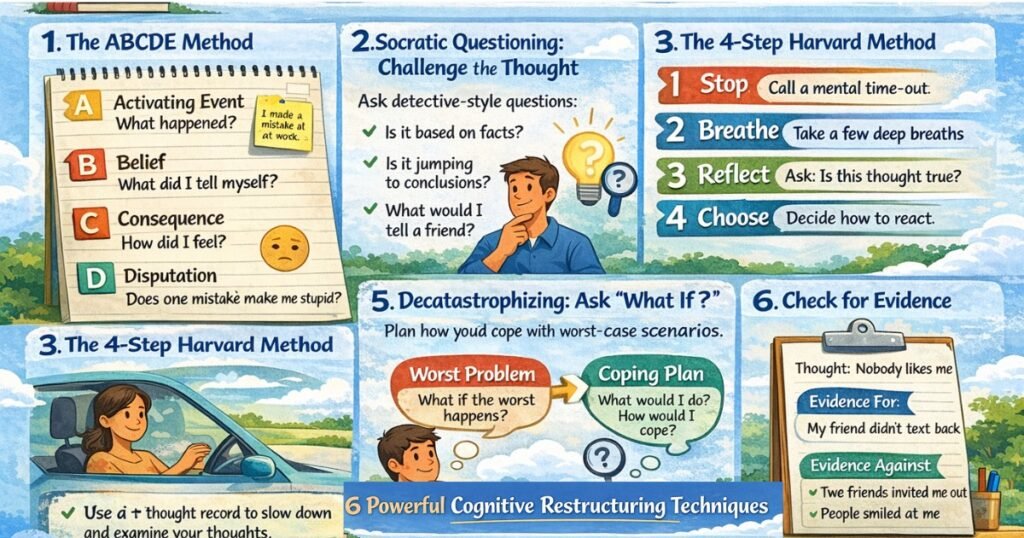
Ready to get started? Here are some of the most effective cognitive restructuring techniques you can use today.
1. The ABCDE Method
This is one of the most popular frameworks used in therapy (Sank & Shaffer, 1984). It guides you through the process step by step:
- A – Activating Event: What happened? (e.g., I made a mistake at work).
- B – Belief: What did I tell myself? (e.g., “I am so stupid”).
- C – Consequence: How did I feel and act? (e.g., I felt ashamed and stopped working).
- D – Disputation: Challenge the belief. (e.g., “Is it true that one mistake makes me stupid? What evidence do I have that I am competent?”)
- E – Effective New Approach: Create a new, balanced thought. (e.g., “I made a mistake because I was rushing. I am human. I can learn from this and do better next time.”)
2. Socratic Questioning: Challenge the Thought
Once you catch a negative thought, put it on trial. Ask yourself some tough questions (Wenzel, 2013):
- Is this thought based on facts or just my feelings?
- What is the evidence for this thought?
- What is the evidence against it?
- Am I jumping to conclusions?
- What would I tell a friend who had this thought?
These questions help you see that your thoughts are not always accurate. As the NHS suggests, this is like “detective thinking” (University Hospitals Plymouth NHS Trust, 2025).
3. The 4-Step Harvard Method
Harvard Health recommends a simple four-step process (Solan, 2024):
- Stop. Consciously call a mental time-out when undesirable thoughts take over. By saying “Stop,” you can halt the negative response cycle.
- Breathe. Take a few deep breaths to reduce physical tension and step back from the stressor before you react.
- Reflect. Ask yourself questions. Is this thought true? Did I jump to a conclusion? What evidence do I have? Is there another way to view the situation?
- Choose. Decide how to deal with the source of your stress. Challenge distorted thinking and adjust your view of reality.
Here is an example of how this approach might work (Solan, 2024). If you get stuck in traffic on the way to meet a friend and feel agitated, stop and notice signs of stress in your body, such as a tight neck and shoulders. Try to relax and take a few deep breaths. Reflect: “It’s just traffic. It’s not worth getting upset.” Now, choose how to deal with it. Don’t assume your friend will be angry. Tell yourself, “I’ll just be a few minutes late. It will be okay. I’m doing the best I can. I can handle this.”
4. Thought Records: Write It Down
A cognitive restructuring worksheet is a powerful tool. It is often called a thought record. You write down the situation, the automatic thought, the emotion you felt, and then a more balanced thought (Kumar, 2009).
Putting pen to paper forces you to slow down and think clearly. It takes the thoughts out of your swirling mind and puts them in front of you where you can examine them. Many people find this incredibly helpful, especially when they are just starting out.
5. Decatastrophizing: Ask “What If?”
This technique is for people who always imagine the worst (Kumar, 2009). Ask yourself: “What is the worst that could happen?” Then, follow that thought all the way through.
Okay, let’s say the worst happens. What would you do? How would you cope? You will often realize that even the worst-case scenario is something you could survive and manage. This takes the power away from the fear.
6. Check for Evidence
This is a simple but powerful technique (Mills et al., 2008). Take your negative thought and literally list the evidence for it and against it.
- Thought: “Nobody likes me.”
- Evidence For: My friend didn’t text me back right away.
- Evidence Against: I have two close friends who invited me out last week. My family loves me. People smiled at me today.
When you see the evidence laid out, the thought often looks less true.
Cognitive Restructuring Examples in Real Life
Let’s look at a few cognitive restructuring examples to see how this works in everyday situations.
Example 1: The Social Situation
- Situation: You are at a party and someone leaves a conversation you were in.
- Old Thought: “They left because I am boring. Nobody likes me.” (This is mind reading and personalization)
- Restructured Thought: “They probably just saw someone they know or needed another drink. I cannot read their mind. The conversation was going fine before they left.”
Example 2: The Work Mistake
- Situation: You send an email with a typo to your boss.
- Old Thought: “I am so unprofessional. I’m going to get fired. I ruin everything.” (This is catastrophizing and overgeneralization)
- Restructured Thought: “Everyone makes typos sometimes. My boss probably didn’t even notice. If they did, it is a small mistake. I am generally good at my job.”
Example 3: The Health Worry
- Situation: You notice a small bump on your skin.
- Old Thought: “This is probably cancer. I’m going to be really sick.” (This is catastrophizing and fortune-telling)
- Restructured Thought: “Most skin bumps are harmless. I will keep an eye on it and see a doctor if it changes. Worrying won’t help me know what it is.”
The Research Behind Cognitive Restructuring
You might be wondering if this actually works. The answer is yes. A large body of research supports cognitive restructuring in CBT.
One recent study tested a digital program that taught cognitive restructuring to adolescents (Steinberg et al., 2024). The researchers found that young people who learned these skills kept using them over time. In contrast, those who did not learn the skills showed a decline in their ability to challenge negative thoughts. This suggests that learning cognitive restructuring techniques helps you maintain better mental health habits.
Another study published in 2025 found that both learning training and cognitive restructuring interventions helped people change their thinking patterns (Norbury et al., 2025). Participants became less likely to blame themselves for negative events and more likely to give themselves credit for positive ones.
The NHS reports that CBT interventions using cognitive restructuring usually last between 6 to 8 sessions (University Hospitals Plymouth NHS Trust, 2025). Importantly, progress continues even after the sessions end, especially when people practice the new skills at home.
How to Change Negative Thoughts?
If you want a simple summary of how to change negative thoughts, follow these steps:
- Notice the Thought. Pay attention when your mood shifts. What just popped into your head?
- Name the Distortion. Look at the list above. Is this all-or-nothing thinking? Catastrophizing? Labeling?
- Challenge It. Ask yourself the detective questions. What is the evidence? Is there another way to see this?
- Create a Balanced Thought. Write a new thought that is fair and realistic. It doesn’t have to be super positive. It just has to be true.
Remember, this is a skill. It takes practice. Your brain has been thinking a certain way for years. Do not expect to change overnight.
When to Seek Professional Help
These techniques are powerful, and you can practice them on your own. Many people use worksheets and the techniques above to challenge their own thoughts successfully (Mills et al., 2008).
However, if your negative thoughts feel overwhelming or are linked to depression, anxiety, or suicidal thoughts, please reach out to a mental health professional. A therapist can guide you through cognitive behavioral therapy techniques and provide support tailored to you (Watkins, 2016).
Working with a professional is especially helpful if your negative thoughts are tied to deeper core beliefs like “I am worthless” or “I am a failure.” These beliefs are more constant than automatic thoughts and often fuel the negative thinking you experience day to day (Papageorgiou & Wells, 2004). Therapists usually wait until patients have mastered basic tools before working with these deeper beliefs.
Conclusion
How to change negative thoughts is a skill you can learn. It takes practice, patience, and consistency (Borders, 2020). Over time, as you continue to notice, question, and be intentional with your thoughts, your thinking patterns will change. Your behavior will follow. The negative thoughts that once limited your life will no longer stand in the way.
Start small. Pick one negative thought today and challenge it. Write it down. Ask yourself the questions. Every time you do this, you are training your brain to find a new, healthier path. You have the power to change your mind.
FAQs
1. What is the difference between positive thinking and cognitive restructuring?
Positive thinking sometimes means repeating happy phrases. Cognitive restructuring is different. It is about finding realistic and balanced thoughts. If you fail a test, positive thinking might say, “I am a genius.” Restructuring says, “I failed this test, but I can study harder next time. I am capable of learning.” The replacement thought must be realistic to be helpful (Mills et al., 2008).
2. Can I do cognitive restructuring on my own?
Yes, you can. Many people use worksheets and practice at home. Research shows that self-guided digital programs can be effective (Steinberg et al., 2024). However, working with a therapist can be very helpful, especially if your negative thinking is deeply rooted.
3. How long does it take to see results?
It varies. Some people feel better after a few days of practice. NHS interventions usually last between 6 to 8 sessions, and progress continues even after the sessions end (University Hospitals Plymouth NHS Trust, 2025). The key is consistent practice.
4. What is a cognitive restructuring worksheet?
It is a tool that guides you through the process. It usually has spaces to write down the situation, your automatic thought, the type of distortion, and your new, balanced thought (Kumar, 2009). You can find many free worksheets online to help you get started.
References
Borders, A. (2020). Rumination and related constructs: Causes, consequences, and treatment of thinking too much. Academic Press.
Clark, D. A. (2013). Cognitive restructuring. In S. G. Hofmann (Ed.), The Wiley handbook of cognitive behavioral therapy (pp. 1–22). John Wiley & Sons.
Kumar, S. M. (2009). The mindful path through worry and rumination: Letting go of anxious and depressive thoughts. New Harbinger Publications.
Mills, H., Reiss, N., & Dombeck, M. (2008). Cognitive restructuring. MentalHelp.net. https://www.mentalhelp.net
Norbury, A., Liu, S., Campanella, S., & Romer, A. L. (2025). Learning training as a cognitive restructuring intervention. Behaviour Research and Therapy, *185*, 104678. https://doi.org/10.1016/j.brat.2024.104678
Papageorgiou, C., & Wells, A. (Eds.). (2004). Depressive rumination: Nature, theory, and treatment. John Wiley & Sons.
Sank, L. I., & Shaffer, C. S. (1984). A therapist’s manual for cognitive behavior therapy in groups. Plenum Press.
Serafini, G., Costanza, A., Aguglia, A., Amerio, A., Placenti, V., Magnani, L., Escelsior, A., Sher, L., & Amore, M. (2023). Overall goal of cognitive-behavioral therapy in major psychiatric disorders and suicidality: A narrative review. Journal of Clinical Medicine, *12*(9), 3225. https://doi.org/10.3390/jcm12093225
Solan, M. (2024, January 1). Try this: How to change your negative thoughts. Harvard Health Publishing. https://www.health.harvard.edu
Steinberg, J. S., Fitzpatrick, O. M., Khurana, S., Kim, M. Y., Maira, P., Schleider, J. L., Hatzenbuehler, M. L., & Weisz, J. R. (2024). Is there a place for cognitive restructuring in brief, self-guided interventions? Randomized controlled trial of a single-session, digital program for adolescents. Journal of Clinical Child & Adolescent Psychology. Advance online publication. https://doi.org/10.1080/15374416.2024.2384029
University Hospitals Plymouth NHS Trust. (2025). Cognitive restructuring (CR). Patient Information Leaflet.
Watkins, E. R. (2016). Rumination-focused cognitive-behavioral therapy for depression. The Guilford Press.
Wenzel, A. (2013). Cognitive restructuring: Automatic thoughts. In A. Wenzel, Strategic decision making in cognitive behavioral therapy (pp. 83–104). American Psychological Association.
Yurica, C. L., & DiTomasso, R. A. (2005). Cognitive distortions. In A. Freeman, S. H. Felgoise, A. M. Nezu, C. M. Nezu, & M. A. Reinecke (Eds.), Encyclopedia of cognitive behavior therapy (pp. 117–120). Springer.

Mariam holds an MS in Sociology with a specialization in Medical Sociology and Social Psychology. With a strong academic background and extensive research work in both fields, she brings depth and clarity to complex topics. Her writing explores the intersection of society, health, and the human mind, making academic ideas easy to grasp and relevant to everyday life.