Quick Answer
If someone asks, “What is psychoanalysis theory?”, the answer is simple:
Psychoanalysis theory is a psychological theory created by Sigmund Freud. It explains that unconscious thoughts, childhood experiences, and inner conflicts influence a person’s personality, emotions, and behavior.
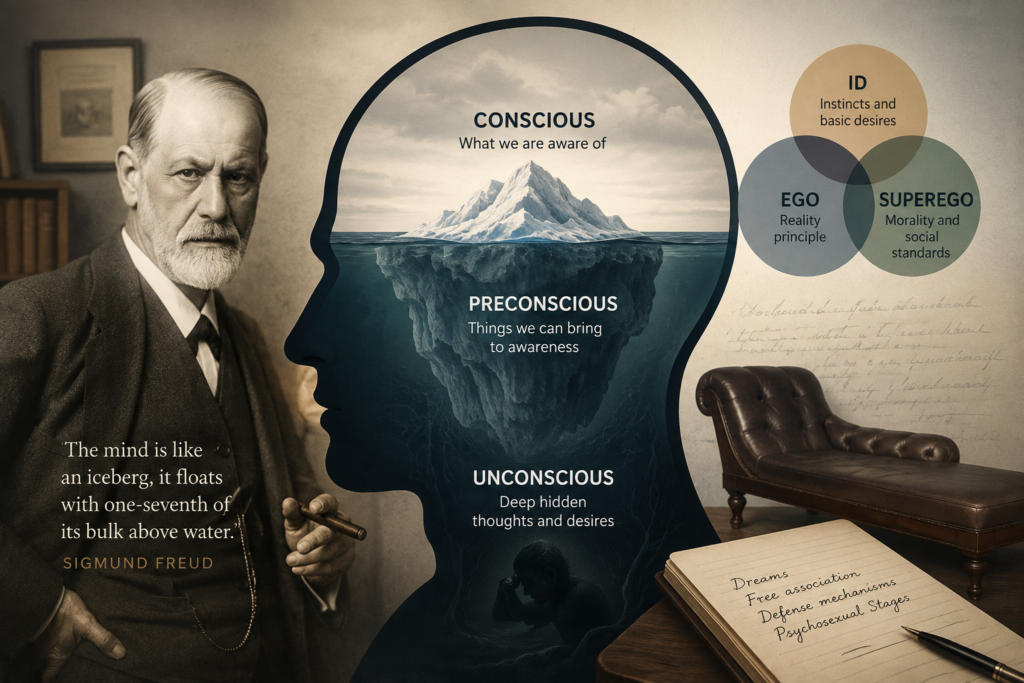
Table of Contents
What Is Psychoanalysis Theory?
Psychoanalytic theory is a psychological framework that explains how the human mind works and why people behave as they do. It suggests that many of our thoughts, feelings, and actions are influenced by the unconscious mind, which is the part of the mind that stores hidden memories, emotions, wishes, and fears.
The theory was developed by Sigmund Freud, an Austrian neurologist, in the late 1800s. Freud believed that experiences from childhood and unconscious thoughts continue to shape our personality, emotions, and behavior throughout life.
Today, psychoanalysis is still an important part of psychology because it introduced many ideas that changed how people understand the human mind. While some of Freud’s theories have been updated or challenged by modern research, his work continues to influence psychology, counseling, literature, and education.
Who Is the Founder of Psychoanalysis Theory?
The founder of psychoanalysis theory is Sigmund Freud (1856–1939). He was an Austrian neurologist who became one of the most influential figures in the history of psychology.
Freud began his career as a doctor treating patients with nervous and emotional problems. As he worked with people, he noticed that many emotional difficulties seemed connected to experiences they had forgotten or could not fully remember. This led him to explore the unconscious mind and develop a new way of understanding human behavior.
His ideas became known as psychoanalysis, a theory that explains how hidden thoughts and early life experiences can affect mental health and personality.
Although psychology has changed significantly since Freud’s time, many of his concepts—such as the unconscious mind, defense mechanisms, and the importance of childhood experiences—remain widely discussed in psychology courses and mental health fields.
What Does Psychoanalysis Theory Explain?
Psychoanalysis theory helps explain several important questions about human behavior, including:
- Why do people sometimes act without knowing why?
- How do childhood experiences affect adult personality?
- Why do people experience anxiety, fear, or guilt?
- What causes inner emotional conflicts?
- Why do dreams sometimes seem meaningful?
Freud believed that many answers to these questions are found in the unconscious mind. Even though we are not aware of everything stored there, hidden memories and emotions can influence our decisions, relationships, and reactions in everyday life.
The theory also suggests that understanding these unconscious influences can help people better understand themselves and improve their emotional well-being.
The Three Levels of the Mind
One of Freud’s best-known ideas is that the human mind has three levels of awareness. Each level plays a different role in how we think, remember, and behave.
1. Conscious Mind
The conscious mind includes everything you are thinking about right now. These are thoughts and feelings you are fully aware of at the present moment.
For example, when you are:
- Reading this article
- Talking with a friend
- Solving a puzzle
- Listening to music
you are using your conscious mind.
It represents only a small part of everything happening in the human mind.
2. Preconscious Mind
The preconscious mind contains information that is not in your conscious awareness right now but can be easily recalled when needed.
Examples include:
- Your home address
- Your birthday
- The name of your favorite teacher
- What you ate for breakfast
These memories are stored just below your conscious awareness and can quickly come back when you think about them.
3. Unconscious Mind
The unconscious mind is the most important part of psychoanalysis theory.
According to Freud, it stores thoughts and feelings that are hidden from our awareness, such as:
- Childhood memories
- Fears
- Wishes
- Painful experiences
- Strong emotions
- Unresolved conflicts
Although we cannot easily access these thoughts, Freud believed they continue to influence many of our behaviors, emotions, and decisions without us realizing it.
Freud’s Iceberg Model of the Mind
To explain the human mind, Freud compared it to an iceberg floating in the ocean.
Only a small part of an iceberg is visible above the water, while most of it remains hidden beneath the surface.
Freud believed the mind works similarly:
| Part of the Iceberg | Part of the Mind |
| Above the water | Conscious mind |
| Just below the surface | Preconscious mind |
| Deep below the water | Unconscious mind |
This model shows that much of what influences our behavior happens outside our conscious awareness.
Sigmund Freud’s Theory of Personality
One of Freud’s most important contributions was his explanation of how personality develops. He believed that personality is shaped by the interaction of three parts of the mind: the id, the ego, and the superego.
These three parts constantly work together and sometimes compete with one another, influencing the choices people make every day.
The Id
The id is the first part of personality to develop. It is present from birth and represents our basic instincts and natural desires.
The id wants immediate satisfaction without thinking about rules, consequences, or other people’s feelings. Freud said it follows the pleasure principle, which means it always seeks pleasure and tries to avoid discomfort.
Simple examples of the id include:
- A baby crying because they are hungry.
- Wanting to eat a piece of cake immediately.
- Wanting to play games instead of doing homework.
The id acts on impulse and does not consider whether something is right or wrong.
What Is Ego in Psychoanalysis Theory?
Many people ask, “What is ego in psychoanalysis theory?”
The ego is the part of personality that helps us make realistic and sensible decisions. It develops as children grow and begin to understand the world around them.
Instead of acting on every desire, the ego considers reality, rules, and possible consequences before making a decision.
For example, imagine you are hungry during an important class.
- Your id says, “Eat your lunch right now.”
- Your ego says, “I’ll wait until the class is over because that’s the appropriate time to eat.”
Freud explained that the ego follows the reality principle, helping people balance their desires with what is practical and socially acceptable.
The Superego
The superego is the third part of Freud’s personality theory. It develops as children learn the rules and values of their family, school, and society.
The superego acts like an inner moral guide. It helps people understand the difference between right and wrong and encourages them to make responsible choices.
If the id wants immediate pleasure and the ego tries to find a practical solution, the superego asks:
- Is this the right thing to do?
- Is this fair to other people?
- Will I feel proud or guilty about this decision?
For example, imagine you find a lost wallet.
- The id says, “Keep the money.”
- The ego says, “Someone might notice, and you could get into trouble.”
- The superego says, “Return the wallet because it is the honest thing to do.”
According to Freud, a healthy personality depends on a balance between the id, ego, and superego.
The Three Parts of Personality at a Glance
| Part | Main Goal | Guided By | Example |
| Id | Wants immediate pleasure | Instincts | Eating all the candy at once |
| Ego | Makes realistic decisions | Reality | Saving some candy for later |
| Superego | Follows morals and values | Right and wrong | Sharing the candy with others |
These three parts are always working together. Most everyday decisions involve some balance between our desires, practical thinking, and moral values.
Freud’s Psychosexual Stages of Development
One of Freud’s best-known ideas is that personality develops during childhood through a series of stages. He believed that experiences during these stages could influence a person’s behavior and relationships later in life.
Freud called these the psychosexual stages of development.
1. Oral Stage (Birth to 1 Year)
During the oral stage, babies explore the world mainly through their mouths.
Activities such as:
- Sucking
- Eating
- Chewing
provide comfort and satisfaction.
Freud believed that if a child’s needs were not met during this stage, it might influence certain habits later in life. However, modern psychology does not strongly support many of these specific claims.
2. Anal Stage (1 to 3 Years)
The anal stage focuses on learning self-control, especially during toilet training.
Freud believed children begin learning:
- Responsibility
- Independence
- Self-discipline
He suggested that overly strict or overly relaxed toilet training could affect personality, although this idea has limited scientific support today.
3. Phallic Stage (3 to 6 Years)
During this stage, children become more aware of their bodies and may become curious about differences between boys and girls.
Freud also introduced ideas such as the Oedipus complex during this stage. These ideas are historically important but are not widely accepted in modern psychology because they lack strong scientific evidence.
4. Latency Stage (6 Years to Puberty)
During the latency stage, children focus more on:
- Learning
- Making friends
- Playing sports
- Developing hobbies
- Building social skills
Freud believed that sexual feelings become less important during this period while children develop intellectually and socially.
5. Genital Stage (Puberty and Adulthood)
The genital stage begins during puberty and continues into adulthood.
According to Freud, individuals develop mature relationships, emotional connections, and a stronger sense of responsibility.
He believed that successfully completing the earlier stages helped people develop healthy adult personalities.
Defense Mechanisms in Psychoanalysis Theory
One of Freud’s lasting contributions to psychology is the idea of defense mechanisms.
Defense mechanisms are unconscious ways the mind protects itself from stress, anxiety, or emotional pain.
Although Freud introduced this idea, his daughter, Anna Freud, later explained many defense mechanisms in greater detail.
Some defense mechanisms continue to be studied in modern psychology, although they are understood differently today.
Repression
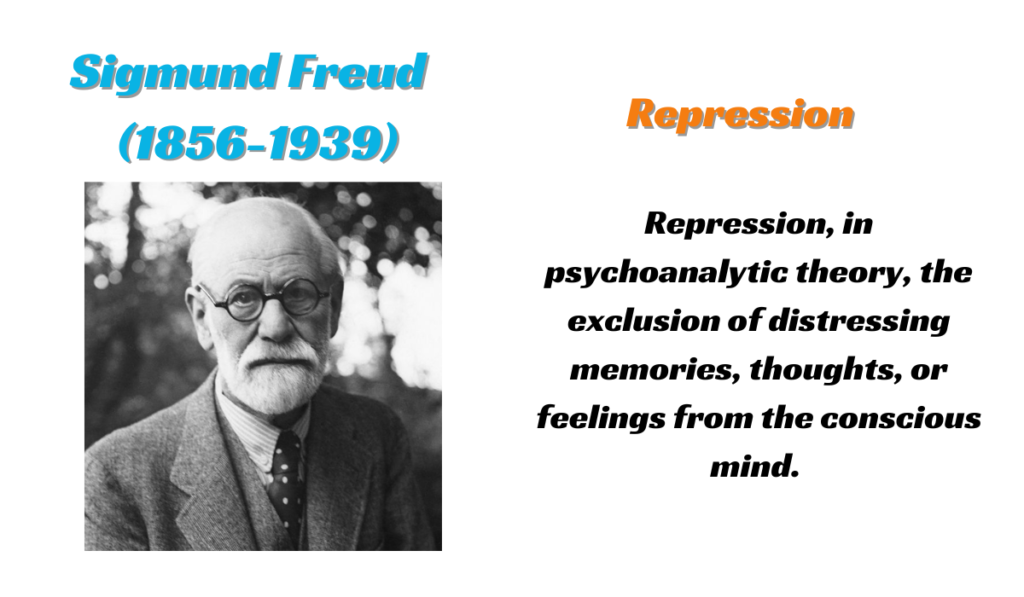
Repression means pushing painful thoughts or memories into the unconscious mind.
A person may not remember a difficult experience because the mind hides it to reduce emotional distress.
Denial
Denial happens when someone refuses to accept a difficult reality.
For example, a person may ignore clear signs of a serious problem because accepting it feels overwhelming.
Projection
Projection means attributing your own thoughts or feelings to someone else.
For example, an angry person may believe that everyone else is angry with them.
Displacement
Displacement happens when someone redirects emotions toward a safer target.
For example:
A student receives criticism at school and later becomes angry with a sibling at home instead of expressing frustration toward the teacher.
Rationalization
Rationalization involves creating reasonable-sounding explanations for behavior instead of admitting the real reason.
For example:
Someone who fails an exam may say,
“The test was unfair, so studying wouldn’t have helped.”
What Is Psychoanalytic Therapy?
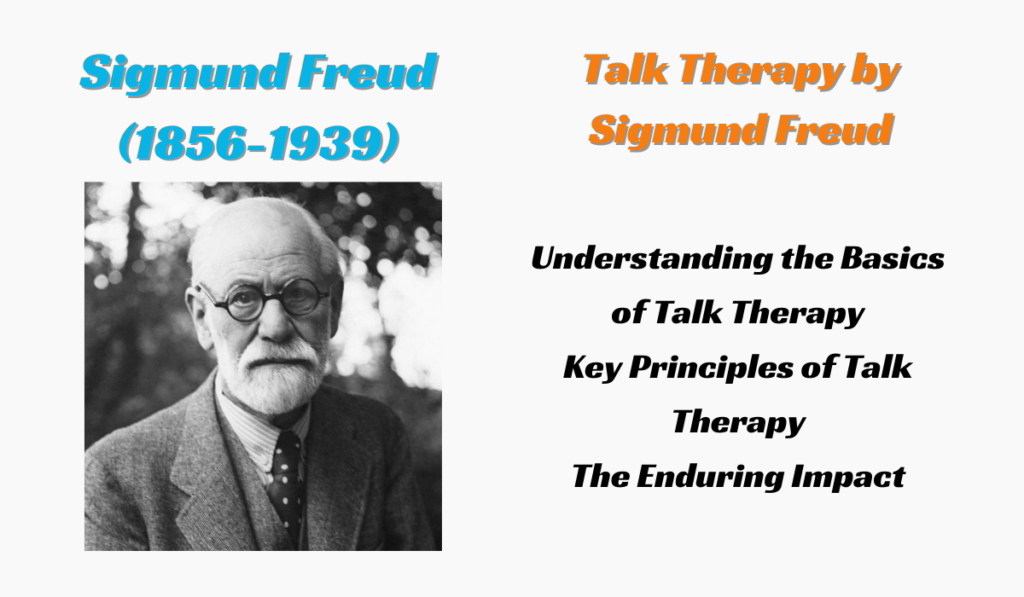
Psychoanalytic therapy is a form of talk therapy based on Freud’s ideas. The goal is to help people better understand unconscious thoughts, emotions, and past experiences that may be affecting their current lives. Unlike short-term counseling, psychoanalytic therapy often focuses on long-term patterns of thinking and behavior. A therapist helps the person explore feelings, relationships, memories, recurring emotional difficulties, and core psychoanalytic concepts such as cathexis and anticathexis, which describe how mental energy is invested in desires and how the ego works to control or redirect those impulses. Modern psychoanalytic therapy has changed considerably since Freud’s time and often combines newer psychological knowledge with traditional psychoanalytic concepts.
Common Techniques Used in Psychoanalysis
Freud developed several techniques to explore the unconscious mind.
Free Association
In free association, the person says whatever comes to mind without trying to organize or filter their thoughts.
Freud believed this could reveal unconscious feelings and conflicts.
Dream Analysis
Freud believed dreams could provide clues about unconscious wishes and emotions.
He suggested that dreams contain both:
- Manifest content: the dream as remembered.
- Latent content: the hidden meaning behind the dream.
Today, many psychologists view dreams differently, and there is no single scientific explanation for why people dream.
Transference
Transference happens when a person unknowingly transfers feelings about someone from their past onto the therapist.
Recognizing these patterns can help people better understand their emotions and relationships.
Is Psychoanalysis Theory Still Relevant Today?
Yes, but with important limitations.
Many of Freud’s original ideas are considered historically important rather than scientifically proven. Over time, psychologists have tested his theories, and while some concepts remain influential, others have little empirical support.
Today, psychology still recognizes several ideas introduced by Freud, including:
- The importance of early childhood experiences.
- The role of unconscious mental processes.
- The use of talk therapy to explore emotions.
- Some defense mechanisms, which continue to be studied and discussed.
At the same time, many of Freud’s specific claims, such as several aspects of the psychosexual stages and dream interpretation, are viewed with caution because they are difficult to test scientifically.
Modern psychology combines biological, cognitive, behavioral, developmental, and social approaches to provide a more complete understanding of human behavior.
Real-Life Examples of Psychoanalysis Theory
Psychoanalysis theory can be easier to understand when we look at simple, everyday situations. These examples show how unconscious thoughts, childhood experiences, and inner conflicts might influence behavior.
Example 1: Fear of Public Speaking
Imagine a person becomes extremely nervous every time they have to speak in front of a group.
From a psychoanalytic perspective, this fear might be connected to a childhood experience, such as being laughed at or criticized. Even if the person no longer remembers that event clearly, the unconscious mind may still influence their emotions.
Other psychological theories may explain this fear differently, so this is only one possible interpretation.
Example 2: Forgetting an Important Event
A student keeps forgetting the date of an important meeting that makes them feel anxious.
Freud suggested that the unconscious mind may sometimes avoid unpleasant thoughts or situations. However, forgetting can also happen for many ordinary reasons, such as being busy or distracted.
Example 3: Feeling Angry Without Knowing Why
Someone comes home from work feeling unusually irritated and argues with family members over small issues.
Psychoanalysis suggests that hidden stress or unresolved emotions may be influencing the person’s behavior, even if they are not fully aware of it.
Example 4: Repeating the Same Relationship Problems
A person notices they often experience similar conflicts in different friendships or romantic relationships.
A psychoanalytic therapist may explore whether these patterns are connected to earlier life experiences or unconscious beliefs developed during childhood.
Strengths of Psychoanalysis Theory
Although psychoanalysis has been debated for many years, it has made important contributions to psychology.
Some of its strengths include:
- It highlighted the importance of the unconscious mind.
- It emphasized how childhood experiences can influence adult life.
- It inspired the development of modern talk therapy.
- It introduced the concept of defense mechanisms.
- It encouraged psychologists to explore emotions and personality in greater depth.
- It influenced many areas beyond psychology, including literature, education, philosophy, and art.
Many modern therapies have developed from ideas first introduced by Freud, even if they no longer follow all of his original theories.
Limitations of Psychoanalysis Theory
Like every psychological theory, psychoanalysis has limitations.
Some common criticisms include:
- Many of Freud’s ideas are difficult to test scientifically.
- Much of the theory was based on observations of a small number of patients.
- Some concepts rely heavily on personal interpretation.
- Several ideas about personality development are not supported by strong scientific evidence.
- Some of Freud’s views may not apply equally across different cultures or modern societies.
Because of these limitations, psychologists today usually study psychoanalysis alongside other approaches rather than treating it as a complete explanation of human behavior.
How Psychoanalysis Influenced Modern Psychology
Even though psychology has changed greatly since Freud’s time, his work continues to influence the field.
Many modern areas of psychology have built upon or responded to Freud’s ideas.
His influence can be seen in:
- Psychodynamic therapy
- Personality psychology
- Counseling and psychotherapy
- Child development research
- Clinical psychology
- Mental health treatment
- Studies of unconscious mental processes
Modern psychologists often combine ideas from psychoanalysis with research from neuroscience, cognitive psychology, and behavioral science to better understand how the mind works.
Psychoanalysis Theory vs. Modern Psychology
| Psychoanalysis Theory | Modern Psychology |
| Focuses on the unconscious mind. | Studies both conscious and unconscious mental processes. |
| Emphasizes childhood experiences. | Considers childhood, biology, environment, learning, and social influences. |
| Developed mainly from clinical observations. | Relies on scientific research and evidence-based methods. |
| Uses psychoanalytic therapy. | Uses many different therapies, including cognitive behavioral therapy (CBT), psychodynamic therapy, acceptance and commitment therapy (ACT), and others. |
| Introduced many important psychological concepts. | Continues to test, refine, and expand psychological knowledge through research. |
This comparison shows that modern psychology has expanded beyond Freud’s original work while still recognizing his historical importance.
Frequently Asked Questions
What is psychoanalysis theory?
Psychoanalysis theory is a psychological theory developed by Sigmund Freud. It explains that unconscious thoughts, childhood experiences, and inner conflicts can influence a person’s emotions, personality, and behavior.
Who is the founder of psychoanalysis theory?
The founder of psychoanalysis theory is Sigmund Freud, an Austrian neurologist who introduced psychoanalysis in the late nineteenth century.
What is ego in psychoanalysis theory?
The ego is the part of personality that helps people make realistic decisions. It balances the desires of the id with the rules and expectations of the real world.
What are the three parts of personality according to Freud?
Freud believed personality consists of three parts:
- Id seeks immediate pleasure.
- Ego makes realistic decisions.
- Superego represents moral values and conscience.
These three parts work together to influence human behavior.
What is the unconscious mind?
The unconscious mind is the part of the mind that stores hidden memories, emotions, fears, wishes, and experiences that are outside our conscious awareness but may still influence our behavior.
Is psychoanalysis still used today?
Yes. Modern psychoanalytic and psychodynamic therapies are still practiced by some mental health professionals. However, many of Freud’s original ideas have been revised or replaced by evidence-based psychological research.
Is psychoanalysis theory scientifically proven?
Some concepts introduced by Freud, such as the importance of childhood experiences and certain defense mechanisms, have influenced later research. However, many parts of his original theory are difficult to test scientifically and are not fully supported by modern evidence.
Key Takeaways
- Psychoanalysis theory was developed by Sigmund Freud.
- It explains that unconscious thoughts and childhood experiences can influence personality and behavior.
- Freud described the mind as having three levels: the conscious, preconscious, and unconscious.
- He believed personality is shaped by the id, ego, and superego.
- Psychoanalysis introduced important ideas such as defense mechanisms, dream analysis, and talk therapy.
- While many of Freud’s ideas remain historically significant, modern psychology relies on scientific research and evidence-based approaches to understand human behavior.
Conclusion
Psychoanalysis theory changed the way people think about the human mind. Before Sigmund Freud, mental health was often viewed very differently. His work introduced the idea that hidden thoughts, emotions, and early childhood experiences could shape personality and influence behavior throughout life.
Although modern psychology has revised many of Freud’s original ideas, his contributions continue to be studied because they helped lay the foundation for personality theory and psychotherapy. Concepts such as the unconscious mind, defense mechanisms, and the role of childhood experiences remain part of psychological education and clinical discussion today.
The best way to understand psychoanalysis is to see it as an important chapter in the history of psychology. It offers valuable insights into human behavior while also reminding us that psychological theories continue to evolve as new scientific evidence becomes available.
Editor’s Note: This article is intended for educational purposes only. Psychology is a continually evolving field, and no single theory fully explains human behavior. Modern psychologists often combine insights from multiple evidence-based approaches to better understand mental health and personality.

Maria holds an MS in Psychology with a specialization in Social Psychology. She is a research-oriented writer with a strong academic background in psychological and behavioral sciences. Her work focuses on bridging academic research and public understanding by simplifying complex psychological theories and social dynamics. She writes about the relationship between society, mental health, and human behavior, making evidence-based ideas more accessible and practical for readers.