How Addiction Affects Mental Health?
Quick answer: Mental health and addiction are closely connected. A mental health condition can increase the risk of problematic substance use, while substance use can worsen or contribute to mental health symptoms. When both a mental health disorder and substance use disorder occur together, they are called co-occurring disorders. Because the two conditions can influence each other, treatment often works best when both are identified and addressed together.
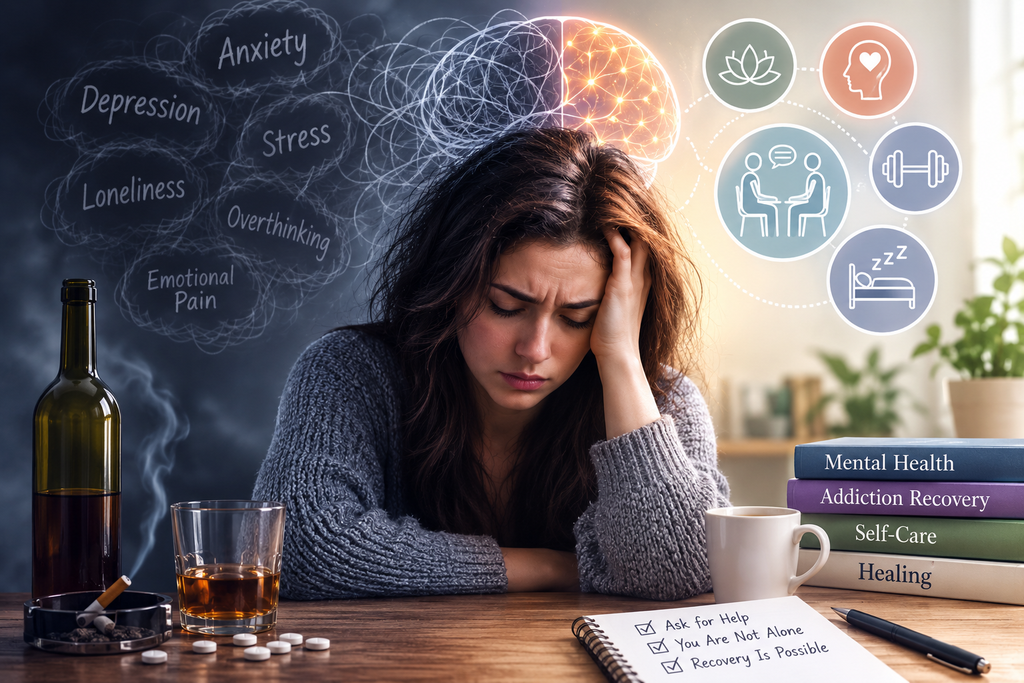
Table of Contents
What Is the Connection Between Mental Health and Addiction?
Mental health and addiction are not separate issues for everyone. They can interact in complicated ways, with each condition potentially affecting the other.
For example, someone experiencing depression may use alcohol or drugs to temporarily escape sadness or emotional pain. The relief may feel helpful for a short time, but continued substance use can create additional problems and may worsen mental health symptoms.
The opposite can also happen. Repeated substance use can affect mood, sleep, thinking, relationships, and daily functioning. Over time, these changes may contribute to or intensify mental health difficulties.
Researchers and health organizations therefore recognize a bidirectional relationship between mental disorders and substance use disorders. In other words, mental health problems can contribute to substance use, while substance use can contribute to or worsen mental health problems.
This relationship is one reason it is important to look at the whole person rather than treating addiction and mental health as completely unrelated problems.
Addiction Definition: What Does Addiction Mean?
Addiction is a complex health condition involving continued substance use or engagement in a behavior despite harmful consequences.
When talking specifically about drugs or alcohol, healthcare professionals generally use the term substance use disorder (SUD).
A substance use disorder occurs when repeated alcohol or drug use causes clinically significant problems, such as health problems, impaired functioning, disability, or difficulty meeting responsibilities at home, school, or work.
Addiction is not simply a lack of willpower.
A person may genuinely want to stop using a substance but find it extremely difficult to do so. Factors such as brain changes, genetics, stress, trauma, environment, mental health, and repeated exposure can all influence the development and persistence of problematic substance use.
This is why describing addiction simply as a “bad habit” can be misleading and stigmatizing.
Is Addiction a Mental Health Disorder?
This question can be confusing because addiction and mental health disorders are closely related, but they are not necessarily the same diagnosis.
Substance use disorders are recognized health conditions. Mental disorders include conditions such as depression, anxiety disorders, bipolar disorder, schizophrenia, and post-traumatic stress disorder.
A person can have:
- A substance use disorder without another mental disorder.
- A mental health disorder without a substance use disorder.
- Both a mental health disorder and a substance use disorder.
When the two occur together, healthcare professionals may describe them as co-occurring disorders.
SAMHSA defines co-occurring disorders as the coexistence of a mental health disorder and a substance use disorder. There is no single combination that qualifies; different mental health and substance use disorders can occur together.
So, rather than asking whether addiction is always a mental health disorder, it is more useful to recognize that addiction is a treatable health condition that can occur alongside mental health conditions.
How Does Addiction Affect Mental Health?
One of the most important questions surrounding mental health addiction is how continued substance use can affect psychological well-being.
The effects vary depending on the substance, frequency and duration of use, individual health, genetics, environment, and existing mental health conditions.
1. Addiction Can Worsen Anxiety
Some substances may temporarily make a person feel calmer or less anxious.
However, this temporary relief can create a cycle in which the person repeatedly uses the substance whenever anxiety appears.
Over time, substance use may contribute to greater emotional instability, withdrawal-related anxiety, sleep problems, or increased dependence on the substance to feel normal.
This can make it harder to develop healthier ways of managing anxiety.
2. Addiction Can Affect Depression
People experiencing depression may turn to substances in an attempt to escape sadness, hopelessness, loneliness, or emotional pain.
However, substance use can interfere with sleep, relationships, daily responsibilities, and emotional regulation.
These problems may make depressive symptoms more difficult to manage.
This creates a potentially harmful cycle:
Depression → substance use → temporary relief → consequences → worsening emotional distress → more substance use
Breaking that cycle often requires addressing both the substance use and the underlying emotional difficulties.
3. Addiction Can Affect Sleep
Sleep and mental health are closely connected.
Substance use can disrupt normal sleep patterns, while poor sleep can make it harder to regulate emotions and cope with stress.
Someone may therefore find themselves caught in another cycle:
Poor mental health → poor sleep → substance use → disrupted sleep → worsening mental health
Addressing sleep problems can be an important part of recovery, although treatment should be individualized.
4. Addiction Can Affect Emotional Regulation
Healthy emotional regulation involves recognizing emotions and responding to them in manageable ways.
Repeated substance use can become a person’s primary method of coping with uncomfortable emotions.
Instead of learning to tolerate sadness, frustration, anxiety, or stress, the person may automatically turn to the substance.
This can make everyday emotional challenges increasingly difficult to handle without it.
5. Addiction Can Affect Relationships
Addiction can affect communication, trust, finances, family responsibilities, and social relationships.
For example, someone may begin hiding their substance use, missing important responsibilities, withdrawing from family members, or behaving differently while intoxicated.
Relationship problems can then create additional stress and loneliness, potentially reinforcing the cycle of substance use.
6. Addiction Can Affect Decision-Making and Daily Functioning
Substance use disorders can affect thinking and behavior and may interfere with work, education, family responsibilities, and other areas of life.
The resulting consequences can further affect self-esteem and psychological well-being.
How Does Mental Health Affect Addiction?
The relationship also works in the opposite direction.
A person experiencing a mental health disorder may be more vulnerable to problematic substance use.
For some people, substances become a form of self-medication.
Someone experiencing severe anxiety, for example, may drink alcohol because it temporarily makes social situations feel easier.
Someone experiencing emotional trauma may use drugs to numb distressing thoughts or memories.
Someone experiencing depression may use substances to temporarily feel more energetic or disconnected from emotional pain.
The problem is that short-term relief does not necessarily address the underlying condition.
Instead, substance use may eventually introduce additional physical, emotional, financial, and relationship problems.
SAMHSA notes that mental health problems can sometimes contribute to substance use as a form of self-medication, while substances can also produce or worsen mental health symptoms. Shared factors—including genetics, brain changes, stress, and trauma—may also contribute to both conditions.
Why Do Mental Health and Addiction Often Occur Together?
There is no single explanation.
Several factors may increase the likelihood that someone experiences both conditions.
Shared Risk Factors
Mental health disorders and substance use disorders can have overlapping risk factors, including:
- Genetics
- Chronic stress
- Childhood adversity
- Trauma
- Social isolation
- Environmental stress
- Family history
- Exposure to substance use
- Certain brain and biological factors
These factors do not guarantee that someone will develop addiction or a mental health disorder.
Instead, they can influence vulnerability.
Self-Medication
Self-medication is another important part of the relationship.
A person may discover that a substance temporarily changes an unwanted emotional state.
For example:
“When I drink, I don’t feel as anxious.”
The person may then begin drinking whenever anxiety appears.
Eventually, using the substance can become an automatic coping strategy.
The underlying anxiety has not necessarily disappeared. Instead, the person has developed another problem alongside it.
What Mental Health Conditions Are Commonly Associated With Addiction?
Mental health and substance use disorders can occur together in many different combinations.
Commonly associated mental health conditions include:
- Depression
- Anxiety disorders
- Bipolar disorder
- Post-traumatic stress disorder (PTSD)
- Schizophrenia
- Attention-deficit/hyperactivity disorder (ADHD)
- Other serious mental health conditions
SAMHSA identifies anxiety and mood disorders, schizophrenia, bipolar disorder, major depressive disorder, PTSD, ADHD, and other conditions among mental disorders that may occur alongside substance use disorders.
However, this does not mean that everyone with one of these conditions will develop addiction.
What Are Co-Occurring Disorders?
Co-occurring disorders occur when a person has both a mental health disorder and a substance use disorder.
For example:
- Depression + alcohol use disorder
- PTSD + opioid use disorder
- Anxiety disorder + stimulant use disorder
- Bipolar disorder + alcohol use disorder
The relationship can be complicated because each condition may influence the symptoms of the other.
A person may also have difficulty determining which problem appeared first.
For example:
Mental health condition → substance use → worsening symptoms
But another person may experience:
Substance use → mental health symptoms → continued substance use
There can also be shared underlying factors contributing to both conditions.
Dual Diagnosis vs. Co-Occurring Disorders
You may also see the term dual diagnosis used when discussing addiction and mental health.
The terms are closely related.
Dual diagnosis generally refers to having both a mental health disorder and a substance use disorder.
Co-occurring disorders is a more current term commonly used by healthcare and behavioral health organizations to describe the same general situation.
The important point is not the terminology.
The important point is recognizing that both conditions may need assessment and treatment.
What Does the Research on Co-Occurring Disorders Show Us?
Research shows that mental health disorders and substance use disorders frequently occur together and can influence one another.
SAMHSA’s 2024 National Survey on Drug Use and Health estimated that approximately 21.2 million U.S. adults had both a mental illness and a substance use disorder. The same report describes the relationship as bidirectional, meaning either condition can contribute to or worsen the other.
The combination can also create greater challenges than either condition alone.
People with co-occurring conditions may experience greater functional impairment and more complicated treatment needs.
This is one reason screening for both mental health and substance use problems is important.
Signs That Someone May Have Co-Occurring Disorders
It is not possible to diagnose someone simply by observing their behavior.
However, certain patterns may indicate that professional assessment could be helpful.
Possible signs include:
- Significant changes in mood
- Increased substance use during periods of emotional distress
- Using substances to cope with anxiety or sadness
- Withdrawal from family and friends
- Problems at work or school
- Changes in sleep
- Difficulty controlling substance use
- Repeated attempts to stop without success
- Increased irritability
- Unexplained behavioral changes
- Continued substance use despite negative consequences
- Symptoms of depression or anxiety alongside problematic substance use
These signs can have many possible explanations, so a qualified professional should conduct an assessment rather than assuming that addiction or another mental health disorder is present.
How Social Media Addiction Can Affect Mental Health
Addiction is not limited to drugs and alcohol.
People also frequently ask how does social media addiction affect mental health?
The terminology here requires some caution. Excessive or problematic social media use can affect well-being, but not every person who spends significant time on social media has an addiction.
Problematic social media use may involve:
- Difficulty controlling use
- Constantly checking notifications
- Losing track of time
- Neglecting responsibilities
- Using social media despite negative consequences
- Feeling distressed when unable to access it
For some people, excessive social media use may contribute to sleep disruption, social comparison, reduced productivity, or emotional distress.
It can also become a way of avoiding uncomfortable feelings.
For example:
Stress → social media scrolling → temporary distraction → more time online → unfinished responsibilities → additional stress
Recognizing this pattern can be more useful than simply labeling someone as “addicted.”
What Is Integrated Treatment for Co-Occurring Disorders?
When someone has both a mental health disorder and a substance use disorder, treating only one condition may leave an important part of the problem unaddressed.
Integrated treatment for co-occurring disorders brings mental health and substance use treatment together.
Instead of making a person move between disconnected systems, integrated care aims to coordinate assessment, treatment, and recovery planning.
Research published with National Library of Medicine recommends integrated care because treating both conditions together can improve quality of care and outcomes.
Integrated treatment may involve:
- Mental health assessment
- Substance use assessment
- Psychotherapy
- Medication when appropriate
- Addiction treatment
- Behavioral interventions
- Relapse-prevention strategies
- Peer or support services
- Family involvement
- Recovery planning
Treatment should be individualized because people have different symptoms, histories, risks, and recovery goals.
Why Treating Both Conditions Matters
Imagine someone has severe anxiety and alcohol dependence.
If treatment focuses only on stopping alcohol use but does not address the anxiety, the person may continue experiencing the emotional distress that contributed to their drinking.
Likewise, if treatment focuses only on anxiety while ignoring alcohol dependence, continued alcohol use may interfere with recovery.
This is why integrated treatment can be valuable.
The goal is not simply:
“Stop using the substance.”
It is also:
“Understand what is driving the behavior and develop healthier ways to cope.”
Villa Treatment Center reports that integrated treatment can be associated with improvements in substance use, psychiatric symptoms, functioning, quality of life, and other outcomes .
What Treatments Can Help With Mental Health and Addiction?
Treatment depends on the individual’s diagnosis, substance use, physical health, symptoms, and circumstances.
Possible approaches include the following.
Psychotherapy
Talk therapy can help people understand thoughts, emotions, behaviors, and coping patterns.
Different evidence-based therapies may be used depending on the person’s needs.
Cognitive Behavioral Therapy
Cognitive behavioral therapy (CBT) can help people identify unhelpful thoughts and behaviors and develop healthier coping strategies.
It may be useful for both certain mental health conditions and substance use problems.
Motivational Interviewing
Motivational interviewing can help people explore their reasons for change and work through uncertainty about treatment.
This can be particularly useful when someone recognizes that substance use is causing problems but is not yet ready to make major changes.
Medication
Some mental health conditions and substance use disorders can be treated with medication.
The appropriate medication depends on the person’s diagnosis and medical circumstances.
Medication decisions should always be made with a qualified healthcare professional.
Support Groups
Peer support can provide connection and encouragement during recovery.
Support groups may also help reduce isolation and give people opportunities to learn from others with similar experiences.
Family Support
Family members can play an important role in recovery.
Education can help families understand addiction as a health condition rather than simply a behavioral failure.
What Are Mental Health Addiction Services?
Mental health addiction services are services designed to address psychological health and substance use problems.
Depending on someone’s needs, services may include:
- Mental health counseling
- Addiction counseling
- Psychiatric evaluation
- Substance use treatment
- Medication management
- Group therapy
- Individual therapy
- Family therapy
- Residential treatment
- Outpatient programs
- Peer recovery support
- Relapse-prevention planning
The appropriate level of care depends on the severity of the person’s symptoms and substance use.
Someone with mild problems may benefit from outpatient support, while someone experiencing severe substance use, withdrawal risks, or significant psychiatric symptoms may require more intensive care.
When Should Someone Seek Help?
You do not need to wait until addiction has completely disrupted your life before asking for help.
Consider speaking with a healthcare or mental health professional if:
- You repeatedly try to stop using a substance but cannot.
- Substance use is affecting work or school.
- Relationships are being damaged.
- You use substances primarily to cope with emotional pain.
- Anxiety or depression is becoming difficult to manage.
- Your substance use is increasing.
- You experience withdrawal symptoms.
- You are worried about your own substance use.
- Someone close to you has expressed concern.
- You suspect you may have both a mental health condition and a substance use disorder.
Early assessment can help identify problems before they become more severe.
How to Support Someone With Mental Health and Addiction Problems
Supporting someone with addiction and mental health difficulties can be challenging.
You can help by:
Listen Without Immediately Judging
Try to understand what the person is experiencing instead of immediately criticizing their behavior.
Encourage Professional Help
A qualified professional can assess both mental health and substance use concerns.
Avoid Enabling Harmful Behavior
Supporting someone does not mean protecting them from every consequence of their substance use.
Healthy boundaries can be important for both people.
Learn About Co-Occurring Disorders
Understanding the connection between mental health and addiction can make it easier to respond with compassion and realistic expectations.
Take Care of Yourself
Supporting another person can be emotionally exhausting.
Family members and caregivers may also benefit from counseling or peer support.
Can Someone Recover From Co-Occurring Disorders?
Yes.
Having both a mental health disorder and a substance use disorder can make recovery more complicated, but both conditions are treatable.
Recovery does not necessarily happen in a straight line.
Some people experience setbacks. Others need to try different treatments before finding an approach that works for them.
The important thing is to view recovery as an ongoing process rather than a single event.
SAMHSA emphasizes that mental health and substance use disorders are treatable and that many people recover.
Final Thoughts
The relationship between mental health and addiction is complex.
Addiction can affect mood, behavior, relationships, sleep, and emotional well-being. At the same time, mental health difficulties can increase vulnerability to problematic substance use, particularly when substances are used as a way to cope with emotional pain.
When both conditions occur together, they are known as co-occurring disorders.
The most important takeaway is that a person should not have to choose between treating their mental health and treating addiction. Integrated care can address both problems as part of one recovery plan.
If you or someone you care about is struggling with substance use alongside depression, anxiety, trauma, or another mental health concern, consider speaking with a qualified healthcare or mental health professional.
Getting help is not a sign of weakness. It is a step toward understanding what is happening and finding healthier ways forward.
Frequently Asked Questions
Is addiction a mental health issue?
Addiction is a treatable health condition, and substance use disorders can occur alongside mental health disorders. When a person has both a mental health disorder and a substance use disorder, they are described as having co-occurring disorders.
How does addiction affect mental health?
Addiction can affect mood, sleep, emotional regulation, relationships, decision-making, and daily functioning. Substance use may also worsen existing anxiety, depression, or other mental health symptoms.
How does social media addiction affect mental health?
Problematic social media use may contribute to sleep disruption, stress, social comparison, distraction, and difficulty controlling online behavior. However, heavy social media use alone does not necessarily mean someone has an addiction.
What are co-occurring disorders?
Co-occurring disorders refer to the presence of both a mental health disorder and a substance use disorder. They can occur in many different combinations and may require treatment for both conditions.
What is integrated treatment for co-occurring disorders?
Integrated treatment addresses mental health and substance use problems together rather than treating them as completely separate conditions. SAMHSA identifies integrated care as an important approach for people with co-occurring disorders.
Can mental health and addiction be treated at the same time?
Yes. Treatment can address both conditions simultaneously through approaches such as psychotherapy, medication when appropriate, addiction treatment, behavioral interventions, and recovery support. The exact treatment plan should be individualized.

Maria holds an MS in Psychology with a specialization in Social Psychology. She is a research-oriented writer with a strong academic background in psychological and behavioral sciences. Her work focuses on bridging academic research and public understanding by simplifying complex psychological theories and social dynamics. She writes about the relationship between society, mental health, and human behavior, making evidence-based ideas more accessible and practical for readers.