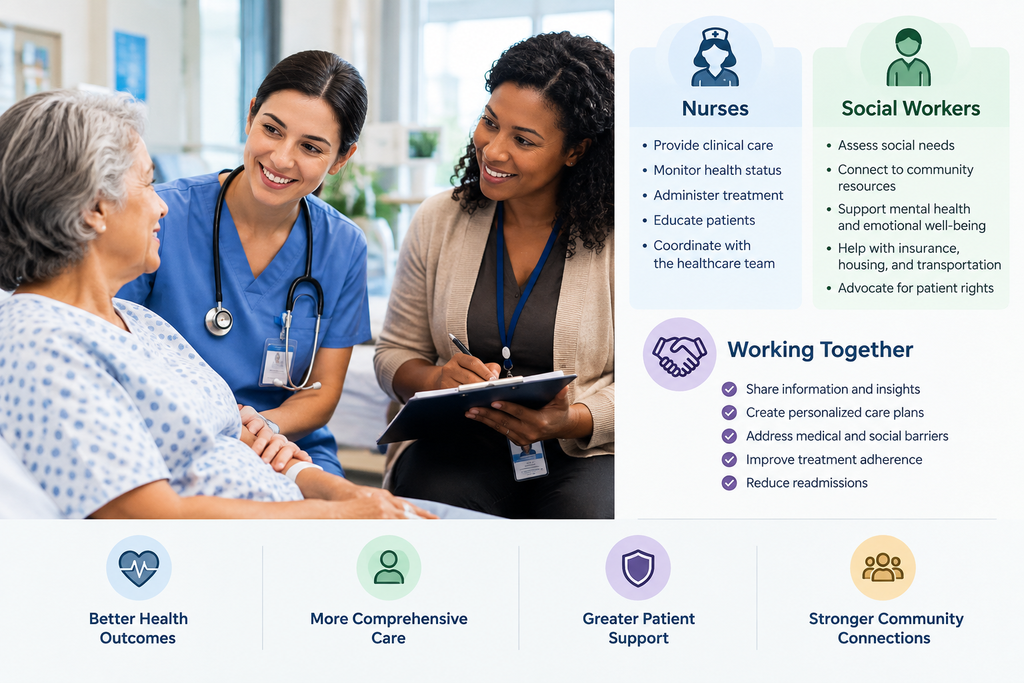
Healthcare has become increasingly complex, with patients often managing chronic conditions, shorter hospital stays, and a range of social and environmental factors that can affect their health. As healthcare providers address these challenges, Collaboration between social workers and nurses has become increasingly important. Nurses provide ongoing clinical care and monitor patients’ immediate health needs, while social workers help address factors such as housing, financial difficulties, transportation, family support, and access to community resources. Together, they can provide more coordinated, patient-centered care that considers both medical and social needs.
In this article, we take a detailed look at how this partnership takes place.
Table of Contents
What Roles Do Nurses Play in Healthcare?
The nurse’s job in this process is clinical and patient-centric. They’re concerned with monitoring the patient’s health, administering treatment prescribed by the physicians, and generally coordinating care to ensure that the patient receives and understands the necessary tests, and so on.
Nurses play a 24-7 kind of role in a patient’s life when they are in the hospital setting.
When Social Workers Enter the Equation
Social workers generally enter the equation during the discharge phase. There might be several factors that instigate their presence. It’s often a fairly standard element of discharge coordination when patients are older.
The social worker in these cases is there to simply ensure that they’re able to make it to their follow-ups, follow the prescribed treatment plan, pick up medications, and do things that might require the assistance of another person.
Social workers are also commonly introduced to situations where a person was the victim of violence or are suffering from a mental health condition.
They also become active when there is a clear environmental factor that might be contributing to illness, food insecurity, homelessness, et cetera. The social worker’s job is to assist and advocate for the patient. They help them navigate insurance, disability applications, guardianship, patient rights, protection, and more.
Why These Roles Are Synergistic
The relationship between nurses and social work recognizes a complicated connection between environment and health.
It’s a productive collaboration because it acknowledges the fact that a person can receive very good care at the hospital and still experience a heavy recurrence of symptoms based on environmental factors that a doctor or nurse has no say in.
Social workers, on the other hand, can go into a person’s home and evaluate the safety. They can arrange home health aids, help the person secure necessary medical equipment, and essentially ensure that the person is able to access the appointments that they need.
This can create a significant reduction in hospital readmission and help people stick to their medication requirements much more closely.
Can Any Social Worker Assist in the Hospital Environment?
There are actually many social work specialties that would influence the role a person plays in the healthcare environment.
The path toward getting these jobs generally involves either a graduate degree or a specialized certification. There are healthcare-specific social work roles that perform many of the tasks described above.
There are also social work jobs that take on a clinical aspect. Clinical social workers may evaluate a person’s mental health and determine, in these ways, how a person interacts with the medical system.
A clinical social worker might identify mental health factors that are contributing to other health conditions or simply connect people with resources they need to thrive in their environment.
It’s worth noting that getting an undergraduate degree in social work generally provides professionals with access to only the most entry-level careers.
These will generally involve managing the details of the family reunification process, or something along those lines. Entry-level social positions rarely involve an enhanced level of strategy or coordination of the kind that I’m describing above.
The good news is that you can receive a graduate degree in social work very quickly if you have the required undergraduate credentials. Many programs take a year to complete. If you do not have an undergraduate degree in social work, you can still enroll in graduate-level programs that would allow you to do much of the same work we’ve described above. In this case, however, it would usually take two to three years to complete.
There are also jobs that require specialized certifications, but not necessarily graduate school.
If you are interested in playing a more impactful role as a social worker, but you don’t quite know in what way, spend some time learning about all of the options available to you.
Specialized Nursing Roles
There are also advanced practice nursing positions that further influence a person’s ability to assist in the mental health care process.
These roles are going to range pretty widely based on the specific type of job the nurse is looking for.
There are mental health-related positions as well as those concerning general health. Some nurses take on advanced practice roles that allow them to work almost the way a general practitioner would.
In all cases, these jobs are a good way to contribute at the highest possible level as a nurse. Advanced practice jobs generally require a graduate degree that can take two to three years to get, depending on how much time you’re able to devote to your studies.
How Do Social Workers and Nurses Work Together?
Social workers and nurses work together by combining their different areas of expertise to address the medical, emotional, and social needs of patients. Nurses may identify concerns during patient assessments, such as difficulty understanding a treatment plan, lack of family support, or barriers to obtaining medications. They can then communicate these concerns to the social worker, who can help identify appropriate resources and coordinate additional support.
For example, a nurse may recognize that a patient is likely to struggle with recovery at home because they live alone or lack reliable transportation. The social worker can then help arrange appropriate community services, transportation resources, home-care support, or other assistance. The nurse can continue monitoring the patient’s clinical needs and provide education about medications, follow-up appointments, and recovery.
This communication can be especially valuable during transitions between hospital and home. By sharing relevant information and coordinating their efforts, nurses and social workers can help patients better understand their care plans while addressing practical barriers that could interfere with recovery. The result is a more comprehensive approach to patient care that recognizes how medical needs and social circumstances can influence one another.
Conclusion
The collaboration between social workers and nurses, or even just the wider healthcare environment, is a recognition of how complex and multifaceted human health really is.
Most people who have had an interaction with the healthcare system require more than one type of help. You can make a difference in so many different ways.
Choose the path that makes the most sense for you.
You will definitely love reading this: Patients Should Know Who Is Treating Their Mental Health

Maria holds an MS in Psychology with a specialization in Social Psychology. She is a research-oriented writer with a strong academic background in psychological and behavioral sciences. Her work focuses on bridging academic research and public understanding by simplifying complex psychological theories and social dynamics. She writes about the relationship between society, mental health, and human behavior, making evidence-based ideas more accessible and practical for readers.