Have you ever wondered why two people can react completely differently to the same situation? Why does one student thrive in a challenging classroom while another struggles? Why do some people become motivated by their environment while others seem unaffected?
The answer may lie in a psychological concept called reciprocal determinism. Developed by psychologist Albert Bandura, reciprocal determinism explains how a person’s behavior, personal characteristics, and environment continuously influence one another.
Understanding this concept can help explain human behavior in schools, workplaces, relationships, social media, and everyday life. In this guide, you’ll learn the reciprocal determinism psychology definition, how the theory works, practical examples, and why it remains one of the most influential ideas in modern psychology.
What Is Reciprocal Determinism?
Reciprocal determinism is the idea that a person’s behavior, personal factors, and environment interact with and influence one another continuously.
Instead of viewing behavior as being caused solely by internal traits or external circumstances, reciprocal determinism suggests that all three factors work together in a dynamic cycle.
In simple terms:
- Your thoughts and beliefs affect your behavior.
- Your behavior affects your environment.
- Your environment influences your thoughts, feelings, and future behavior.
This ongoing interaction helps shape who we are and how we act.
Simple Definition
Reciprocal determinism is a psychological theory stating that behavior, personal factors, and environmental influences continuously affect each other.
Reciprocal Determinism Psychology Definition
In psychology, reciprocal determinism refers to the mutual influence among:
- Personal factors (thoughts, beliefs, emotions, personality)
- Behavior (actions and responses)
- Environment (social surroundings, culture, physical settings)
According to the theory, no single factor independently determines behavior. Instead, each component influences and is influenced by the others.
This concept forms a core part of Bandura’s Social Cognitive Theory, which emphasizes learning through observation, experience, and social interaction.
Who Developed Reciprocal Determinism?
The concept was introduced by Albert Bandura, one of the most influential psychologists of the twentieth century.
Bandura challenged earlier theories that viewed human behavior as controlled solely by environmental reinforcement. He argued that people are not passive recipients of external influences. Instead, they actively shape their environments while being influenced by them.
His research transformed the understanding of learning, motivation, self-efficacy, and social behavior.
The Three Components of Reciprocal Determinism
To understand how reciprocal determinism works, it’s important to examine its three key elements.
1. Personal Factors
Personal factors include:
- Beliefs
- Attitudes
- Expectations
- Emotions
- Knowledge
- Self-confidence
- Personality traits
These internal characteristics influence how individuals perceive situations and respond to them.
Example
A student who believes they are good at math may approach challenging problems with confidence and persistence.
2. Behavior
Behavior refers to observable actions.
Examples include:
- Studying
- Exercising
- Communicating
- Socializing
- Working
- Learning new skills
Behavior can change both personal beliefs and environmental conditions.
Example
Regular studying improves academic performance, which may increase confidence and encourage further studying.
3. Environment
The environment includes everything outside the individual.
Examples include:
- Family
- Friends
- School
- Workplace
- Social media
- Community
- Cultural influences
Environmental factors can support, discourage, or shape behavior.
Example
A supportive teacher can increase a student’s motivation and academic engagement.
How Reciprocal Determinism Works
Reciprocal determinism operates as a continuous feedback loop.
Imagine the following cycle:
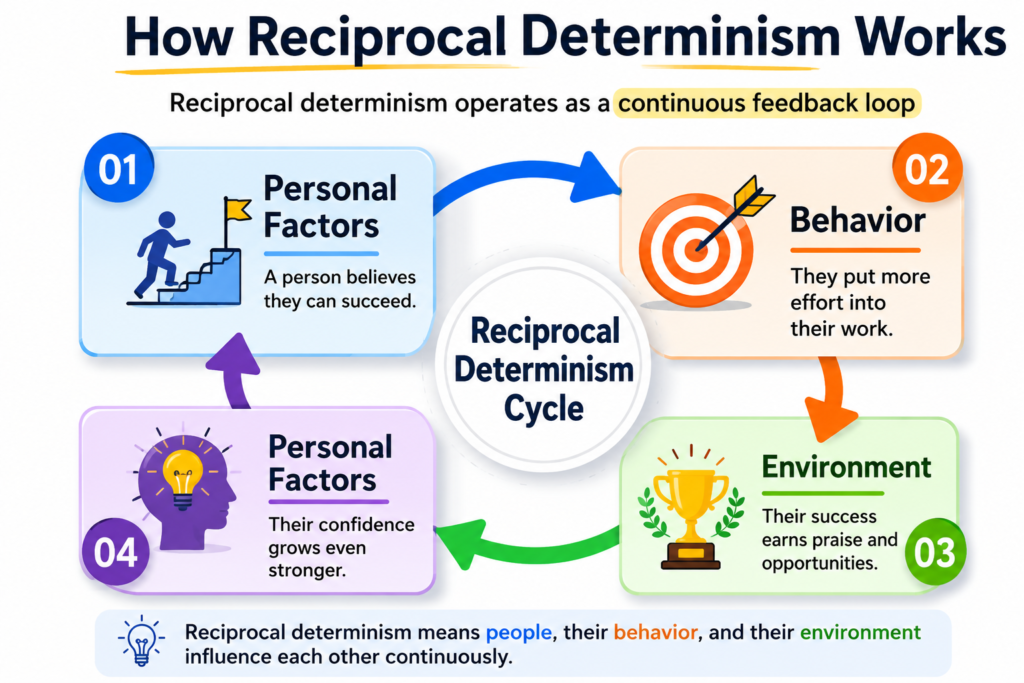
The cycle then repeats, reinforcing positive outcomes.
The same process can also create negative cycles if beliefs, behaviors, or environments become unfavorable.
Reciprocal Determinism Example in Everyday Life
One of the easiest ways to understand reciprocal determinism is through real-life situations.
Fitness Example
Consider someone trying to improve their health.
Personal Factor
They believe exercise will improve their well-being.
Behavior
They start going to the gym regularly.
Environment
They meet supportive friends who encourage healthy habits.
Result
The positive environment increases motivation, making continued exercise more likely.
Each factor strengthens the others.
Examples of Reciprocal Determinism in Psychology
School Example
A student enjoys reading.
Because of this interest, they spend more time reading books.
Their improved skills lead to better grades and positive feedback from teachers.
This supportive environment increases their confidence and motivation to continue learning.
In this case:
- Personal factor: Interest in reading
- Behavior: Reading frequently
- Environment: Positive reinforcement from teachers
Workplace Example
An employee believes they can excel at their job.
They volunteer for challenging projects.
Managers notice their initiative and provide growth opportunities.
The employee gains confidence and continues performing well.
Again, personal factors, behavior, and environment influence one another.
Social Media Example
A content creator enjoys sharing educational content.
They consistently post helpful information.
Followers engage positively and provide encouragement.
The creator becomes more motivated and continues producing quality content.
This illustrates reciprocal determinism in the digital age.
Sports Example
An athlete believes they can improve.
They practice regularly.
Their coach provides positive feedback and advanced training.
The athlete’s confidence grows, leading to even greater effort and performance.
Reciprocal Determinism and Learning
Reciprocal determinism plays a major role in learning and development.
Students do not simply absorb information from teachers. Their beliefs, actions, and surroundings all contribute to learning outcomes.
For example:
- Confident students participate more actively.
- Participation improves understanding.
- Improved performance receives positive feedback.
- Positive feedback strengthens confidence.
This cycle supports continuous growth.
Why Reciprocal Determinism Matters
Understanding reciprocal determinism helps explain why behavior is often complex and difficult to predict.
It reminds us that:
- People influence their environments.
- Environments influence people.
- Thoughts and beliefs affect actions.
- Actions can change future opportunities.
This perspective encourages a more complete understanding of human behavior than theories that focus on only one factor.
Applications of Reciprocal Determinism in Real Life
Education
Teachers can create supportive environments that encourage student success.
Parenting
Parents can model positive behaviors that children learn through observation.
Mental Health
Therapists often help clients change thoughts, behaviors, and environments simultaneously.
Workplace Development
Organizations can improve employee performance by fostering supportive work cultures.
Personal Growth
Individuals can intentionally modify habits and surroundings to achieve desired outcomes.
Reciprocal Determinism vs Traditional Determinism
Traditional determinism often suggests that behavior is controlled by either internal traits or external circumstances.
Reciprocal determinism differs because it recognizes a two-way relationship among multiple factors.
| Traditional Determinism | Reciprocal Determinism |
| Behavior is caused by a single dominant factor. | Behavior results from interacting factors. |
| Individuals are more passive. | Individuals actively shape their environments. |
| Focuses on one direction of influence. | Emphasizes mutual influence. |
This broader approach better reflects the complexity of human behavior.
Strengths of Reciprocal Determinism
Comprehensive Explanation
The theory considers multiple influences on behavior.
Realistic View of Human Behavior
People both influence and are influenced by their surroundings.
Practical Applications
The concept is useful in education, counseling, health psychology, and organizational settings.
Encourages Personal Agency
It recognizes that individuals can make choices and actively change their circumstances.
Criticisms of Reciprocal Determinism
Like all psychological theories, reciprocal determinism has limitations.
Difficult to Measure
The interactions among personal factors, behavior, and environment can be complex.
Challenges in Establishing Causality
Determining which factor influences another at a specific moment can be difficult.
Broad Framework
Some researchers argue that the theory explains behavior generally rather than making highly specific predictions.
Despite these criticisms, reciprocal determinism remains widely respected and influential.
Frequently Asked Questions
What is reciprocal determinism?
Reciprocal determinism is a psychological theory stating that behavior, personal factors, and environmental influences continuously affect one another.
What is reciprocal determinism in psychology?
In psychology, reciprocal determinism explains how thoughts, emotions, actions, and surroundings interact to shape human behavior.
Who developed reciprocal determinism?
Psychologist Albert Bandura developed the concept as part of his Social Cognitive Theory.
Why is reciprocal determinism important?
It provides a more complete understanding of human behavior by recognizing the interaction among personal factors, actions, and environmental influences.
Conclusion
Reciprocal determinism is one of the most important concepts in modern psychology because it explains behavior as the result of continuous interaction among personal factors, behavior, and the environment. Rather than viewing people as passive products of their circumstances, the theory highlights how individuals actively shape their experiences while being shaped by them.
Whether in education, work, relationships, health, or personal development, reciprocal determinism helps us understand why behavior changes over time and how positive changes in one area can create positive changes in others. By recognizing these interconnected influences, individuals can take meaningful steps toward personal growth, improved learning, and healthier lifestyles.
Key Takeaway: Human behavior is not determined by a single cause. Instead, our thoughts, actions, and environments constantly interact, creating the dynamic process known as reciprocal determinism.
You May Like: Cognitive Restructuring: How to Change Negative Thinking

Maria holds an MS in Psychology with a specialization in Social Psychology. She is a research-oriented writer with a strong academic background in psychological and behavioral sciences. Her work focuses on bridging academic research and public understanding by simplifying complex psychological theories and social dynamics. She writes about the relationship between society, mental health, and human behavior, making evidence-based ideas more accessible and practical for readers.