In the complex architecture of human existence, few things are as defined as our ability to communicate. Language is the tapestry upon which we weave our thoughts, memories, and social bonds. Yet, we often take the intricate neurological choreography required to produce a sentence or recall a name for granted until that choreography falters.
When the brain’s ability to process language or executive function is compromised by injury, disease, or developmental delay, there is one clinical profession that stands at the epicenter of recovery: Speech-Language Pathology (SLP).
While often colloquially referred to as “speech therapy,” the scope of what you can do as a modern Speech-Language Pathologist (SLP) reaches far beyond articulation. It is a rigorous clinical discipline that sits squarely at the intersection of linguistics, cognitive science, and neurobiology.
The Neurobiology of Communication
To understand the SLP, one must first understand the clinical landscape they navigate. Communication is not merely a motor act of moving the tongue or lips; it is a profound cognitive achievement. When a patient experiences a stroke, a traumatic brain injury (TBI), or neurodegenerative decline, the SLP must act as a clinical detective, mapping the breakdown of the brain’s communication networks.
The SLP investigates how damage to Broca’s or Wernicke’s areas affects a patient’s syntax and comprehension. They analyze how executive dysfunction, the “control center” of the brain residing in the frontal lobes, manifests as an inability to organize thoughts during conversation. By understanding the neuroanatomical correlates of language, the SLP does not just treat the symptom; they treat the underlying connectivity of the brain.
The Cognitive-Linguistic Nexus
The defining feature of the SLP profession is the inseparable nature of cognition and language. We cannot separate the capacity to use language from the capacity to think. This is most evident in the treatment of cognitive-communication disorders.
Consider a patient living with aphasia, a common post-stroke condition. The SLP must decipher whether the patient’s struggle is a “word-finding” issue, a retrieval failure, or a breakdown in the conceptualization of the idea itself. As they guide the patient through strategies to restore these pathways, the clinician is engaging in a sophisticated form of neuroplasticity training.
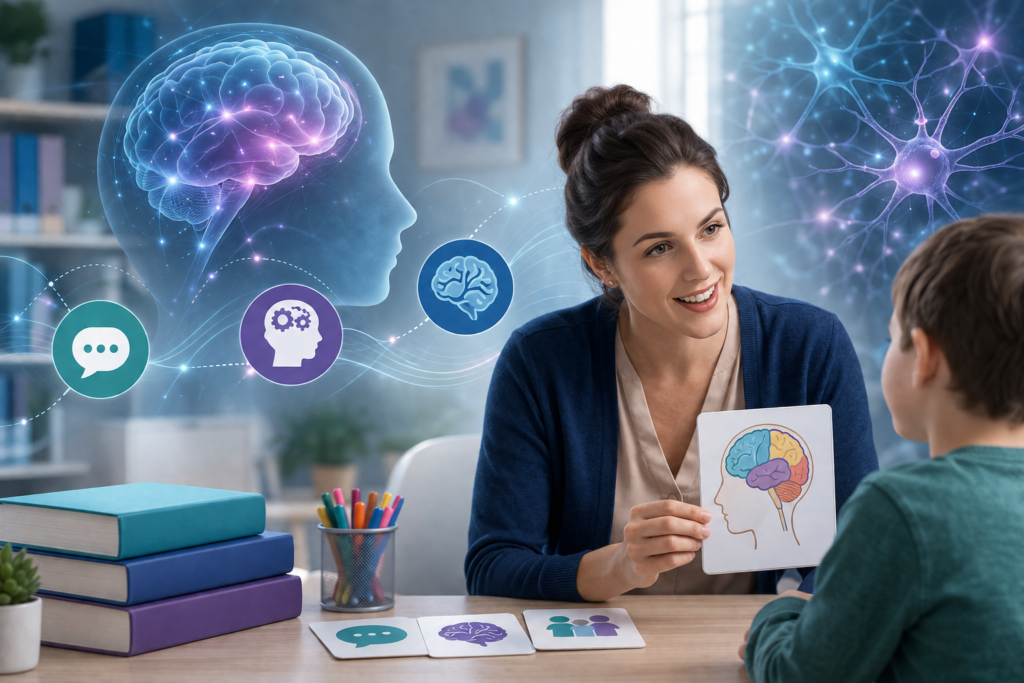
In the pediatric world, this intersection takes a different form. A child struggling with social communication might have intact language structures but a cognitive deficit in “Theory of Mind,” the ability to understand that others have thoughts and perspectives different from their own. Here, the SLP uses language as a tool to bridge the cognitive gap, providing the child with a functional framework to navigate a world that requires rapid, real-time social inference.
Beyond Words: The Science of Interaction
If the brain is the hardware and language is the software, the SLP is the technician who ensures the system runs efficiently. This requires a profound knowledge of linguistics, the study of phonology, morphology, syntax, semantics, and pragmatics.
A patient with a cognitive impairment might be able to articulate words perfectly but lose the ability to maintain the “rules” of conversation. They may interrupt, lose the thread of
a story, or misinterpret irony. The SLP’s expertise lies in identifying exactly which linguistic rule-set has been disrupted. They apply evidence-based interventions that stimulate the cerebral cortex, encouraging the brain to reorganize itself around the site of an injury. This is therapeutic intervention rooted in the highest sciences of the human condition.
The Clinical Future
As we move into an era of advanced neuroimaging and digital health, the role of the SLP is evolving. We are learning more about the brain’s resilience than ever before. Modern clinicians are increasingly integrating neuro-feedback, augmented communication devices, and high-tech software that tracks eye movement and cognitive load to provide targeted therapy. Yet, the core of the profession remains profoundly human.
Because language is the primary vehicle for human consciousness, the work of an SLP is fundamentally about restoring agency. When an individual loses the ability to speak or process information, they lose a piece of their autonomy. The SLP restores that autonomy, not by simple repetition, but by meticulously applying the science of how the brain processes meaning and intent.
Conclusion
The Speech-Language Pathologist occupies a unique niche in the healthcare hierarchy. They are part linguist, part neurologist, and part cognitive psychologist. They are the practitioners who remind us that our brain is not a static organ, but a dynamic, growing system that responds to targeted, intentional input.
By sitting at the crossroads of language, cognition, and the brain, the SLP is more than a therapist. They are engineers of the human connection, reconstructing the bridges of communication that allow us to step back into the world, to share our history, and to voice our future. In every session, they prove that while a brain may be damaged, the mind often remains intact, waiting only for the right clinician to help it find its voice once again.

Maria holds an MS in Psychology with a specialization in Social Psychology. She is a research-oriented writer with a strong academic background in psychological and behavioral sciences. Her work focuses on bridging academic research and public understanding by simplifying complex psychological theories and social dynamics. She writes about the relationship between society, mental health, and human behavior, making evidence-based ideas more accessible and practical for readers.