In the world of academics, mental health is not an adjacent concern to achievement, but a core component of the process. Students need an environment in which they feel psychologically safe and personally nurtured to achieve their best results.
Kids spend nearly 40 hours a week in a classroom. It’s not just an environment where they learn facts; it’s the primary backdrop of their lives. This reason that psychology has become an increasingly prominent factor in student achievement.
In this article, we take a look at classroom factors that have a direct impact on student well-being.
Classroom Factors that Impact Student Well-being
The Teacher-Student Relationship
It’s important to keep in mind that students and teachers have a relationship dynamic that extends beyond the transmission of information. Yes, instruction is an important component of the process, but it’s built upon a foundation of trust.
The quality of the relationship between student and teacher will often directly determine how well they do in school. Students who feel:
- anxious
- unmotivated
- overwhelmed
Will often struggle significantly with their academics.
A good student-teacher relationship is not necessarily about developing something approximating a friendship, but rather trust. Teachers should be responsive to personal factors that might impact performance. They should also make themselves emotionally available to people in the classroom.
Not only do these factors create an atmosphere of acceptance, but they also contribute to conditions that are more supportive of positive results.
Classroom Climate
The classroom climate refers to an aggregated set of conditions that collectively determine the culture of a given room. Part of this climate is academic in nature, of course, but there’s also a collective social and emotional component that arguably has an even bigger influence on student experience.
How comfortable do students feel being vulnerable, making mistakes, working together, and sharing their thoughts? These features certainly cannot be set by lesson plans alone but are a byproduct of culture of how the teacher prioritizes social-emotional considerations in the classroom.
In many schools, the architecture behind classroom culture is carefully devised and under constant development and revision. Teachers are, at every stage, shapers of that climate. By creating an atmosphere in which students feel comfortable disclosing their feelings and expressing themselves, teachers help establish a room that is optimally oriented toward productivity and student success.
Creating an Environment of Inclusion
What does inclusion look like in the classroom setting? Obviously, all students are legally protected, but actual inclusion and accessibility are very culturally dependent. Teachers are increasingly prioritizing inclusivity by diversifying lesson plans and developing systems where people from all backgrounds feel more comfortable being themselves.
In practice, this doesn’t just mean creating spaces where people can share their feelings but also allowing as many ways into a lesson as possible. For example, diversified instruction that leaves room for multiple learning styles, one-on-one time with instructors made possible through the inclusion of paraprofessionals and specialists, and adaptable learning modules that allow people to learn in the way that makes the most sense to them.
These accommodations are increasingly common and optimally suited not just to utilitarian function but also to broader inclusivity. People don’t just do better in an environment that allows more entry points into the lesson plan—they also feel better.
Providing Students With a Sense of Ownership
Teachers are also making an increasing effort to provide students with a sense of autonomy and ownership over their studies by allowing them to interpret materials. They’re engaging at a deeper level and also discovering who they are as readers, thinkers, and learners.
In practice, this means:
- allowing multiple ways to participate in an assignment
- breaking students into think-pair-share groups that allow for small discussion and more personalized interpretation
- prioritizing presentations, among other things
Naturally, more public speaking assignments are not always received warmly and can have the unintended effect of creating anxiety. That said, studies do show with astounding consistency that students who are able to explain concepts to their peers are much more likely to understand them on a deeper level.
Recognizing Environmental Factors
Modern classroom management also recognizes that a student’s home life can, and often does, have a heavy influence on how they learn and how they behave in the classroom. This reason is that homework is often significantly less prominent in modern public schools. It’s a simple fact that many students have at-home responsibilities or circumstances that are not conducive to independent learning.
It’s also recognized that truancy or persistent tardiness is often not a behavioral concern but an indication that some form of specialized intervention is necessary to help students stay on track. There are admittedly limits to how much a school can do to help a student personally. However, even recognizing the way that the environment influences studies can be a big step forward in helping students achieve the best possible results.
Students will often be more trusting of teachers who understand what they’re going through and are willing to meet them where they are. It’s very common now for schools to make special accommodations for kids based not necessarily on their ability level, but on their personal circumstances. For example, study clubs that take place during school hours or wireless hotspots that make online independent learning possible for students who do not have internet access at home.
How to Improve Student Wellbeing in the Classroom
Understanding how to improve student wellbeing starts with creating a classroom environment where students feel safe, valued, and supported. While academic achievement is important, students are more likely to succeed when their emotional, social, and mental wellbeing is also prioritized.
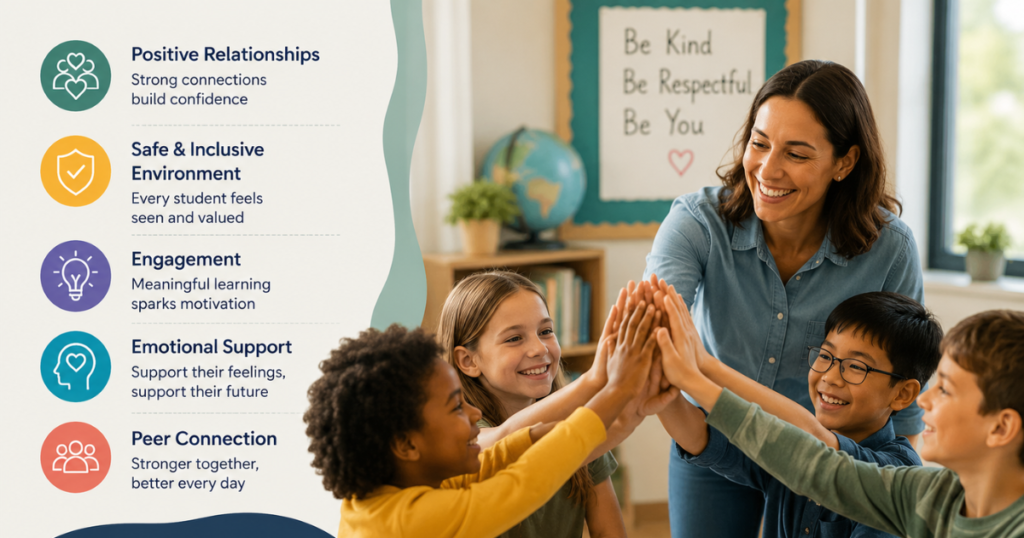
Here are some practical ways educators can improve student wellbeing:
1. Build Positive Relationships
Strong teacher-student relationships help students feel connected and respected. Take time to learn about students’ interests, listen to their concerns, and provide consistent encouragement.
2. Create a Safe and Inclusive Environment
Students thrive when they feel accepted regardless of their background, abilities, or identity. Encourage respectful communication and establish clear expectations for kindness and inclusion.
3. Encourage Student Voice and Choice
Giving students opportunities to make decisions about their learning can increase engagement and confidence. Simple choices, such as selecting project topics or learning activities, help students feel empowered.
4. Support Social and Emotional Learning
Teach skills such as self-awareness, empathy, emotional regulation, and conflict resolution. These abilities help students manage challenges both inside and outside the classroom.
5. Promote a Healthy Learning Balance
Excessive academic pressure can negatively affect wellbeing. Balance rigorous learning with opportunities for creativity, collaboration, movement, and reflection.
6. Recognize and Celebrate Progress
Acknowledging effort and improvement, not just high grades, helps build self-esteem and motivation. Small celebrations of achievement can have a lasting positive impact on student wellbeing.
7. Foster Peer Connections
Group activities, cooperative learning, and classroom discussions help students develop friendships and a sense of belonging, which are essential for emotional wellbeing.
By focusing on these strategies, schools and educators can create learning environments that support both academic success and overall student wellbeing. Small, intentional changes in classroom practice can make a meaningful difference in how students feel, learn, and grow.
Frequently Asked Questions
1. What classroom factors have the greatest impact on student wellbeing?
The classroom factors that most directly impact student wellbeing include positive teacher-student relationships, a safe and inclusive learning environment, peer support, student engagement, and opportunities for social and emotional learning. These factors influence how connected, confident, and supported students feel at school.
2. Why is student wellbeing important for academic success?
Student wellbeing plays a critical role in academic achievement. When students feel safe, valued, and emotionally supported, they are more likely to participate in class, stay motivated, develop resilience, and achieve better learning outcomes.
3. How can teachers improve student wellbeing in the classroom?
Teachers can improve student wellbeing by building strong relationships, encouraging student voice, promoting inclusivity, recognizing student achievements, supporting social-emotional learning, and creating a positive classroom culture where every student feels respected and supported.
Conclusion
None of the things we’ve described in this article are necessarily revolutionary, but rather exist as a sort of conceptual progression. Teachers have always been focused on student well-being, but as more data emerges and as schools develop better resources, the value of social-emotional support and individualized attention has gained particular importance.
Not only do we now know how valuable inclusivity is, but we also have more of an ability to facilitate it. The basic premise is simple: recognizing that students are not just learners, but people with a complex range of needs. As children, they are not necessarily fully empowered to meet those needs on their own. That’s where special consideration in the school setting comes into play.
Teachers who recognize the individuality of their students are able to create a more nurturing and ultimately productive classroom environment.

Maria holds an MS in Psychology with a specialization in Social Psychology. She is a research-oriented writer with a strong academic background in psychological and behavioral sciences. Her work focuses on bridging academic research and public understanding by simplifying complex psychological theories and social dynamics. She writes about the relationship between society, mental health, and human behavior, making evidence-based ideas more accessible and practical for readers.