Imagine someone collapses in a crowded place. Many people see it. Yet for a few seconds or longer, no one moves.
This is the bystander effect: a social-psychology phenomenon in which people become less likely to help someone in need when others are present. It does not mean bystanders are cruel or that crowds never help. More often, people hesitate because they are unsure what is happening, assume somebody else will act, fear making a mistake, or freeze under stress.
Understanding the bystander effect matters because hesitation is not inevitable. A clear request, a specific role, and one person taking the lead can turn a passive crowd into a helpful group.
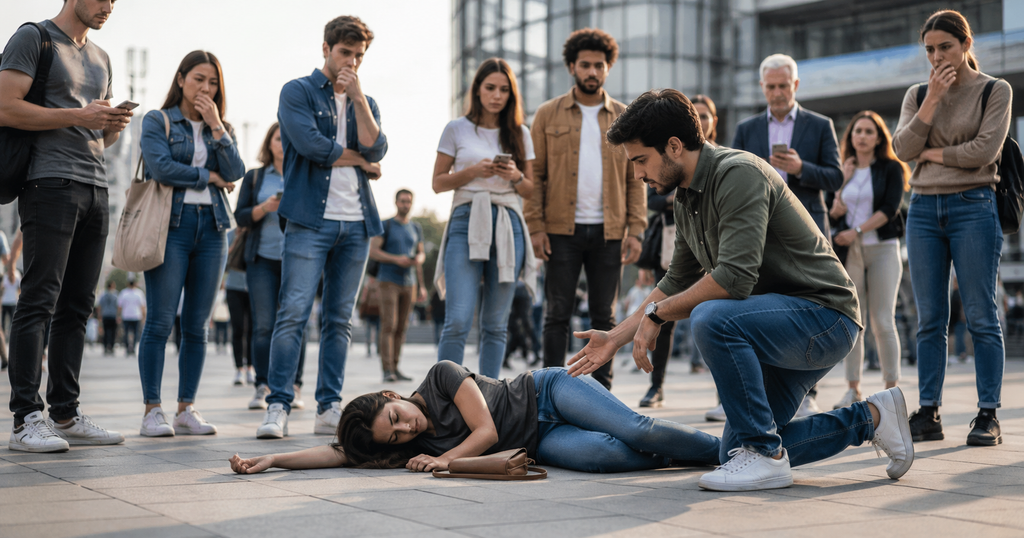
Table of Contents
What is the bystander effect?
The bystander effect definition in psychology is simple: an individual may be less likely, or slower, to offer help in an emergency when other people are also present.
In other words, when you are alone and see a problem, the responsibility feels like yours. In a group, it can feel as if the responsibility belongs to everyone else whand therefore to no one in particular.
The bystander effect likely occurs due to a combination of social cues, uncertainty, fear, and shared responsibility. It is sometimes called bystander apathy, although that label can be misleading. People who do not act may still care deeply; they may simply be confused, afraid, or waiting for a signal that help is needed.
To understand how other people shape choices, you may also find this overview of psychology as the science of mind and behavior useful. The bystander effect is a classic example of how social settings influence individual behavior.
Is the bystander effect real?
Yes, the bystander effect is real, but it is more complicated than the popular version suggests.
Classic studies found that individuals were often slower or less likely to seek help when they believed other bystanders were present. A major review of decades of research concluded that the effect is especially likely in situations that are ambiguous or relatively low-danger.
However, this does not mean that people never help in real emergencies. In an analysis of 219 public conflicts captured on CCTV in the United Kingdom, the Netherlands, and South Africa, at least one bystander intervened in roughly nine out of ten incidents. More people present could increase the chance that someone helped, even if each person individually felt less responsible.
The most accurate takeaway is this:
The bystander effect can reduce an individual’s willingness to act, especially when a situation is unclear. But groups can also provide support, safety, knowledge, and additional people who are able to help.
This distinction is important when learning about social psychology. Like confirmation bias, the bystander effect shows that human judgment is shaped by mental shortcuts and social context—not simply by whether a person is “good” or “bad.”
Why does the bystander effect happen?
Psychologists have identified several reasons people may hesitate to act around others.
| Psychological factor | What it means | Everyday example |
| Diffusion of responsibility | Each person assumes someone else will handle the problem | “There are lots of people here. Someone must have already called for help.” |
| Pluralistic ignorance | People look to others for cues; when everyone appears calm, they assume nothing is wrong | A student sees bullying but assumes others do not see it as serious because no one reacts |
| Evaluation apprehension | A person fears embarrassment, criticism, or doing the wrong thing publicly | “What if I misunderstood and everyone thinks I overreacted?” |
| Lack of confidence | People may not know what to do or may assume another person is more qualified | “Someone else probably knows first aid better than I do.” |
| Freeze or distress response | Stress can temporarily shut down action, even when a person wants to help | A witness feels overwhelmed and cannot decide what to do first |
Diffusion of responsibility
Diffusion of responsibility is the most widely known explanation. When several people witness a problem, each person may believe another bystander will call emergency services, speak up, or step in.
That belief can create a dangerous delay. Everyone waits for someone else to become the first mover.
A useful way to remember it is: the more “someone” there is, the easier it is to feel that you are not that someone.
Pluralistic ignorance
Pluralistic ignorance happens when people privately feel concerned but publicly follow the group’s apparent calmness.
For example, imagine several passengers hear someone crying on a train. Each person notices, but nobody reacts immediately. Because no one else acts, each passenger may wrongly conclude that the situation is not serious.
This is why visible action can be powerful. When one person asks, “Are you okay?” it can help others recognize the problem and step in.
Fear of getting it wrong
People may hesitate because they worry about interfering, embarrassing someone, escalating conflict, or being judged by others.
That fear is understandable. Still, safe, low-risk actions can often help without requiring confrontation. You can check in, call for trained assistance, alert staff, document relevant details when appropriate, or ask another person to stay with the individual.
Social situations also influence identity and belonging. The power of belonging and community can make people more likely to support those they see as part of their group.
The five steps before someone helps
Psychologists John Darley and Bibb Latané described bystander intervention as a decision process. A person must successfully move through several steps before taking action.
- Notice that something unusual is happening
- Interpret it as a situation where help is needed
- Accept responsibility to do something
- Know how to help or find appropriate help
- Act on the decision
A person can stop at any stage.
For instance, someone may notice a person sitting on the ground but assume they are resting. Another person may recognize a problem but think a security guard has already been informed. A third may want to help but be unsure whether to call emergency services.
This framework helps explain why inaction is not always indifference. It may be uncertainty at one specific point in the process.
A real-life example of the bystander effect
Here is a common example:
A student is being mocked in a class group chat. Dozens of people see the messages. Several classmates privately think the behavior is cruel, but no one responds at first.
Why might this happen?
- Each person expects someone else to defend the student.
- People may worry that speaking up will make them a target.
- Silence can make the bullying seem socially accepted, even when most group members disagree.
- Some may not know whether the targeted student wants public support.
One person can disrupt the pattern by writing, “This is not okay. Let’s stop,” privately checking in with the targeted student, reporting the behavior, or asking a trusted adult, moderator, teacher, or manager to step in.
The same social dynamics can occur offline, at school, at work, in public, or within friend groups. Learning about behavioral psychology can help explain how cues, habits, rewards, and social pressure shape what people do in these moments.
Was the Kitty Genovese story true?
The murder of Kitty Genovese in Queens, New York, in 1964 became strongly associated with the bystander effect. Early news reports claimed that 38 people watched or heard a prolonged attack and did nothing.
That account was substantially inaccurate. Later reporting and historical research found that the number of witnesses and what they could see or hear had been exaggerated; some people did seek help, and a neighbor comforted Genovese after the attack.
So, has the bystander effect been debunked? No.
What has been debunked is the simplified myth that 38 indifferent witnesses watched a murder unfold without lifting a finger. The event helped motivate research, but the scientific evidence for bystander effects comes from controlled studies and later research—not from treating the original news account as proof.
This is also a useful reminder to question neat, emotionally powerful stories. The same critical-thinking habit is central to understanding confirmation bias: people can be drawn to information that fits an existing belief, even when the fuller evidence is more complex.
What breaks the bystander effect?
The best way to break the bystander effect is to make the need for action clear and give people a specific role.
1. Point to one person
Avoid vague requests such as, “Can somebody call for help?”
Instead, choose a person and be direct:
- “You in the blue jacket, call emergency services.”
- “Please ask the manager to come here.”
- “Can you stay with them while I get help?”
A specific request reduces diffusion of responsibility because the chosen person knows the task is theirs.
2. Name what you are seeing
Ambiguity causes delay. Calmly state the concern:
- “This person has fallen and may be injured.”
- “They look unwell. Let’s check whether they need help.”
- “That comment is not okay. Please stop.”
Naming the issue helps other people interpret the situation correctly.
3. Use safe forms of intervention
Helping does not always mean confronting someone directly. If a situation feels unsafe, prioritize your own safety and get trained or authorized help.
Useful options may include:
- Calling local emergency services for an immediate medical or safety emergency
- Alerting security, staff, a teacher, a manager, or another authority figure
- Asking the person if they are okay when it is safe to do so
- Creating a distraction to interrupt a tense interaction
- Staying nearby so the person is not isolated
- Gathering other bystanders who can help safely
- Reporting harassment, abuse, threats, or dangerous conduct through the appropriate channel
4. Build confidence before an emergency
First-aid training, workplace training, harassment-prevention training, and rehearsing simple scripts can make action easier under pressure.
You do not need to become a hero or take unnecessary risks. You need a realistic plan: notice, assess safety, get help, and make one clear choice.
5. Model action for others
One calm action can change the social signal for everyone nearby. When one person checks in, calls for help, or assigns a role, others often become more willing to assist.
This is one reason communities matter. Adler’s idea of social interest emphasizes connection and contributing to others’ welfare, values that can make supportive action more likely.
The bystander effect at work and online
The bystander effect is not limited to physical emergencies.
In the workplace
At work, people may stay silent after witnessing harassment, discrimination, unethical conduct, or unsafe practices. They may fear retaliation, damaging relationships, or being labeled difficult.
A safer response may involve documenting what happened, checking in with the affected person, using an official reporting channel, or consulting HR, a manager, a union representative, or an ombuds service where available.
On social media and group chats
Online spaces can create a different version of the same problem. A post receives many views, but nobody reports a threat, defends a targeted person, or checks whether a troubling message signals real danger.
Online intervention can include reporting harmful content, contacting platform moderators, privately checking in, refusing to amplify abuse, and seeking emergency help when someone appears to be at immediate risk.
The core principle remains the same: do not assume visibility means someone else has already taken responsibility.
FAQs
What is a bystander example?
A bystander is someone who witnesses an event but is not directly involved. For example, someone who sees a cyclist fall on the street is a bystander. They may help, call for assistance, find a first-aid kit, or simply observe.
What is a real-life example of the bystander effect?
A real-life example is a group of coworkers hearing a colleague being insulted but remaining silent because each assumes another coworker or manager will respond. The effect is more likely if the situation is ambiguous or if people fear social consequences for speaking up.
Is the bystander effect real?
Yes. Research shows that the presence of others can reduce or delay an individual’s helping behavior, especially in ambiguous situations. But real-world studies also show that bystanders often do help, so the effect should not be treated as universal or inevitable.
Has the bystander effect been debunked?
No. The oversimplified story surrounding Kitty Genovese has been corrected, but the bystander effect itself remains a well-established topic in social psychology. The strongest interpretation is nuanced: the presence of others can discourage an individual from acting, while a larger group may still increase the likelihood that at least one person helps.
What breaks the bystander effect?
Clear action breaks the bystander effect. Directly assign someone a task, state what is happening, ask for trained help, and choose a safe way to respond. For example: “You, call emergency services. You, get the manager. I’ll stay here with them.”
Final takeaway
The bystander effect does not mean people lack empathy. It shows how uncertainty, fear, social pressure, and shared responsibility can make people hesitate at exactly the moment action is needed.
The most practical lesson is simple: if you see a problem and it is safe to act, do not wait for an unnamed person to take charge. Make the situation clear, give one person a specific task, and get appropriate help.
A crowd can spread hesitation, but one person can also start a chain of support.

Maria holds an MS in Psychology with a specialization in Social Psychology. She is a research-oriented writer with a strong academic background in psychological and behavioral sciences. Her work focuses on bridging academic research and public understanding by simplifying complex psychological theories and social dynamics. She writes about the relationship between society, mental health, and human behavior, making evidence-based ideas more accessible and practical for readers.