If you’re trying to understand the difference between psychiatric nurse practitioner and psychiatrist, you’re not alone. As mental health services become more accessible through clinics, hospitals, and telehealth platforms, many people find themselves choosing between different types of mental health providers without knowing what each professional does. While both psychiatric nurse practitioners and psychiatrists can diagnose mental health conditions, prescribe medication, and create treatment plans, their education, training, and scope of practice are not the same.
Choosing the right mental health provider is an important step toward receiving effective care. Whether you’re seeking treatment for anxiety, depression, ADHD, bipolar disorder, or another mental health condition, understanding who is providing your care can help you make a more informed decision. Knowing the differences can also set realistic expectations about the services each provider offers and when one may be a better fit than the other.
In this guide, we’ll explain the difference between psychiatric nurse practitioner and psychiatrist, compare their qualifications, responsibilities, prescribing authority, and treatment approaches, and help you determine which professional may best meet your mental healthcare needs.
Difference between Psychiatric Nurse Practitioner and Psychiatrist
The Medical Model: Psychiatrists and Psychiatric Nurse Practitioners
When we talk about the “medical model” of mental health, we are talking about practitioners who focus on the biological and physiological aspects of the brain.
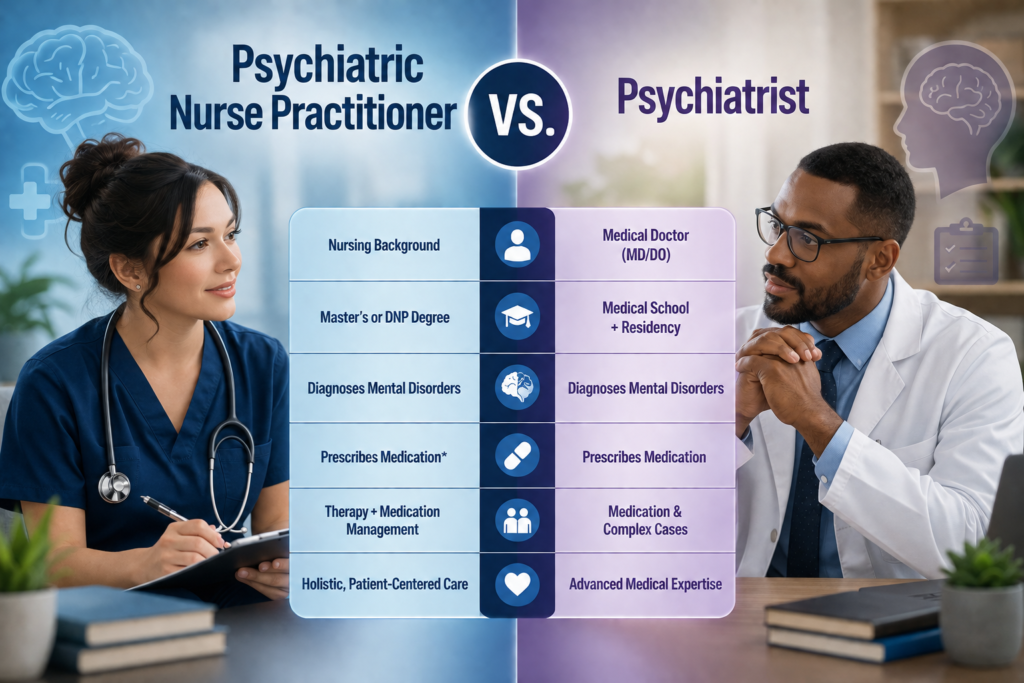
Psychiatrists (MD or DO) are medical doctors who have completed four years of medical school followed by a residency in psychiatry. They are licensed to diagnose mental health conditions, order lab tests, and—most significantly—prescribe medication. Because of their extensive medical training, they are uniquely qualified to understand how mental health symptoms intersect with physical illnesses, such as thyroid disorders or neurological issues.
Psychiatric-Mental Health Nurse Practitioners (PMHNPs) are advanced practice nurses who have specialized training in psychiatric care. They can diagnose and prescribe medication, often working in tandem with, or independently of, a psychiatrist. In many states, they have full practice authority. Patients often find that PMHNPs have a more holistic, nursing-focused approach to care, though their clinical training pathways differ significantly from those of physicians.
The Psychotherapeutic Model: Psychologists and Counselors
If the medical model focuses on “fixing the hardware,” the psychotherapeutic model focuses on “reprogramming the software.” These professionals do not prescribe medication; instead, they specialize in the science of human behavior, emotional regulation, and cognitive patterns.
Psychologists (PhD or PsyD) hold doctoral degrees. A PhD in psychology typically emphasizes research and academic training, while a PsyD (Doctor of Psychology) focuses more on clinical application and therapy. Psychologists are trained to conduct comprehensive psychological testing—such as evaluations for ADHD, autism, or complex personality disorders—that other therapists are not qualified to perform. They provide deep-dive psychotherapy aimed at long-term personality architecture and complex trauma.
Licensed Therapists (LCSW, LMFT, LPC) represent the backbone of the talk-therapy world. These practitioners hold master’s degrees and are licensed by their state boards to conduct psychotherapy.
- LCSWs (Licensed Clinical Social Workers) often look at the patient through the lens of their environment, social support, and systemic factors.
- LMFTs (Licensed Marriage and Family Therapists) are trained specifically in systems theory, looking at how relationships and family dynamics drive individual mental health.
- LPCs (Licensed Professional Counselors) focus on general mental health wellness, goal-setting, and therapeutic techniques.
Why Distinctions Matter
The most common mistake patients make is assuming that because someone is a “doctor,” they are the best person for talk therapy, or that because someone is a “therapist,” they aren’t “serious” enough to handle a severe diagnosis. Neither assumption is true.
If you are struggling with moderate-to-severe clinical depression or bipolar disorder, you may require a collaborative team: a psychiatrist or PMHNP to manage the biochemistry of your brain through medication, and a psychologist or therapist to manage the behavioral and emotional aspects of your life.
Conversely, if you are navigating a life transition, childhood trauma, or relationship conflicts, a psychiatrist may not be the best use of your time or money. They are often booked into short, fifteen-minute “medication management” sessions, whereas a therapist will typically provide 50 minutes of dedicated, focused investigation into your internal world.
Final Thoughts
Your mental health is not a commodity, and you are not a passive recipient of services. Everyone will be a consumer of healthcare off and on over the duration of their lives. As such, when you walk into that office—or log into that screen—you have the right to ask direct questions such as, “What is your clinical background, and how does your specific degree qualify you to help with what I am experiencing?”
The professional sitting across from you is a tool in your recovery toolkit. By understanding their training and scope, you can better leverage their expertise to build a life of health and happiness.

Maria holds an MS in Psychology with a specialization in Social Psychology. She is a research-oriented writer with a strong academic background in psychological and behavioral sciences. Her work focuses on bridging academic research and public understanding by simplifying complex psychological theories and social dynamics. She writes about the relationship between society, mental health, and human behavior, making evidence-based ideas more accessible and practical for readers.