What Is Reverse Psychology?
Have you ever told someone not to do something, only to secretly hope they would do it? If so, you’ve witnessed reverse psychology in action.
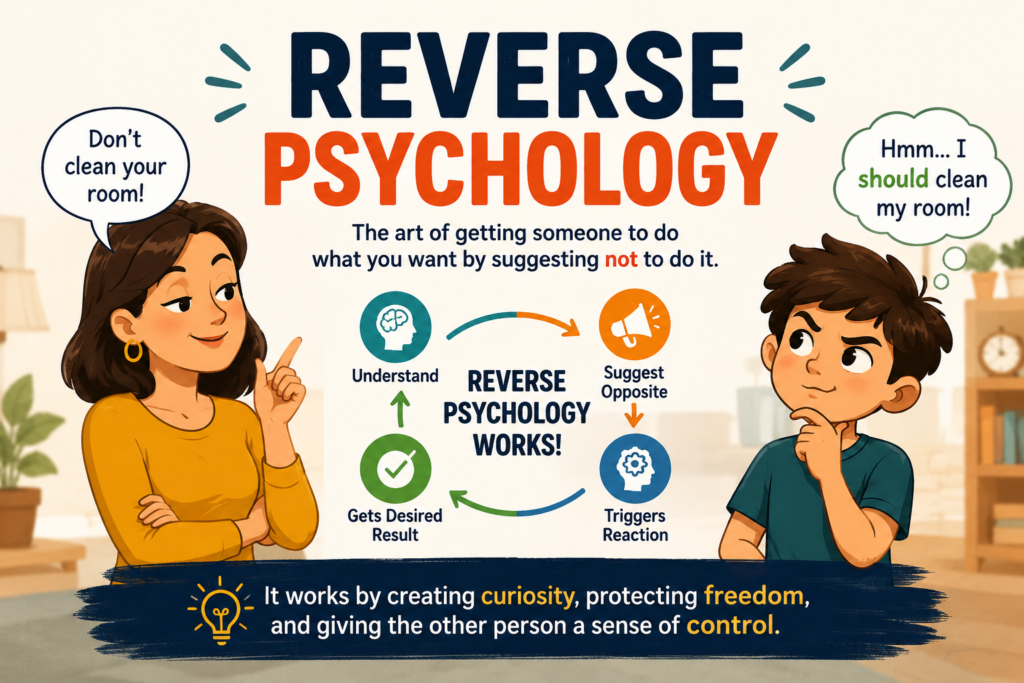
Reverse psychology is a persuasion technique where a person encourages someone to do the opposite of what they actually want, expecting that the individual will resist the suggestion and choose the desired behavior instead.
This strategy is based on a psychological phenomenon called reactance, which is the tendency for people to push back when they feel their freedom of choice is being threatened.
For example, a parent might say, “You probably won’t like these vegetables,” hoping the child will prove them wrong and try them.
While reverse psychology can sometimes be effective, it also raises questions about ethics, trust, and manipulation. Understanding how it works can help you recognize when it’s being used and decide whether it’s an appropriate tactic in different situations.
Quick Answer: What Is Reverse Psychology?
Reverse psychology is a method of influencing someone’s behavior by suggesting the opposite of what you want them to do. It relies on a person’s desire to maintain independence and make their own choices.
Example:
Instead of saying:
“You should read this book.”
Someone using reverse psychology might say:
“This book is probably too complicated for you.”
The goal is to spark curiosity or resistance, motivating the person to read the book anyway.
How Does Reverse Psychology Work?
At its core, reverse psychology works because many people dislike feeling controlled.
When individuals sense that someone is trying to restrict their choices, they often experience psychological reactance—a motivational response that pushes them to reclaim their freedom.
The process typically looks like this:
- A person makes a suggestion opposite to their actual goal.
- The other person perceives pressure or a challenge.
- They react by asserting their independence.
- They choose the behavior the first person wanted all along.
Example
Imagine a teenager who refuses to clean their room.
A parent might say:
“Don’t worry about cleaning it. It’s probably impossible for you anyway.”
The teenager may feel challenged and decide to clean the room to prove the parent wrong.
This reaction occurs because the teenager wants to maintain autonomy and demonstrate capability.
The Psychology Behind Reverse Psychology
Reverse psychology is closely linked to psychological reactance theory, developed by psychologist Jack Brehm.
According to the theory, people value their freedom to choose. When that freedom seems threatened, they often act to restore it.
Several factors influence whether reverse psychology works:
Personality
People with strong independent personalities are more likely to resist direct instructions and respond to reverse psychology.
Age
Children, teenagers, and young adults may be more susceptible because they often seek independence and autonomy.
Situation
Reverse psychology tends to work best when the stakes are low and the person already has some interest in the suggested behavior.
Relationship Dynamics
The technique is often more effective when trust exists between the people involved.
What Is Reverse Psychology Example?
To better understand the concept, let’s look at real-life examples.
Example 1: Parenting
A parent says:
“I don’t think you’re ready to ride this bike yet.”
The child becomes determined to prove otherwise and practices more.
Example 2: Marketing
A company advertises:
“Not everyone can appreciate this premium product.”
Consumers may become curious and want to see whether they belong to the select group.
Example 3: Education
A teacher says:
“This puzzle is very difficult. Most students won’t solve it.”
Students become motivated to prove the statement wrong.
Example 4: Friendships
A friend says:
“You probably wouldn’t enjoy that restaurant.”
The other friend becomes curious and decides to try it.
How to Use Reverse Psychology
Many people wonder how to use reverse psychology effectively without damaging relationships.
Here are some practical guidelines.
1. Know Your Audience
Reverse psychology works best on people who value independence and dislike being told what to do.
2. Avoid Overusing It
Using this technique repeatedly can make others suspicious and reduce its effectiveness.
3. Keep the Stakes Low
It should not be used for major decisions involving health, finances, or important life choices.
4. Stay Respectful
The goal should never be to embarrass, manipulate, or deceive someone.
5. Understand Their Motivations
Successful reverse psychology relies on accurately predicting how someone will react.
Reverse Psychology When Someone Ignores You
One of the most searched questions online is reverse psychology when someone ignores you.
When someone ignores messages, calls, or attempts to communicate, some people believe reverse psychology can help regain attention.
Examples include:
- Stopping repeated messages.
- Giving the person space.
- Appearing less emotionally dependent.
- Focusing on your own activities rather than seeking validation.
The idea is that withdrawing attention may increase curiosity or encourage the other person to reconnect.
However, there is an important distinction:
Healthy distance is not the same as manipulation.
If your goal is simply to trigger jealousy, guilt, or anxiety, the tactic can become unhealthy and damage trust.
In relationships, honest communication is generally more effective than psychological games.
Reverse Psychology in Romantic Relationships
Reverse psychology often appears in dating and relationships.
Examples include:
- Acting less available to increase perceived value.
- Suggesting a partner doesn’t need to attend an event.
- Expressing indifference to provoke interest.
While these tactics may occasionally influence behavior, they carry significant risks.
Healthy relationships thrive on:
- Trust
- Transparency
- Communication
- Mutual respect
Relying heavily on reverse psychology can create confusion, misunderstandings, and emotional distance.
Better Alternative
Instead of saying:
“You don’t have to spend time with me.”
Try:
“I’d really enjoy spending time together this weekend.”
Direct communication usually produces healthier long-term outcomes.
Is Reverse Psychology Manipulation?
Another common question is:
Is reverse psychology manipulation?
The answer depends on intent and context.
Reverse psychology can be considered a form of manipulation because it attempts to influence behavior indirectly rather than openly.
However, not all influence is harmful.
When It May Be Acceptable
- Encouraging a child to try new foods.
- Motivating students to tackle challenges.
- Using playful persuasion among friends.
When It Becomes Problematic
- Creating guilt intentionally.
- Exploiting insecurities.
- Controlling someone’s decisions.
- Deceiving people for personal gain.
A useful rule is to ask:
Would I be comfortable if the other person knew exactly what I was trying to accomplish?
If the answer is no, the tactic may cross ethical boundaries.
Situations Where Reverse Psychology Often Works
Reverse psychology tends to be more successful when:
The Person Is Naturally Rebellious
People who resist authority often react strongly against direct instructions.
The Desired Action Is Reasonable
The technique works better when the request aligns with the person’s interests.
The Consequences Are Minor
Low-risk situations encourage experimentation and independence.
There Is Existing Trust
People are more receptive when they feel respected rather than controlled.
When Reverse Psychology Backfires
Reverse psychology is not foolproof.
In fact, it can fail dramatically.
The Person Agrees With You
If you say:
“Don’t bother applying for the job.”
They may simply decide not to apply.
They Recognize the Strategy
Once people realize they’re being manipulated, trust can decline.
It Creates Resentment
Repeated use can make others feel controlled.
The Stakes Are Too High
Important decisions require honesty and transparency rather than indirect persuasion.
Pros and Cons of Reverse Psychology
| Pros | Cons |
| Can motivate independent thinkers | May damage trust |
| Encourages autonomy | Can be manipulative |
| Useful in some parenting situations | Often backfires |
| Can increase curiosity | Creates misunderstandings |
| Sometimes effective with resistant individuals | Not suitable for serious decisions |
Signs Someone Is Using Reverse Psychology on You
You may be experiencing reverse psychology if someone:
- Frequently tells you not to do things they secretly support.
- Challenges your abilities to provoke action.
- Appears indifferent while expecting a response.
- Uses statements designed to trigger resistance.
- Often says the opposite of what they truly want.
Recognizing these patterns can help you make decisions based on your own judgment rather than emotional reactions.
Healthier Alternatives to Reverse Psychology
Instead of relying on indirect tactics, consider:
Open Communication
Clearly express your needs and expectations.
Positive Reinforcement
Reward desired behaviors rather than provoking resistance.
Collaboration
Work together toward shared goals.
Active Listening
Understanding another person’s perspective often produces better results than attempting to influence them indirectly.
Frequently Asked Questions
What is reverse psychology in simple terms?
Reverse psychology is a technique where someone suggests the opposite of what they want, hoping the other person will choose the desired action.
How does reverse psychology work?
It works by triggering psychological reactance, a natural tendency to resist perceived attempts to control behavior.
What is reverse psychology example?
A parent saying, “You probably won’t eat these vegetables,” hoping the child will try them to prove otherwise.
Is reverse psychology manipulation?
It can be. Whether it is ethical depends on the intention, honesty, and impact on the other person.
Does reverse psychology work in relationships?
Sometimes, but direct communication is usually healthier and more effective for long-term relationship success.
Can reverse psychology backfire?
Yes. The person may agree with the opposite suggestion, recognize the tactic, or lose trust in the relationship.
Final Thoughts
Reverse psychology is a fascinating persuasion technique that relies on people’s desire for independence and freedom of choice. By suggesting the opposite of what is actually desired, a person hopes to trigger resistance and encourage a specific behavior.
Understanding what reverse psychology is, how it works, and whether it is manipulation can help you use the concept more responsibly or recognize when others are using it on you.
Although it can occasionally be effective in parenting, education, marketing, and relationships, it should never replace honest communication, mutual respect, and trust. In most situations, direct and transparent conversations remain the strongest foundation for healthy interactions.

Maria holds an MS in Psychology with a specialization in Social Psychology. She is a research-oriented writer with a strong academic background in psychological and behavioral sciences. Her work focuses on bridging academic research and public understanding by simplifying complex psychological theories and social dynamics. She writes about the relationship between society, mental health, and human behavior, making evidence-based ideas more accessible and practical for readers.