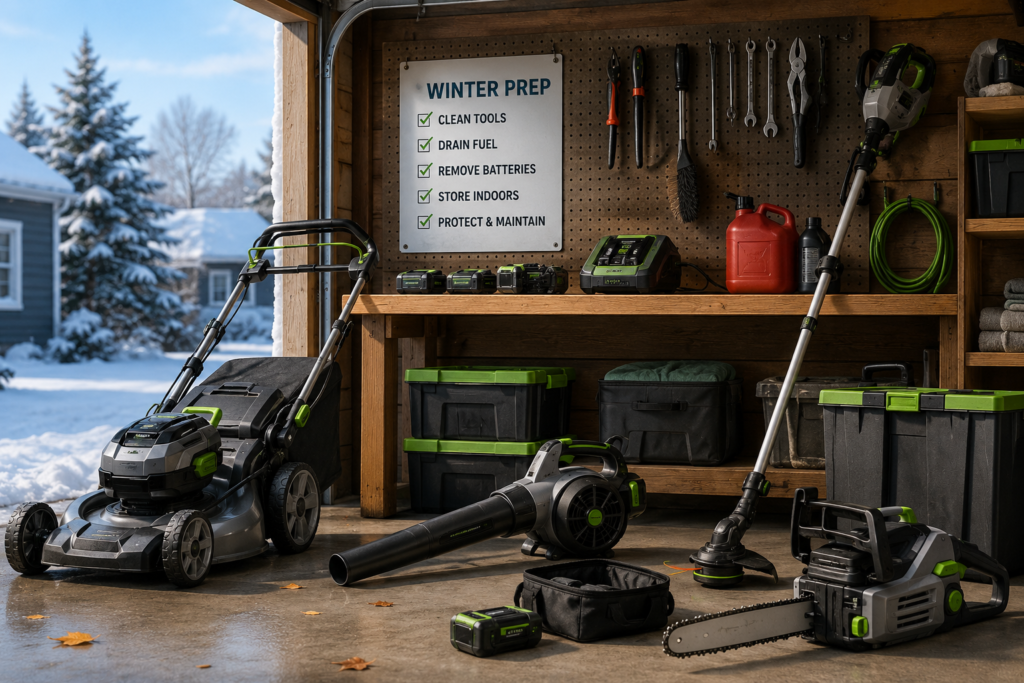
As winter approaches, smart Canadian homeowners know that preparing their homes involves more than clearing gutters and sealing drafts. It also means protecting valuable outdoor power tools from months of freezing temperatures, moisture, snow, and ice. Whether you rely on a lawn mower, leaf blower, chainsaw, or string trimmer, proper winter storage can significantly extend the life of your equipment and reduce expensive repairs when spring arrives.
Yet many homeowners postpone this task until the first snowfall or skip it altogether. Interestingly, psychology helps explain why. People naturally underestimate future risks, delay maintenance tasks that do not provide immediate rewards, and assume their equipment will be “fine” until next season. The homeowners who consistently protect their outdoor power tools before winter are often the ones who develop proactive maintenance habits and think long term about protecting their investments.
From fuel stabilization and battery care to rust prevention and smart storage practices, this guide explains how to safely store outdoor power tools for a Canadian winter while exploring the behavioral habits that make winter maintenance successful.
Why Your Brain Encourages Costly Mistakes
Most homeowners understand that winter can damage outdoor power tools, yet many still leave maintenance until the last minute. Psychology offers several explanations for this behavior.
One common reason is optimism bias, the tendency to believe that negative outcomes are less likely to happen to us than to others. A homeowner may assume their lawn mower battery will survive the winter because it worked fine last year, even though freezing temperatures can permanently reduce battery performance.
Another factor is present bias, where people prioritize immediate convenience over future benefits. Draining fuel tanks, cleaning mower decks, or removing batteries may only take a few minutes, but because the reward will not be seen until spring, the task often gets postponed.
There is also the tendency to underestimate gradual damage. Rust, fuel degradation, and battery deterioration occur slowly and out of sight, making them easy to ignore. Unfortunately, these small issues often turn into expensive repairs or replacement costs when the warmer months return.
Understanding these psychological tendencies can help homeowners make better decisions and take preventive action before winter weather arrives.
How to Safely Store Outdoor Power Tools Before a Canadian Winter
1. Winterizing Gas-Powered Tools: Prevent Fuel Degradation
If your garage is still stocked with traditional gas-powered equipment, your primary winterization priority is draining the fuel. Winter in Canada can stretch from 4 to 6 months. Regular gasoline left sitting in a tank for more than 30 days begins to degrade, forming a gummy residue that clogs the carburetor and prevents the engine from firing up when spring arrives.
- Empty the Fuel Tank: After your final autumn cleanup, run the tool until it completely runs out of gas. Alternatively, use a fuel siphon pump to drain the remaining gas, then start the engine and let it idle until it stalls out on its own, ensuring no residual fuel is left in the carburetor.
- Use a Fuel Stabilizer: If you must store the tool with some fuel left inside, add a proper amount of fuel stabilizer. Run the engine for 5 to 10 minutes to allow the treated fuel to circulate through the entire fuel system.
- Change the Oil and Spark Plugs: Late autumn is the perfect time for an oil change, as dirty oil contains acids and contaminants that can corrode internal engine components over months of storage. It is also recommended to remove the spark plug, pour a few drops of clean engine oil into the cylinder, pull the starter rope a few times to lubricate the cylinder walls, and then reinsert the plug.
2. The Golden Rules for Cordless Battery Tools: Disconnect and Temperature Control
In recent years, high-performance cordless lithium-ion yard tools have spiked in popularity among Canadian homeowners due to their low maintenance, eco-friendly nature, and quiet operation. However, lithium-ion batteries are highly sensitive to extreme cold. Leaving them exposed to sub-zero temperatures can cause irreversible damage to their internal chemical structure, drastically reducing battery capacity or killing them entirely.
A Smart, Low-Maintenance Choice: MOVA 60V Cordless Garden & Yard Tools
If you are looking for top-tier performance that takes the headache out of winter maintenance, consider upgrading to MOVA 60V Cordless Lawn & Garden Equipment. Designed specifically for heavy-duty Canadian yard care, MOVA’s advanced cordless lineup includes high-efficiency brushless lawn mowers, powerful leaf blowers, and precise string trimmers. Unlike gas equipment that requires tedious fuel draining and spark plug swaps, the MOVA 60V battery ecosystem makes winter prep incredibly simple. Just bring the battery indoors, and you are good to go—no engine maintenance required. Plus, enjoy fast shipping and dedicated support across Canada!
For cordless outdoor power tools, always follow these three steps for disconnection and temperature control:
- Disconnect and Separate: Never leave a battery clicked into a tool over the winter. Always remove the lithium-ion battery from your mower or blower and store it separately in a dry environment to prevent parasitic electronic drains from completely depleting the battery.
- Optimize Storage Charge: Lithium-ion batteries should never be stored completely full or entirely dead. The ideal “hibernation” charge level is between 40% and 60% (typically 2 to 3 bars on the battery indicator). Storing a battery at 100% accelerates aging, while storing it at 0% can cause it to fall into a deep discharge state, rendering it unchargeable.
- Move to a Temperature-Controlled Environment: While your lawn mower or tool chassis can stay in an unheated outdoor shed or detached garage, you must bring the batteries and chargers indoors. Store them in a basement, utility closet, or an attached, heated garage where temperatures stay between 10°C and 25°C. Never allow them to freeze in Canada’s brutal sub-zero weather.
3. Protecting Mechanical Components from Rust and Freezing
Beyond the power source (gas or battery), the mechanical body of your tools requires meticulous care. Canadian winters bring high humidity and corrosive road salt, which can quickly lead to rusted metal and brittle plastic parts.
- Deep Clean: Before storage, use a brush and a damp cloth to thoroughly scrape away caked-on grass clippings, mud, and debris from underneath your mower deck. Decaying grass holds moisture and acids that rapidly corrode metal parts. Always let the tools dry completely after cleaning.
- Apply Lubrication: Spray a thin layer of rust-preventative lubricant (such as WD-40) on all exposed metal components, mower blades, trimmer shafts, bearings, and springs. This creates a barrier against airborne moisture and prevents oxidation.
- Inspect and Sharpen: Take advantage of the winter downtime to inspect your mower blades or chainsaw chains for wear. You can remove and sharpen them yourself or take them to a local service shop during the off-season, so your tools are sharp and ready to work the moment the snow melts.
How Behavioral Habits Affect Winter Maintenance Success
Research in behavioral psychology shows that successful maintenance is often less about knowledge and more about habits. Most homeowners already know they should protect their outdoor power tools before winter. The difference lies in whether they have a system that turns that knowledge into action.
Smart homeowners often use simple habit-building strategies, such as creating an end-of-season maintenance checklist, scheduling tool maintenance on the same weekend every year, or storing batteries indoors immediately after the final yard cleanup. These routines reduce the need for decision-making and make proper maintenance automatic.
Behavioral scientists refer to this as habit stacking, attaching a new behavior to an existing routine. For example, after completing the final leaf cleanup of the season, a homeowner can immediately clean equipment, drain fuel, and move batteries indoors. Over time, these actions become a regular part of winter preparation.
The result is not only better-protected equipment but also lower ownership costs, fewer springtime repairs, and greater confidence that outdoor power tools will be ready to perform when the snow finally melts.
Conclusion: Care for Today, an Easy Start Tomorrow
When dealing with a long, frozen Canadian winter, taking care of your outdoor power tools is a necessity, not an option. By sticking to a strict routine completely draining gas engines, bringing cordless batteries indoors, and thoroughly cleaning and lubricating mechanical parts you protect your investment from the elements. Come spring, your tools will start up effortlessly at the first push of a button, letting you get straight to enjoying a beautiful, healthy yard.
*This article is written by gardening and smart home technology experts. To discover high-efficiency, hassle-free yard care solutions across Canada, visit the official MOVA CA store.

Maria holds an MS in Psychology with a specialization in Social Psychology. She is a research-oriented writer with a strong academic background in psychological and behavioral sciences. Her work focuses on bridging academic research and public understanding by simplifying complex psychological theories and social dynamics. She writes about the relationship between society, mental health, and human behavior, making evidence-based ideas more accessible and practical for readers.