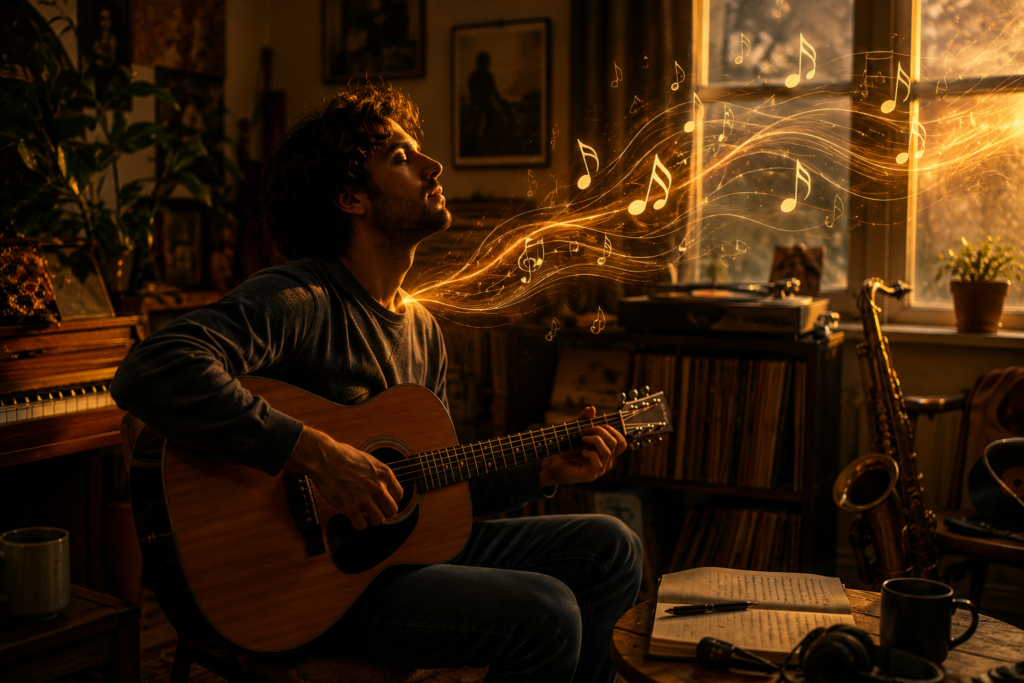
There is a reason people say music heals the soul. Certain jazz records feel like a slow exhale after a long day. John Coltrane’s A Love Supreme does not just move through scales; it moves through something closer to prayer. Kenny G’s smooth soprano lines, for all their commercial polish, have soundtracked countless anxious commutes and restless nights. The science behind why music affects us so deeply is still evolving, but the feeling is nearly universal. Music has a unique ability to soothe, comfort, and connect with emotions that words often fail to express. It bypasses the thinking brain and lands somewhere softer, somewhere pre-verbal, offering a sense of calm that many people instinctively seek during difficult times.
That comfort is not passive. For the musicians who create it, music is often the only reliable anchor in a life of chaos. Eric Clapton wrote his way through loss and dependency, funneling the wreckage into “Layla” and a hundred other songs that still feel raw decades later. Mariah Carey has spoken openly about using music as a lifeline during dark periods, describing the studio as a sanctuary when nothing else made sense. The pattern repeats across genres. The very thing that takes such a heavy toll on so many artists, the road, the party, the pressure, becomes the thing that saves others when they finally learn to separate the craft from the crash.
That tension is what makes a recent discovery so quietly radical.
An Unlikely Find in the New Jersey Woods
While reporting on alternative approaches to mental wellness, a friend mentioned a recovery house in Voorhees, New Jersey. The description was odd enough to warrant a visit. A residence filled with instruments, two grand pianos, a collection of guitars, a cajon drum, and a basement converted into a fully soundproofed creative bunker. Outside, a pool and a sprawling backyard ringed by mature trees. The person running the place called it Muse Sober Living, but the name hardly matters. What matters is the concept: infusing music into early recovery as a core fundamental, not an afterthought.
This is not a treatment facility. There are no clinicians on staff, no whiteboards with daily affirmations. It is a peer-led home for people navigating the precarious first months of rebuilding their lives. But unlike most transitional recovery residences, which tend to strip away everything familiar, this sober living home offers a truly unique and bright atmosphere. The home actively encourages residents to experiment with the in-house instruments or bring their own, to play freely, to write, to record, to make a mess of sound in a sound proofed basement that will not bother anyone.
The logic is almost embarrassingly simple. If music provided comfort and an oasis of mental wellness during the hardest times of using, why would it not provide comfort during the hardest times of stopping?
The Grim Math of Creativity and Crash
The backdrop here is uncomfortable but necessary. Addiction has always run a parallel track alongside creative culture. Charlie Parker, Billie Holiday, Kurt Cobain, Amy Winehouse. The list is not a curiosity. It is a graveyard. Musicians have a huge attraction to drugs, alcohol and the fast life. Almost always tasked with irregular schedules, easy access to substances, a culture that romanticizes the tortured artist, and the often brutal loneliness of touring. For every Clapton who finds his way out, a dozen others never get the chance.
The party life is seductive at first. Late nights become identity. A drink before a set becomes a ritual. A pill to come down becomes a necessity. Somewhere in that slide, the art and the substance become entangled. The musician stops knowing where the inspiration ends and the dependence begins. That entanglement is precisely why standard recovery models often fail creative people. Asking a guitarist to stop playing for ninety days is like asking a fish to stop swimming. It is not a break. It is an existential crisis.
A Different Prescription for Mental Wellness
Muse Sober Living for Artists of all sorts does not claim to have solved addiction. What it offers is a niche community. The house integrates principles of mental wellness that are often ignored in traditional settings: sensory regulation, creative flow, and the restorative power of nature. The pool and the trees are not amenities. They are tools for resetting an overstimulated nervous system. The soundproofed basement is, however, truly a luxury. But more importantly, it is a permission slip to be loud, angry, sad, or ecstatic without judgment.
For a musician in early recovery, having access to a space where you can play a grand piano at midnight without waking anyone is not trivial. It is a lifeline. Playing an instrument activates the same reward pathways that substances hijack, but in a sustainable way. Dopamine is released upon mastering a difficult passage. Oxytocin rises during a collaborative jam session. Endorphins spike after a cathartic drum session on that cajon. These are not just pleasant feelings. They are biological alternatives to the chemical rush of using.
The house also leans heavily on the social dynamics of creative communities. Isolating is a major relapse trigger. But forced socializing in an unfamiliar setting can be a stressor in itself. At Muse, residents bond over shared projects. A songwriter needs a bassist. A guitarist wants feedback on a new riff. The collaboration feels natural because it is grounded in the very identity that brought them there. This is how addiction recovery for musicians and artists is progressing in 2026 and beyond possibly. A sober community designed by people who understand that a jam session can be as enticing as it was in the former life, sometimes more.
The Delicate Balance of Structure and Freedom
Of course, music alone is not a plan. The residence still operates with rules, house meetings, drug testing, and accountability structures. Residents are expected to contribute to chores, maintain employment or actively seek it, and attend outside recovery meetings. The difference is that after those obligations are met, there is no blank wall of boredom. There is a basement full of instruments and a backyard with a pool.
One current resident, a jazz pianist who asked to remain anonymous, described the difference this way. “In a standard halfway house, you sit around watching TV or staring at your phone. That idle time is dangerous. Here, I could go downstairs and just play. After a few weeks, I realized I was practicing more than I ever had while using. The music came back before I did, and it carried me the rest of the way.”
That is not a sentimental story. It is a practical one. The house essentially provides a substitute behavior that is already deeply rewarding to the person. That is the holy grail of behavioral change. Not white knuckling through cravings, but replacing the destructive habit with a creative one that feels even better.
A Model Worth Watching
Muse is not the first to try this approach, but it may be one of the most fully realized examples of sober living for artists and musicians in the northeastern United States. The combination of high-quality instruments, a soundproofed space, and a natural outdoor environment creates a rare triad. Most recovery residences have one of those elements at best. Very few have all three.
There are limitations, of course. The house is already in strong demand. It seemed that when I visited in early June, there was a private room open and one bed in a semi-private room, according to the house manager, Matt. It’s not just for musicians; they also encourage those with an appreciation for the arts in general. A resident sat drawing on what seemed like a type of paper an architect or an advanced artist would use. So for the right person, for the guitarist who has cycled through three programs and relapsed each time because no one let them play, this could be an even more attractive experience.
The larger lesson is about mental wellness itself. Wellness is not the absence of struggle. It is the presence of meaningful engagement. Music provides that engagement in a way that few other activities can. It is rhythmic, social, physically demanding, emotionally expressive, and structurally complex. All of those features are protective against relapse.
The Final Note
John Coltrane once said that he wanted to make music that was a force for good. He was talking about spirituality, but the sentiment applies here. There is something quietly revolutionary about handing a recovering musician a guitar instead of a workbook. About saying, “Go ahead. Make some noise. Create and release.”
In a field that often prizes uniformity and protocol, that message is worth repeating. Comfort comes from unexpected places. For some, it comes from a house with two grand pianos, a cajon drum, and the sound of leaves rustling outside the window. For others, it comes from a pool on a summer afternoon. What experiences like these remind us is that music heals the soul in ways that are deeply personal and often impossible to measure. Muse Sober Living simply had the good sense to create an environment where healing, creativity, and self-discovery could coexist. The rest is up to the person holding the instrument and finding their own path through the music.
Read more: The Role of Art & Music Therapy for Autism

Maria holds an MS in Psychology with a specialization in Social Psychology. She is a research-oriented writer with a strong academic background in psychological and behavioral sciences. Her work focuses on bridging academic research and public understanding by simplifying complex psychological theories and social dynamics. She writes about the relationship between society, mental health, and human behavior, making evidence-based ideas more accessible and practical for readers.