Are Robot Lawn Mowers Worth It in Canada?
Yes, robot lawn mowers are worth it for many Canadian homeowners, especially those who value their time, want to reduce weekly chores, and prefer a healthier lawn with less ongoing maintenance. Beyond the financial savings, robotic mowers can reduce mental load, decision fatigue, and the stress associated with repetitive household tasks.
Every Hour You Save Changes More Than Your Schedule
Modern life has changed the way we think about time. Between demanding careers, family responsibilities, social commitments, and the endless list of household chores, many people feel like there simply aren’t enough hours in the day.
Psychologists describe this constant pressure as mental load—the invisible effort involved in remembering, planning, organizing, and completing everyday responsibilities. While each task may seem small, they accumulate over time and contribute to chronic stress, decision fatigue, and reduced life satisfaction.
Research in behavioral psychology suggests that people experience greater well-being when repetitive, low-value tasks are reduced or automated. Instead of spending weekends catching up on chores, they gain more opportunities to relax, spend time with family, exercise, or pursue meaningful hobbies.
One of the most repetitive household responsibilities for Canadian homeowners is lawn maintenance.
Every spring, millions of Canadians dust off their lawn mowers knowing that the next five or six months will involve weekly—or sometimes twice-weekly—grass cutting. While maintaining a beautiful yard is rewarding, the ongoing commitment can quietly consume dozens of hours every summer.
That raises an increasingly common question:
Are Robot Lawn Mowers Worth It in Canada?
The answer isn’t based solely on price.
It also depends on how much you value your personal time, how often you mow your lawn, your property’s layout, and whether reducing repetitive chores improves your overall quality of life.
This guide explores robotic lawn mowers from both practical and psychological perspectives, helping you determine whether investing in automation is worthwhile for Canadian conditions.
Why Our Brains Love Automation
Humans naturally seek efficiency.
Behavioral economists have long observed that people continuously look for ways to reduce physical effort and simplify routine decisions. This isn’t laziness—it’s how the brain conserves cognitive energy.
Every recurring task requires attention:
- When should I mow?
- Is it going to rain?
- Do I have enough fuel?
- Is the blade sharp?
- Do I have enough free time today?
Individually, these questions seem insignificant.
Collectively, they create what psychologists call decision fatigue.
Decision fatigue occurs when the brain becomes overwhelmed by the sheer number of choices we make throughout the day. Studies have shown that reducing unnecessary decisions leaves more mental energy for important work, relationships, creativity, and relaxation.
Automating predictable household chores removes dozens of these small decisions every month.
Instead of planning your weekend around lawn care, your lawn simply stays maintained in the background.
This psychological benefit is often overlooked when comparing robotic lawn mowers to traditional equipment.
The True Cost of Traditional Canadian Lawn Maintenance
Traditional lawn care involves much more than simply buying a mower.
Whether hiring professionals or maintaining your own equipment, expenses accumulate every year.
| Lawn Maintenance Option | Estimated Cost / Effort | Notes & Impact |
| Professional Mowing Service | $1,000–$2,240 CAD per season | Based on $45–$80 per visit over a 22–26 week growing season. |
| Gas Mower Fuel & Servicing | $350–$500 CAD annually | Includes fuel, oil, spark plugs, filters, sharpening, and maintenance. |
| Personal Time Invested | 30–60 hours each summer | Based on mowing an average property once or twice weekly. |
Although these numbers vary depending on yard size and region, they illustrate that lawn care is far from a one-time expense.
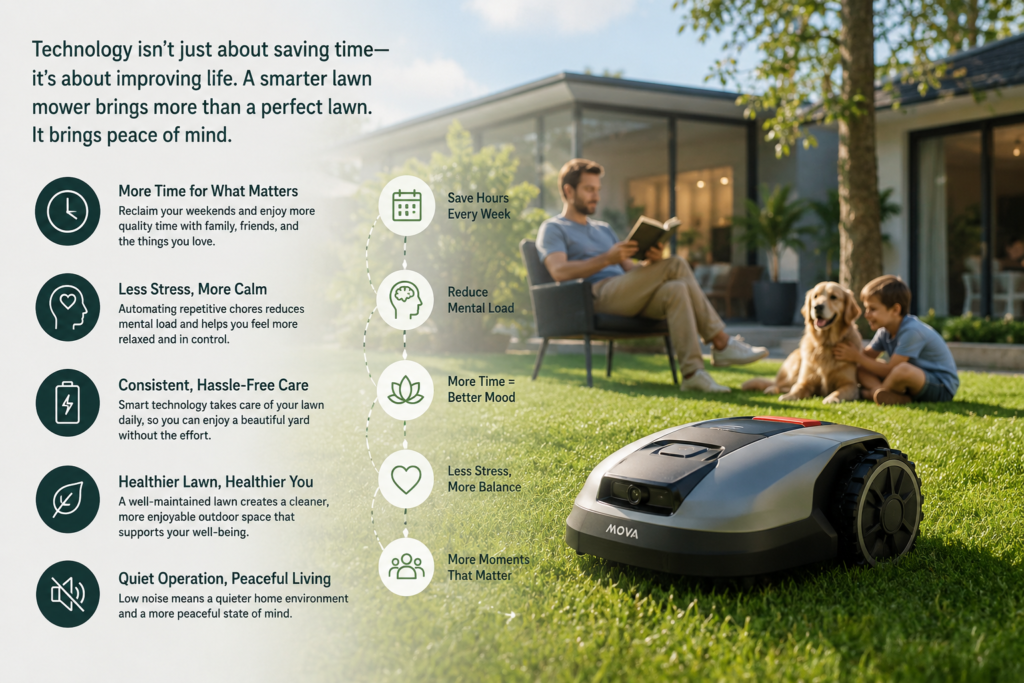
Option 1: Hiring Professional Lawn Services
For homeowners with busy schedules, outsourcing lawn maintenance can be appealing.
Across many Canadian suburban communities, professional mowing services typically charge between $45 and $80 CAD per visit.
Over a typical 22–26 week growing season, annual expenses often range from $1,000 to more than $2,200 CAD.
Over five years, homeowners may spend anywhere between $5,000 and $11,200 CAD, yet own no equipment at the end of that period.
Professional services certainly eliminate the physical work, but they also create recurring yearly costs that continue indefinitely.
Option 2: Conventional Gas or Push Mowers
Buying your own mower initially appears to be the more economical choice.
A quality gas mower generally costs between $400 and $800 CAD.
However, ownership includes ongoing expenses such as:
- Fuel
- Engine oil
- Air filters
- Spark plugs
- Blade sharpening
- Replacement blades
- Winter fuel stabilizers
- Seasonal servicing
Combined, these routine maintenance costs typically total $350–$500 CAD every year, depending on usage.
Additionally, gas mowers require storage space, regular cleaning, and manual operation throughout the growing season.
The Unseen Cost: Your Time
Money isn’t the only resource homeowners spend.
Time is often the most valuable investment.
Maintaining an average quarter-acre property typically requires around 90 minutes per mowing session, including trimming edges, cleaning equipment, and putting everything away.
During periods of rapid grass growth, many Canadians mow twice each week.
Over one summer, that adds up to approximately 35–50 hours spent on lawn maintenance.
Viewed differently, that’s:
- A full working week.
- More than a hundred family meals.
- Dozens of workouts.
- Several weekend trips.
- Hundreds of pages of books.
- Countless hours of relaxation.
Psychologically, reclaiming this time can have a meaningful impact on stress levels and overall well-being (source).
Instead of feeling obligated to mow whenever the weather allows, homeowners gain greater flexibility over how they spend their weekends.
The Long-Term Value of Automation
Looking Beyond the Price Tag
When considering a robotic lawn mower, many homeowners focus on the upfront purchase price. While that initial investment is important, it tells only part of the story.
From a behavioral psychology perspective, people naturally give more weight to immediate costs than future savings—a phenomenon known as present bias. We often hesitate to spend more today, even if doing so leads to significant financial and personal benefits over the coming years.
This is why many homeowners continue using traditional lawn care methods despite spending hundreds or even thousands of dollars every year on fuel, maintenance, or professional services.
The better question isn’t “How much does a robot mower cost in Canada?”
Instead, ask:
“How much will this decision cost me over the next five years?”
Calculating the Long-Term Value of Automation
Although robotic lawn mowers generally cost between $1,100 and $3,500 CAD, depending on yard size and features, their ongoing operating expenses are remarkably low.
When comparing ownership over several years, automation becomes far more competitive than many people initially expect.
| Option | Estimated 5-Year Cost | Overall Value |
| Professional Lawn Service | $5,000–$11,200 CAD | Highest long-term cost with no equipment ownership |
| Gas Mower Ownership | $2,150–$3,300 CAD | Lower initial investment but recurring maintenance and personal labor |
| Smart Robotic Mower | $1,600–$3,200 CAD | Higher upfront cost offset by minimal maintenance and substantial time savings |
For homeowners already paying for weekly lawn services, a quality robotic mower may recover its purchase price within one to two mowing seasons.
Electricity vs. Fuel: A Smaller Difference Than Many Expect
One common misconception is that robotic mowers are expensive to operate.
In reality, most models consume relatively little electricity.
Running a robotic mower throughout an entire Canadian growing season typically costs between $20 and $35 CAD in electricity, depending on local utility rates and lawn size.
Compare that with a traditional gas mower, which requires:
- Gasoline
- Engine oil
- Spark plugs
- Air filters
- Seasonal tune-ups
- Blade sharpening
- Winter storage preparation
These recurring expenses can easily total $350–$500 CAD every year.
Besides saving money, electric operation also eliminates fuel storage, oil changes, and engine maintenance—tasks that many homeowners find inconvenient.
Minimal Maintenance Means Less Mental Load
Financial savings are only one side of the equation.
Psychologists often distinguish between physical work and mental work.
Even when mowing takes only an hour, homeowners still need to remember:
- When the lawn needs cutting
- Whether rain is coming
- If the mower has fuel
- Whether maintenance is overdue
- If the blades need sharpening
- When to schedule the chore
These ongoing reminders contribute to what psychologists call mental load—the invisible effort of managing everyday responsibilities.
Robotic lawn mowers significantly reduce this burden.
Once programmed, they follow a consistent schedule with minimal input from the homeowner. Instead of remembering another weekly task, the lawn simply remains maintained in the background.
For busy professionals, parents, and retirees alike, removing one recurring responsibility can make weekends feel noticeably less stressful.
The Psychology of Buying Back Your Time
Behavioral researchers frequently describe time as one of the few resources that cannot be replaced.
Money can be earned again.
Free time cannot.
Studies consistently show that people who spend money on products or services that save time often report greater life satisfaction than those who spend the same amount on material possessions.
A robotic lawn mower is not simply a landscaping tool.
For many homeowners, it represents an investment in:
- More family time
- Reduced weekend stress
- Greater flexibility
- Improved work-life balance
- Less physical fatigue
- Fewer recurring household responsibilities
While these benefits are difficult to assign a dollar value, they are often the reasons owners say they would never return to traditional mowing.
Can Robotic Lawn Mowers Handle Canadian Conditions?
Canada presents unique challenges for lawn care.
Long winters, spring frost, uneven terrain, heavy tree cover, and changing weather patterns all influence how well automated systems perform.
Fortunately, robotic mowing technology has evolved considerably over the past decade.
Today’s premium systems are specifically designed to overcome many of the limitations found in earlier generations.
Setup Hassles: Then and Now
One of the biggest concerns homeowners have is installation.
Older robotic lawn mowers required homeowners to bury perimeter wires around the entire lawn.
Although effective, this process could be time-consuming and presented several challenges in Canadian climates.
Winter frost heaves, soil movement, aeration, landscaping projects, and accidental digging could all damage underground wires, requiring repairs before the mowing season even began.
To solve this problem, manufacturers introduced RTK GPS navigation.
These systems eliminated perimeter wires by relying on satellite positioning.
However, RTK technology introduced its own limitations.
Dense tree canopies, nearby buildings, garages, and rooflines can occasionally interfere with satellite signals, reducing positioning accuracy in some environments.
The latest generation of robotic lawn mowers has moved beyond both approaches.
Instead of depending primarily on wires or satellite positioning, some premium models now combine 360° 3D LiDAR technology with AI-powered vision systems.
One example is the MOVA LiDAX Ultra 1000, which creates highly accurate three-dimensional maps of a property without requiring perimeter wires or constant satellite communication.
Because it relies on advanced environmental scanning, the system can continue navigating accurately even in shaded gardens, tree-covered yards, or areas where GPS signals are less reliable.
For homeowners looking to minimize installation time, this represents a significant improvement over earlier robotic mower designs.
Comparing Navigation Technologies
| Technology | Boundary Setup | Common Challenges in Canada |
| Perimeter Wire | Manual wire installation | Vulnerable to frost heaves, landscaping work, and accidental cuts |
| RTK GPS | Wireless satellite mapping | Signal interruptions beneath dense trees or near tall structures |
| 360° 3D LiDAR + AI Vision | Automatic visual mapping | Reliable operation in shade, around buildings, and without buried wires |
The right technology depends on your property’s layout, but advances in LiDAR-based navigation have made robotic mowing more practical for a wider range of Canadian homes.
Built for Uneven Terrain and Canadian Landscapes
Many Canadian properties are far from perfectly flat.
Seasonal freeze-thaw cycles can create uneven ground, exposed roots, drainage slopes, and rough patches that challenge conventional robotic mowers.
Lower-powered models may struggle on steep inclines or lose traction in damp conditions.
Modern premium systems have been designed with these environments in mind.
For example, the MOVA LiDAX Ultra 3000 AWD uses four independently powered hub motors to provide all-wheel drive capability. According to the manufacturer, this configuration allows it to climb slopes of up to 80% (38.6°) while also navigating over obstacles such as exposed tree roots or uneven ground.
Although not every homeowner requires this level of capability, those with larger or more complex landscapes may find all-wheel-drive systems particularly valuable.
Smarter Obstacle Detection for Safer Operation
Another common concern involves safety.
Parents and pet owners often wonder whether a robotic mower can safely operate around children’s toys, garden hoses, outdoor furniture, or family pets.
Earlier robotic mowers relied primarily on bump sensors, meaning they detected obstacles only after making contact.
Today’s premium models are considerably more sophisticated.
The MOVA LiDAX Ultra 2000, for example, combines 3D point cloud technology with an HDR camera system capable of recognizing more than 300 different obstacle types, including small objects measuring approximately two centimeters.
Rather than simply stopping after hitting an obstacle, the mower identifies it, plans an alternative route, and continues mowing efficiently.
For busy households, this added layer of intelligence provides greater confidence during everyday operation.
More Than Convenience: How Robotic Mowers Support a Healthier Lawn
When people think about robotic lawn mowers, they usually focus on the time they save. However, one of the biggest long-term advantages is something homeowners notice every day—a greener, healthier lawn.
Traditional gas mowers are typically used once every seven to ten days. During each mowing session, they remove a large portion of the grass blade, creating long clippings that often need to be collected or raked. These heavy clippings can block sunlight, reduce airflow, and create yellow patches if left on the lawn.
Robotic lawn mowers operate differently.
Instead of cutting large amounts of grass at once, they trim tiny amounts every day or every few days. These micro-clippings naturally decompose into the soil, returning valuable nutrients without creating noticeable piles of grass.
| Mowing Style | Clipping Size | Lawn Impact |
| Weekly Gas Mowing | Long, heavy clippings | Can stress grass, create clumps, and often requires bagging |
| Daily Robotic Mowing | Fine micro-clippings | Naturally fertilizes the lawn, improves moisture retention, and encourages thicker growth |
This continuous mulching process offers several advantages:
- Returns natural nutrients to the soil
- Improves moisture retention during hot weather
- Encourages stronger root development
- Reduces the need for chemical fertilizers
- Helps suppress weed growth by maintaining denser turf
- Creates a more consistently maintained appearance throughout the season
For homeowners who take pride in their outdoor spaces, healthier grass is another compelling reason to consider automation.
The Psychology of Convenience
Psychology isn’t only about understanding emotions—it also explains why certain technologies improve our quality of life.
Researchers have consistently found that people experience greater life satisfaction when they spend money on products or services that save time rather than simply purchasing luxury items.
Why?
Because convenience reduces daily friction.
Every repetitive task we eliminate frees attention for activities that provide greater happiness and fulfillment.
Imagine finishing work on a Friday afternoon and realizing:
- The lawn is already cut.
- The yard looks neat.
- There is no fuel to buy.
- No noisy mower to push.
- No grass bags to empty.
- No maintenance waiting in the garage.
That feeling represents more than convenience—it reduces stress before it even begins.
This is one reason smart home technology has become increasingly popular. People aren’t just buying gadgets; they’re investing in fewer responsibilities and more control over their time.
Who Should Consider a Robotic Lawn Mower?
Although robotic mowers offer many benefits, they aren’t the ideal solution for everyone.
You may benefit most if you:
- Have a busy work schedule.
- Want to spend more time with family.
- Own a small to medium-sized lawn.
- Prefer a consistently maintained yard.
- Already pay for professional mowing services.
- Want to reduce fuel consumption and engine maintenance.
- Appreciate smart home technology.
Who Might Not Need One?
A robotic mower may be less suitable if you:
- Mow only a few times each season.
- Own a rural property with several acres of unmanaged land.
- Enjoy mowing as a hobby or form of exercise.
- Rarely maintain your lawn.
- Have an extremely uneven property that exceeds your preferred mower’s specifications.
Choosing the right mower depends on your lawn size, terrain, budget, and lifestyle.
Choosing the Right Robotic Mower
Not all robotic lawn mowers offer the same capabilities.
When comparing models, consider features such as:
- Lawn size compatibility
- Navigation technology
- Obstacle detection
- Slope-climbing ability
- Battery life
- Mobile app controls
- Weather resistance
- Noise levels
- Theft protection
- Warranty and customer support
Premium models generally offer more advanced navigation and safety features, while entry-level models are often suitable for smaller, simpler lawns.
For homeowners dealing with dense tree cover, irregular property layouts, or significant elevation changes, technologies such as 360° LiDAR mapping, AI vision, and all-wheel drive may provide additional reliability.
The MOVA LiDAX Ultra series is one example of how robotic lawn mower technology has evolved beyond traditional perimeter-wire systems. By combining AI vision with 360° LiDAR mapping, these models simplify setup while maintaining accurate navigation in challenging environments, including shaded gardens and properties surrounded by trees or buildings.
Rather than relying solely on satellite positioning, the system continuously interprets its surroundings, allowing for consistent mowing performance in a wider range of Canadian conditions.
Frequently Asked Questions
Are robot lawn mowers worth the money in Canada?
For many homeowners, yes. When you consider long-term maintenance costs, reduced fuel expenses, time savings, and improved lawn health, robotic lawn mowers can provide excellent value—especially for those who currently pay for professional lawn care.
Can robotic lawn mowers handle Canadian winters?
No. Like most outdoor equipment, robotic mowers should be stored indoors during winter. Before the first snowfall, clean the mower, recharge the battery if recommended by the manufacturer, and store it in a dry location until spring.
Do robotic lawn mowers work in the rain?
Many modern robotic mowers are weather-resistant and can continue operating during light rain. However, some models include rain sensors that automatically return the mower to its charging station during heavy rainfall to protect both the lawn and the equipment.
Are robotic lawn mowers safe around children and pets?
Most modern robotic mowers include lift sensors, collision sensors, automatic blade-stop systems, and obstacle detection technology. Premium models equipped with AI vision and advanced cameras can identify many common obstacles before reaching them. Even so, adult supervision is always recommended when young children or pets are playing in the yard.
How much maintenance do robotic lawn mowers require?
Compared with gas-powered mowers, maintenance is minimal. Most owners simply replace the small cutting blades once or twice per season, clean the underside periodically, and inspect the wheels and sensors to ensure smooth operation.
Final Thoughts
For homeowners looking to reclaim their weekends while maintaining a healthy, attractive lawn, robotic lawn mowers offer far more than simple convenience.
They reduce recurring maintenance, eliminate many of the hidden costs associated with gas-powered equipment, and significantly decrease the time spent on one of summer’s most repetitive household chores.
From a psychological perspective, they also reduce mental load by removing another recurring responsibility from an already busy schedule. Instead of worrying about weather forecasts, fuel levels, and finding time to mow, homeowners gain greater flexibility to focus on what matters most.
Modern robotic mowers have also become considerably more capable than earlier generations. Features such as AI-powered navigation, 360° LiDAR mapping, advanced obstacle detection, and all-wheel-drive systems allow many premium models to perform reliably across a wide range of Canadian landscapes.
For homeowners with complex yards, the MOVA LiDAX Ultra series demonstrates how far robotic mowing technology has progressed, offering wire-free setup, intelligent navigation, and strong performance on uneven terrain. While it represents one of several advanced options available today, it highlights the direction smart lawn care technology is moving.
Ultimately, the answer to “Are robot lawn mowers worth it in Canada?” depends on how much you value your time.
If reducing stress, reclaiming 30 to 60 hours every summer, lowering long-term maintenance costs, and enjoying a consistently healthy lawn are priorities, then a robotic lawn mower is more than a landscaping tool—it is an investment in your home, your well-being, and your quality of life.

Maria holds an MS in Psychology with a specialization in Social Psychology. She is a research-oriented writer with a strong academic background in psychological and behavioral sciences. Her work focuses on bridging academic research and public understanding by simplifying complex psychological theories and social dynamics. She writes about the relationship between society, mental health, and human behavior, making evidence-based ideas more accessible and practical for readers.