Classical conditioning is a fundamental learning process in which your brain automatically links two stimuli so that something once neutral (like a sound, smell, or situation) starts triggering a reflexive response. It happens without conscious effort, shaping everything from your food cravings to your anxiety in certain places.
This article explains what classical conditioning is in plain language, walks through real-world examples, breaks down how it actually works step-by-step, and shows you where it shows up in therapy, advertising, addiction, and even your daily habits. You’ll also learn how it differs from operant conditioning and whether you can use it intentionally on yourself.
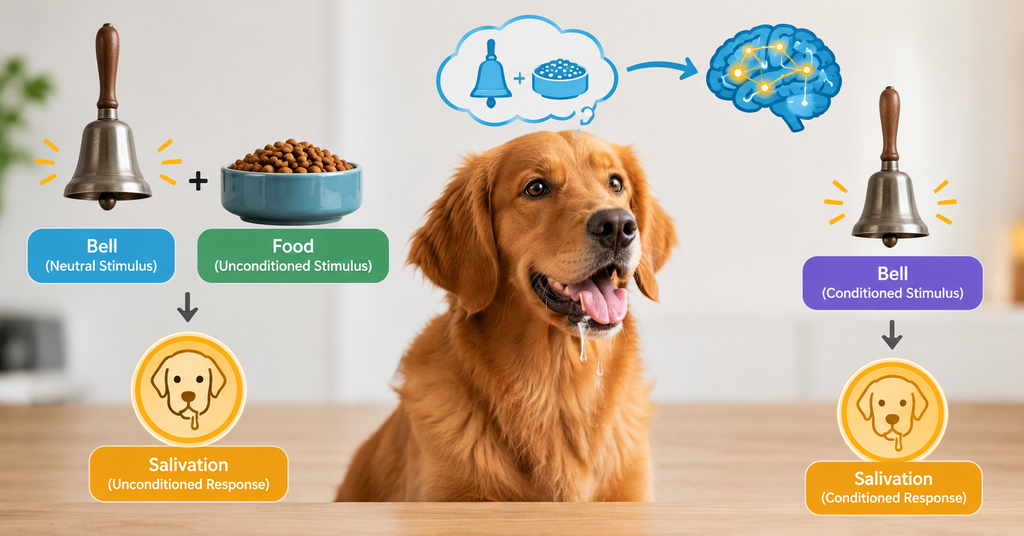
Table of Contents
What Is Classical Conditioning in Psychology?
Classical conditioning (also called Pavlovian or respondent conditioning) is a type of associative learning in which a neutral stimulus becomes associated with a biologically significant stimulus, eventually triggering a similar automatic response by itself.
In simpler terms: your brain learns that “X predicts Y,” so it starts reacting to X as if Y is already happening—even when Y isn’t there.
The Five Core Components
Understanding classical conditioning requires knowing five key terms. These appear in every textbook and research paper on the topic.
| Term | Definition | Real-World Example |
| Unconditioned Stimulus (UCS) | A stimulus that naturally and automatically triggers a response without prior learning | The smell of your favorite food |
| Unconditioned Response (UCR) | The automatic, unlearned reaction to the UCS | Salivating when you smell that food |
| Neutral Stimulus (NS) | A stimulus that initially produces no specific response | The sound of a notification ping |
| Conditioned Stimulus (CS) | The previously neutral stimulus that, after repeated pairing with the UCS, now triggers a response on its own | The notification ping after it’s repeatedly paired with receiving good news |
| Conditioned Response (CR) | The learned response to the CS | Feeling excited or anxious when you hear the ping, even before checking the message |
Classical conditioning is a learning process where a neutral stimulus is repeatedly paired with an unconditioned stimulus until the neutral stimulus alone triggers a similar automatic response.
This idea sits alongside other explanations of why people act the way they do. If you’re curious how personal traits, behavior, and environment continuously shape one another, it’s worth reading about reciprocal determinism, a theory that complements the more rigid stimulus-response view of classical conditioning.
Which Experiment Involves the Use of Classical Conditioning?
The most famous classical conditioning experiment is Ivan Pavlov’s dog study from the 1890s. Pavlov, a Russian physiologist studying digestion, noticed that dogs began salivating not just when food was presented, but at cues that reliably preceded feeding, like the sound of a bell or the lab assistant’s footsteps.
Pavlov’s Dog Experiment Breakdown
Here’s how the experiment unfolded in conditioning terms.
Before Conditioning:
- Neutral Stimulus: Bell sound → No salivation
- Unconditioned Stimulus: Food → Unconditioned Response: Salivation (natural reflex)
During Conditioning:
- Bell sound (NS) + Food (UCS) → Salivation (UCR)
- This pairing was repeated multiple times
After Conditioning:
- Conditioned Stimulus: Bell sound alone → Conditioned Response: Salivation
The dogs had learned: bell = food is coming, so their bodies prepared for digestion in advance.
The Little Albert Experiment
In 1920, psychologists John B. Watson and Rosalie Rayner demonstrated that classical conditioning could explain human emotional responses, specifically fear. Their subject, an infant known as “Little Albert,” was initially unafraid of a white rat.
During the experiment:
- UCS: Loud noise (hammer striking steel bar) → UCR: Fear/crying
- NS: White rat → No fear initially
- During conditioning: White rat + loud noise → Fear
- After conditioning: White rat alone → Fear (CR)
Albert’s fear also generalized to similar stimuli: rabbits, dogs, and even a Santa Claus mask. This study showed that phobias could be learned through association, though by modern ethical standards, the experiment would never be approved today.
This kind of gradual, reward-based behavior training is closely related to another core concept in behavioral psychology. If you want to see how trainers and therapists build up complex behaviors step by step, take a look at what shaping in psychology actually involves and how it differs from the simple pairing used in classical conditioning.
How Classical Conditioning Works: The Three Stages
Classical conditioning unfolds in three distinct phases. Understanding this timeline helps explain why some associations form quickly while others take weeks or never form at all.
Stage 1: Before Conditioning (Pre-Conditioning)
At this point, the organism has natural reflexes but hasn’t learned any new associations yet.
- The unconditioned stimulus (UCS) automatically produces the unconditioned response (UCR)
- The neutral stimulus (NS) produces no relevant response
Example: You’ve never had a bad experience with dentists. The sound of a dental drill (NS) means nothing to you. But pain from a cavity (UCS) naturally makes you flinch (UCR).
Stage 2: During Conditioning (Acquisition)
This is where learning happens. The neutral stimulus is repeatedly paired with the unconditioned stimulus.
Critical timing rule: For strongest conditioning, the NS should come before the UCS (ideally about half a second before), not after or simultaneously. This is called forward conditioning.
Other timing patterns produce weaker results:
- Simultaneous conditioning: NS and UCS occur together → weak learning
- Backward conditioning: NS comes after UCS → minimal to no learning
- Trace conditioning: NS ends, then after a gap, UCS appears → moderate learning
Example: Over several dental visits, the drill sound (NS) consistently precedes pain (UCS). Your brain starts linking them.
Stage 3: After Conditioning (Post-Conditioning)
The previously neutral stimulus is now a conditioned stimulus (CS) that triggers a conditioned response (CR) on its own.
Example: Just hearing the drill sound (CS) now makes you tense up or feel anxious (CR)—even before any pain occurs.
Classical Conditioning Examples in Real Life
Classical conditioning isn’t just a lab phenomenon it shapes your daily experiences in ways you might not notice. Here are evidence-backed examples across different domains:
1. Food Cravings and Taste Aversions
Cravings: If you always eat popcorn while watching movies, eventually the movie itself (CS) can trigger cravings for popcorn (CR), even if you’re not hungry. The theater environment, the opening credits, or even sitting on your couch can become conditioned cues.
Taste aversions: This is a special case of classical conditioning that can occur after just one trial. If you eat sushi (CS) and then get violently ill from a stomach virus (UCS) hours later, you may develop a lasting aversion to sushi (CR)—even though the sushi didn’t cause the illness. This is called the Garcia effect, and it’s evolutionarily adaptive: your brain prioritizes avoiding potentially poisonous foods.
2. Phobias and Anxiety Disorders
Many phobias develop through classical conditioning. A person bitten by a dog (UCS → pain/fear) may later feel anxious around all dogs (CS → CR), even friendly ones.
Panic disorder: Research suggests that an initial panic attack (UCS) can condition anxiety to internal bodily sensations (like a racing heart) or external contexts (like crowded stores). These become conditioned stimuli that trigger anticipatory anxiety, creating a self-reinforcing cycle.
A 2015 meta-analysis of 44 studies found that people with anxiety disorders don’t necessarily learn fear faster, but they show weaker extinction of fear responses and elevated fear even to safety signals. This has important implications for therapy, since treatment often needs to address emotional regulation as much as the original association. Structured approaches like DBT therapy are one example of how clinicians help people manage the intense, conditioned emotional reactions that come with anxiety.
3. Addiction and Cue Reactivity
Classical conditioning is central to cue reactivity theory in addiction. Drug-related cues (people, places, paraphernalia, times of day) become conditioned stimuli through repeated pairing with the drug’s effects (UCS).
When a person encounters these cues, they experience:
- Conditioned response: Craving, physiological arousal, dopamine release
- This happens before the drug is consumed
A meta-analysis of 41 cue-reactivity studies found that dependent individuals consistently showed stronger physiological arousal and craving in response to drug-related cues compared to neutral stimuli. This explains why quitting is harder in familiar environments and why relapse often occurs in specific contexts. It’s also part of why recovery programs pay so much attention to environment design—for example, research on pet-friendly sober living homes shows how replacing old conditioned cues with new, positive routines can support long-term recovery. For people caring for pets during recovery, maintaining healthy routines also includes knowing when veterinary care is needed, and a Sumter veterinarian can help guide you when you need to take your pet to the hospital.
4. Advertising and Marketing
Advertisers use classical conditioning extensively:
- UCS: Attractive models, uplifting music, feelings of belonging
- NS: The product or brand logo
- After conditioning: The brand alone (CS) triggers positive emotions (CR)
This is why commercials rarely focus on product specs—they pair products with emotions, lifestyles, and aspirational imagery to create favorable associations outside your conscious awareness. This tactic often overlaps with other cognitive shortcuts, such as the halo effect, where one positive impression (a likeable spokesperson, a polished ad) leads us to assume the product itself must be good too.
5. Social Media and Smartphone Notifications
Your phone’s notification sound (originally NS) becomes a CS through repeated pairing with socially rewarding messages, likes, or news (UCS → dopamine/positive feelings). Eventually, hearing that ping (CS) triggers an urge to check your phone (CR) even if it’s someone else’s phone or a different app.
This is a form of intermittent reinforcement layered on top of classical conditioning, making the habit especially sticky. Repeated exposure itself can also make certain sounds, apps, or interfaces feel more comfortable and trustworthy over time, a pattern closely related to the mere exposure effect, which explains why familiarity alone can shape our preferences.
6. Classroom and Workplace Anxiety
Students who experience humiliation or bullying at school may develop conditioned anxiety to the school environment itself. Similarly, employees who’ve had traumatic experiences in meetings (being yelled at, public criticism) may feel anxious entering conference rooms even years later.
These associations can persist long after the original incident, affecting performance and well-being.
Key Principles and Phenomena
Beyond the basics, several important phenomena describe how conditioned responses behave over time:
Acquisition
Acquisition is the initial learning phase in which the association between the CS and UCS is established. The strength of the CR increases with repeated pairings, eventually reaching an asymptote (maximum strength).
Factors affecting acquisition speed:
- Timing: Forward conditioning (CS before UCS) is strongest
- Consistency: More consistent pairings = faster learning
- Intensity: Stronger UCS (e.g., severe pain vs. mild discomfort) = faster conditioning
- Biological preparedness: Some associations form more easily due to evolution (e.g., taste → nausea)
Extinction
Extinction occurs when the CS is repeatedly presented without the UCS. Over time, the CR weakens and may disappear.
Example: If the dental drill sound (CS) no longer predicts pain (because you’ve switched to a gentle dentist), your anxiety (CR) will gradually diminish.
Important: Extinction doesn’t erase the original learning—it creates new learning (“CS no longer predicts UCS”) that overrides it. This is why extinguished responses can return.
Spontaneous Recovery
After extinction, if time passes and the CS is presented again, the CR may spontaneously recover typically at a weaker intensity. This shows that extinction suppresses rather than eliminates the association.
Example: Someone who’s overcome a dog phobia might feel a brief surge of anxiety upon encountering a dog months later, even without any new negative experiences.
Stimulus Generalization
Generalization occurs when stimuli similar to the CS also trigger the CR. The more similar the stimulus, the stronger the response.
Example: Little Albert’s fear generalized from the white rat to rabbits, dogs, and furry objects. In real life, someone conditioned to fear one type of spider may fear all spiders, or even spider-like shapes.
Stimulus Discrimination
Discrimination is the opposite of generalization: learning to respond only to the specific CS and not to similar stimuli.
Example: A dog trained to salivate at a 1000 Hz tone but not at a 1200 Hz tone has learned discrimination. In therapy, discrimination training helps people distinguish between truly dangerous situations and safe ones that merely resemble past threats.
Higher-Order (Second-Order) Conditioning
In higher-order conditioning, an already-established CS is used to condition a new neutral stimulus—without the original UCS.
Example:
- First-order: Bell (CS1) → Food (UCS) → Salivation (CR)
- Second-order: Light (NS) + Bell (CS1) → Salivation
- Result: Light alone (CS2) → Salivation (CR)
This shows how associations can chain together, creating complex networks of learned responses.
Blocking
The blocking effect demonstrates that mere pairing isn’t enough for learning. If a CS already fully predicts the UCS, adding a new stimulus provides no additional information and no new learning occurs.
Example: If a light already predicts a shock perfectly, adding a tone alongside the light won’t condition fear to the tone. The tone is “blocked” because it’s redundant.
This finding led to the Rescorla-Wagner model, which proposes that learning depends on prediction error (how surprising the UCS is), not just temporal pairing. It’s a useful reminder that the brain doesn’t passively record every pairing it filters new information against what it already expects, a bit like the way confirmation bias causes us to weigh new evidence differently depending on what we already believe.
Classical vs. Operant Conditioning: What’s the Difference?
This is one of the most common points of confusion in introductory psychology. Both are forms of associative learning, but they work differently.
| Dimension | Classical Conditioning | Operant Conditioning |
| What is associated? | Two stimuli (CS + UCS) | Behavior + Consequence |
| Type of behavior | Involuntary, reflexive (salivation, fear, nausea) | Voluntary, goal-directed (pressing a lever, studying, working) |
| Organism’s role | Passive responses happen automatically | Active organism “operates” on the environment |
| Timing | CS must precede UCS for strongest learning | Consequence must follow behavior |
| Key researcher | Ivan Pavlov (dogs, 1890s) | B.F. Skinner (rats/pigeons, 1930s+) |
| Example | Feeling anxious when hearing a dentist’s drill | Studying harder after receiving praise for good grades |
| Learning mechanism | Stimulus → Stimulus association | Behavior → Reinforcement/Punishment |
Direct answer: Classical conditioning involves associating two stimuli to produce an automatic response, while operant conditioning involves associating a behavior with its consequences to increase or decrease that behavior.
They can interact: A classically conditioned stimulus (like feeling anxious in a specific room) can influence operant behavior (avoiding that room, which is negatively reinforced by anxiety reduction). For a deeper look at how rewards and punishments shape voluntary behavior, see this breakdown of operant conditioning and B.F. Skinner’s theory.
Applications of Classical Conditioning
Classical conditioning isn’t just academic—it has real-world applications in therapy, medicine, education, and beyond.
Behavioral Therapies
Systematic Desensitization: Used to treat phobias, this technique pairs relaxation (new UCS → relaxation response) with gradually increasing exposure to the feared stimulus (CS). Over time, relaxation replaces fear through counter-conditioning.
Exposure Therapy: Based on extinction principles, repeated exposure to the CS without the UCS weakens the fear response. Modern approaches emphasize inhibitory learning building new “this is safe” associations rather than trying to erase old ones.
Aversion Therapy: Pairs an undesirable behavior (like drinking alcohol) with an unpleasant UCS (like a nausea-inducing drug). The behavior becomes a CS that triggers disgust (CR). Effectiveness increases when combined with cognitive-behavioral therapy.
Psychoneuroimmunology
Remarkably, immune responses can be classically conditioned. In animal studies, a flavored drink (CS) paired with an immunosuppressive drug (UCS) eventually caused immunosuppression (CR) when the drink was given alone no drug needed.
This suggests potential for conditioning-based medical interventions, though human applications are still experimental.
Education
Teachers can use classical conditioning principles to create positive emotional associations with learning:
- Pair challenging subjects with encouragement and success experiences
- Avoid pairing school environments with humiliation or excessive stress
- Use consistent, predictable routines to reduce anxiety
A student who repeatedly experiences failure or embarrassment in math class may develop a conditioned aversion to the subject itself not because they lack ability, but because the context has become a CS for anxiety. This kind of internal conflict, where a student’s feelings about a subject clash with what they believe about their own ability, overlaps with what psychologists describe as cognitive dissonance, and understanding it can help educators design classrooms that reduce unnecessary emotional friction.
Can You Do Classical Conditioning on Yourself?
Short answer: Yes, but with important caveats. You can’t directly “will” a conditioned response into existence, but you can structure your environment to encourage certain associations or disrupt unwanted ones.
Intentional Self-Conditioning: What Works
Creating positive associations:
- Study/work environment: Always study in the same quiet space with the same background music. Over time, that environment (CS) will trigger focus and calm (CR).
- Exercise: Pair your workout with a specific playlist or pre-workout ritual. Eventually, hearing that music (CS) can trigger physiological arousal and motivation (CR).
- Sleep hygiene: Use the bed only for sleep (and intimacy), never for work or scrolling. Your bedroom becomes a CS for relaxation.
Breaking unwanted associations:
- Extinction through exposure: If your phone’s notification sound triggers anxiety, turn off notifications for a few weeks. The sound (CS) presented without urgent messages (UCS) will gradually lose its power.
- Counter-conditioning: If you fear public speaking, pair speaking opportunities with preparation, positive self-talk, and small successes. Over time, the context shifts from “threat” to “manageable challenge.”
What Doesn’t Work (Common Misconceptions)
You can’t condition complex voluntary behaviors directly. Classical conditioning works on reflexive, automatic responses not on deciding to study more or eat healthier. Those require operant conditioning (rewards, consequences, habit systems).
Awareness can override conditioning. Unlike animals in lab studies, humans can consciously recognize “this bell doesn’t actually mean food is coming” and suppress the CR. This is both a limitation and an advantage.
One or two pairings usually aren’t enough (except for taste aversions or traumatic events). Building or breaking associations takes consistent repetition over time.
Ethical and Practical Considerations
Self-conditioning requires patience and self-compassion. Don’t expect dramatic changes overnight. Also, be cautious about trying to condition yourself to ignore genuine warning signals (like pain or legitimate anxiety in risky situations).
Limitations and Criticisms of Classical Conditioning
While powerful, classical conditioning doesn’t explain all learning and it has notable limitations:
1. Biological Preparedness
Not all associations form equally. Evolution has “prepared” organisms to learn certain connections more easily:
- Taste → nausea: Can occur after one trial, even with hours between CS and UCS
- Snakes/spiders → fear: Acquired more readily than fear of flowers or mushrooms
- Sound/light → nausea: Much harder to condition than taste → nausea
This contradicts the early behaviorist assumption of equipotentiality (that any stimulus can be conditioned to any response with equal ease).
2. Cognitive Factors
Classical conditioning treats learning as automatic and unconscious. But research shows that awareness matters in humans:
- People who understand the CS-UCS relationship condition more quickly
- Telling someone “the shock won’t happen anymore” can eliminate the CR immediately bypassing gradual extinction
- Language and rule-based learning allow humans to acquire associations without direct experience.
3. Doesn’t Explain Voluntary Behavior
Classical conditioning explains reflexes and emotional responses well but not goal-directed actions like studying, working, or choosing a career path. Those fall under operant conditioning and cognitive theories.
4. Ethical Concerns
The ability to manipulate associations without conscious awareness raises ethical questions:
- Advertising: Creating positive feelings toward products through imagery rather than merit
- Politics: Pairing candidates with patriotic symbols or opponents with negative imagery
- Exploitation: Targeting vulnerable populations (children, people with addictions) with conditioned cues
These practices can reduce human agency and encourage impulsive decisions.
5. Incomplete Explanation of Phobias
While classical conditioning explains how phobias might start, it doesn’t fully explain why they persist for years without reinforcement. Operant conditioning (avoidance is negatively reinforced by anxiety reduction) and cognitive factors (catastrophic thinking, overestimation of danger) are needed for a complete account.
Contemporary Research and Modern Understanding
Classical conditioning research continues to evolve. Key recent findings include:
Anxiety and Extinction Deficits
The 2015 Duits et al. meta-analysis (44 studies, 963 anxiety patients) found that anxiety disorders are characterized less by faster fear acquisition and more by:
- Elevated fear responses to safety cues during acquisition
- Slower, weaker extinction of fear to danger cues
- Impaired retention of extinction learning
This has shaped modern exposure therapy: success depends on maximizing inhibitory learning (violating fear expectations, varying contexts, removing safety behaviors) rather than simple habituation.
Neural Mechanisms
Neuroscience has identified specific brain circuits involved in conditioning:
- Amygdala: Critical for fear conditioning
- Cerebellum: Essential for eyeblink conditioning
- Hippocampus and prefrontal cortex: Involved in more complex conditioning and extinction recall
- Dopamine pathways: Mediate reward-based conditioning and addiction cue reactivity
Understanding these mechanisms opens possibilities for targeted interventions (e.g., medications that enhance extinction learning in PTSD treatment).
Reconsolidation and Memory Updating
Recent research suggests that when a conditioned memory is reactivated, it enters a temporarily labile state where it can be modified before being stored again (reconsolidation). This offers potential for disrupting maladaptive associations (like traumatic memories) by intervening during this window.
Practical Takeaways: Using Classical Conditioning Wisely
Here’s how to apply this knowledge in everyday life:
To Build Positive Associations
- Be consistent: Pair your desired CS (music, location, ritual) with the UCS (positive experience) repeatedly
- Time it right: The CS should come slightly before the UCS for strongest learning
- Minimize competing cues: Reduce distractions that might block or dilute the association
To Break Unwanted Associations
- Extinction through exposure: Present the CS without the UCS repeatedly (e.g., visit the dentist regularly without pain)
- Change context: Extinction learned in one setting may not generalize practice in multiple environments
- Counter-conditioning: Pair the feared CS with a new, incompatible UCS (relaxation instead of anxiety)
To Protect Yourself from Manipulation
- Recognize conditioning in advertising: Ask yourself, “Am I responding to the product or the imagery?”
- Audit your cues: Identify which notifications, environments, or habits trigger automatic responses
- Create friction: Make unwanted conditioned behaviors harder to execute (e.g., turn off notifications, change your route to avoid triggers)
When to Seek Professional Help
If you’re struggling with:
- Phobias that limit your daily life
- Panic attacks or severe anxiety tied to specific contexts
- Addiction cravings triggered by environmental cues
- Trauma-related responses that won’t extinguish
…evidence-based therapies like CBT, exposure therapy, and EMDR directly target conditioned associations. A licensed therapist can guide you through structured extinction and inhibitory learning protocols. If you’re wondering what that process actually looks like session to session, this guide on how therapy works and the power of self-reflection is a good place to start.
Conclusion
Classical conditioning is one of psychology’s most robust and well-documented phenomena. From Pavlov’s dogs to modern neuroscience, it explains how your brain automatically links stimuli together, shaping your emotions, cravings, fears, and habits often outside your awareness.
Understanding this process gives you power: you can recognize when conditioning is working against you (anxiety, addiction, manipulative advertising) and structure your environment to work for you (positive study spaces, healthy habits, intentional cue management).
While it doesn’t explain all learning especially voluntary, goal-directed behavior it remains foundational to behaviorism, therapy, and our understanding of how experience shapes the mind.
Frequently Asked Questions (FAQs)
What is considered classical conditioning?
Classical conditioning is considered any learning process where a neutral stimulus becomes associated with a meaningful stimulus and acquires the capacity to elicit a similar response. The key markers are:
(1) an automatic, reflexive response;
(2) learning through association rather than consequences; and
(3) the response occurring to a previously neutral cue after repeated pairings.
What is Pavlov’s theory of classical conditioning?
Pavlov’s theory proposes that learning occurs when a neutral stimulus is repeatedly paired with an unconditioned stimulus until the neutral stimulus alone triggers a conditioned response. He believed this was a universal mechanism underlying much of behavior, though later research showed it applies primarily to reflexive and emotional responses rather than voluntary actions.
What best describes classical conditioning?
Classical conditioning is best described as associative learning through stimulus pairing where an organism learns that one event predicts another, leading to automatic preparatory responses. Unlike operant conditioning (which focuses on behavior-consequence links), classical conditioning focuses on stimulus-stimulus associations that produce involuntary responses.
Can you do classical conditioning on yourself?
Yes, you can use classical conditioning principles on yourself, but indirectly. You can’t force a conditioned response through willpower alone, but you can structure your environment to create or break associations, such as studying in the same place to build focus cues, or turning off notifications to extinguish anxiety triggers. Success requires consistency and time.
How is classical conditioning different from operant conditioning?
Classical conditioning pairs two stimuli to produce an automatic response (e.g., bell → salivation), while operant conditioning pairs a behavior with a consequence to increase or decrease that behavior (e.g., studying → good grades → more studying). Classical works on involuntary reflexes; operant works on voluntary actions.
Why does classical conditioning matter in everyday life?
Classical conditioning shapes many everyday experiences: food cravings triggered by environments, anxiety in specific places, addiction cravings from cues, positive feelings toward brands, and even immune responses. Understanding it helps you recognize when your reactions are learned and gives you tools to change unwanted associations.
Can classical conditioning explain phobias?
Classical conditioning explains how phobias can develop (through association of a neutral stimulus with a traumatic event), but it doesn’t fully explain why they persist for years. Modern accounts combine classical conditioning (initial learning) with operant conditioning (avoidance is reinforced by anxiety reduction) and cognitive factors (catastrophic thinking).
How long does it take for classical conditioning to work?
It depends. Simple reflexes (like eyeblink conditioning) may require dozens of trials over days. Taste aversions can form in one trial. Emotional conditioning (like phobias) often develops quickly, especially with an intense UCS. Extinction typically takes longer than acquisition and may require multiple sessions in different contexts.
Is classical conditioning permanent?
No. Conditioned responses can be weakened through extinction (presenting the CS without the UCS). However, extinction doesn’t erase the original learning it creates new learning that overrides it. This is why extinguished responses can spontaneously recover after time or stress.
What are real-world examples of classical conditioning?
Common examples include feeling hungry when you see a fast-food logo, feeling anxious when you hear a dentist’s drill, craving cigarettes when you drink coffee, feeling happy when you hear “your song,” flinching at a sound that preceded pain, and checking your phone when you hear a notification, even if it’s not yours.

Maria holds an MS in Psychology with a specialization in Social Psychology. She is a research-oriented writer with a strong academic background in psychological and behavioral sciences. Her work focuses on bridging academic research and public understanding by simplifying complex psychological theories and social dynamics. She writes about the relationship between society, mental health, and human behavior, making evidence-based ideas more accessible and practical for readers.