The psychology of investing explains how emotions and cognitive biases influence financial decisions, often causing investors to buy high and sell low despite knowing the basic rule of investing. Common biases include loss aversion, which makes losses feel more painful than equivalent gains feel rewarding, and anchoring, which causes investors to judge an asset’s value based on its purchase price. Fear of missing out can also encourage people to buy after prices have already risen. Investors can reduce these mistakes by keeping positions appropriately sized, preparing for market volatility, and establishing clear investment rules before making a purchase. These strategies help replace impulsive reactions with a more disciplined decision-making process.
Everyone knows the rule. Almost nobody follows it. Here is the reason why, and four things that actually help.
The Short Version
- Buy low, sell high is the first rule anyone learns, and almost nobody follows it
- Losing money registers roughly twice as hard as making the same amount feels good
- Your brain anchors to what you paid, and the market has no idea what you paid
- A rising price feels like information, which is why people buy after the easy money is gone
- The person buying at the top is usually the one who has been watching longest and finally got convinced
- The fixes that work are structural, not willpower: size the position small, expect the swings, decide before you own anything
Ask anyone how investing works and they will tell you the same thing. Buy low, sell high.
It is the first rule anyone learns. Nobody disputes it. You could stop a stranger on the street and they would get it right.
Now watch what people actually do.
It plays out in public all the time. Zcash spent September pushing into new highs, the kind of chart that pulls people in, and a crypto outlet put out a piece on finding the crypto market top arguing the run was close to out of gas and that the downside targets had become the more attractive ones. The call was not that the asset was bad. It was that the moment it felt safest to buy was the moment the odds had quietly turned. That gap, between how a chart feels and what it is actually telling you, is the whole subject of this article.
How It Usually Goes?
Picture someone we will call Dave. Dave is not reckless. He has a job, a mortgage, and a savings account. He is not the kind of person who gambles.
In March, Dave hears about a stock from a guy at work. He looks it up. It has gone up a bit. He thinks about it and decides to leave it alone, because he does not really know anything about the company.
In April it goes up more. Now two other people mention it.
In May it doubled. The guy at work is up thousands. Dave looks at the chart and it is a clean line going up and to the right, and something changes in his head. It no longer feels like a gamble. It feels like a thing that is happening, and he is not part of it. He thinks about the money he would already have if he had just bought in March.
So Dave buys. Not a small amount either, because at this point it feels less risky than it did in March, not more.
In June it drops 15%. Dave tells himself he is in it for the long term.
In July it drops another 25%. Now he checks the price several times a day. He reads comments from strangers online. The guy at work has gone quiet about it.
In August it drops again, and Dave sells. He cannot take it anymore. He wants it over with.
Dave bought high and sold low. He knew the rule the whole time. He could have recited it to you on any given day, including the day he bought and the day he sold.
Why the chart lies to you
Here is part of what went wrong, and it is not psychological at all. It is just what charts do.
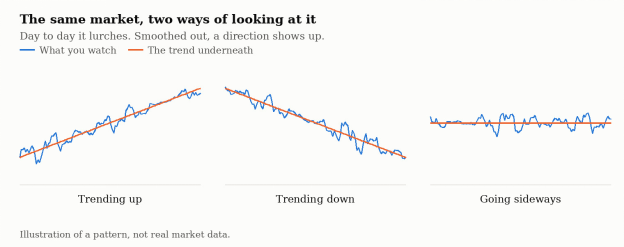
Markets jump around constantly. Day to day they look frantic. But if you smooth out all that noise, most of the time an asset is doing one of three fairly boring things: drifting up, drifting down, or going nowhere.
The blue line is what Dave was staring at. The orange line is what was actually happening.
The problem is that the blue line is loud and the orange line is quiet. The jumps are what you feel. A 6% drop on a Tuesday is a punch in the stomach. The fact that it sits inside a trend that has not changed at all is just a fact, and facts are not very loud.
So people end up reacting to the noise and ignoring the signal. Not because they are foolish, but because one of them is shouting.
What is actually going on in your head
Two things, and both of them are normal.
Losing hurts more than winning feels good. This is the big one. Psychologists Daniel Kahneman and Amos Tversky showed it decades ago, and it is one of the most reliably reproduced findings in the field. Most estimates put it at roughly two to one. Losing a hundred dollars stings about twice as much as finding a hundred dollars pleases.
So when Dave was down, he was not feeling a mild negative. He was feeling something sharp enough that making it stop became its own goal, separate from whether selling was a good idea.
Your brain anchors on what you paid. A stock at $90 feels completely different depending on whether you bought at $50 or at $120. Same company, same future, same everything. The only difference is a number in your memory, and your brain treats that number as if it means something to the market. It does not. The market has no idea what you paid.
Put those two together and you get a trap. Selling a loser means admitting the loss is real, so you hold. Selling a winner locks in a good feeling, so you sell too early. Both pull in the wrong direction at the same time.
This even has a name. Economists Hersh Shefrin and Meir Statman called it the disposition effect back in 1985, and in 1998 a researcher named Terrance Odean measured it across roughly 10,000 real brokerage accounts. People sold their winners about one and a half times as readily as their losers. And the winners they sold went on to beat the losers they kept by about 3.4% over the following year.
Ten thousand people do not share a personality flaw. They share a brain.
There is one more piece, and it is the one nobody likes hearing. The person buying at the top usually is not the least informed person in the room. They are often the person who has been watching the longest and finally became convinced. The Zcash piece mentioned earlier made exactly this point: the asset reached $1,500 and reversed, and the buyers who arrived closest to the high were the ones who had been watching it climb the longest. Confidence peaks at exactly the wrong moment. That is not stupidity. It is the feeling of having done your homework, arriving late.
So what actually helps
None of this gets fixed by deciding to be more disciplined. You cannot out-willpower how your own brain processes loss, and anyone who tells you otherwise is selling something.
What works is setting things up in advance, while you are calm, so that the panicked version of you has less to decide.
1. Do not over invest. This is the big one.
Never put in more than you are comfortable losing.
Now, realistically, there is hardly any amount of money that anyone is genuinely comfortable losing. But there is a level where you know, in your gut, that if it went to zero you would be in actual trouble. Stretched thin. Behind on something. For one person that line might be a month’s rent. For someone else it could be far more, or far less.
For me personally, I never like to lose more than 20% of what I put in, and my investments are typically sized around $2,000 or less. If I lose 20% on $2,000, it is not fun, but I am not in a financial crunch either. Once we start going above that number, it gets uncomfortable fast.
Here is why this matters more than any other tip: almost every bad decision in Dave’s story came from the size of his position, not from his analysis. If he had put in an amount he could shrug off, the 15% drop in June would have been a shrug. It was only unbearable because it was too big. Position size is what turns a market move into an emotional event.
Get this one right and the rest get much easier.
2. Mentally prepare yourself for the swings.
Before you put a single dollar in, picture it dropping 20%. Really sit with it. How would that feel on a Tuesday afternoon when you are already having a bad day?
This sounds soft. It is not. There is a real difference between a drop you expected and a drop that ambushes you, even when the number is identical. An expected drop is information. An unexpected one is a threat, and your brain handles threats by wanting them to stop.
Volatility is not a sign something went wrong. Look at that middle panel again. Every one of those jagged drops was a normal day in a market that was behaving exactly as markets behave. If you go in knowing the ride is bumpy, a bump stops being evidence that you made a mistake.
3. Decide what you will do before you own anything.
Write down, in advance, what would make you sell. Not a feeling. A reason.
This works for an odd reason. The version of you who has not bought yet has nothing to defend. They can think clearly because they have nothing at stake. The note you write is the only way that person gets to speak to the version of you who is down 18% and scrolling for reassurance at midnight.
4. Ask the question that removes the anchor.
When you are stuck holding something painful, try this one: knowing what I know now, would I buy this today at this price?
If the answer is no, then you are not holding it because of the asset. You are holding it because of what you paid, and the market does not care what you paid.
It is a small question and it does something quite sneaky. It moves your reference point off your purchase price and onto reality.
Every Behavior has a Reason
Dave did not buy high and sell low because he was dumb. He did it because losses hit harder than gains, because his brain anchored to a number nobody else in the market could see, and because the loud daily noise drowned out the quiet trend underneath.
Knowing that will not switch the feelings off. Nothing does, and anyone promising otherwise is not being straight with you.
But feelings you can name and expect are feelings you can plan around. That is a much more realistic goal than becoming someone who never feels them, and unlike willpower, it actually works.
This article explains research on decision-making and is not investment advice. Nothing here is a recommendation to buy or sell anything. The author may hold positions in assets discussed.
Sources Used:
- Kahneman and Tversky (1979), prospect theory. Loss aversion and reference dependence. The roughly two-to-one ratio is the commonly cited range from this literature rather than a single fixed constant, which is why the text says “most estimates.”
- Shefrin and Statman (1985) named the disposition effect. Cited for the name only.
- Odean (1998), “Are Investors Reluctant to Realize Their Losses?”, Journal of Finance 53(5), 1775-1798. Roughly 10,000 randomly selected accounts at a US discount brokerage, trade records 1987 to 1993. Proportion of gains realized 0.148 against losses at 0.098. Winners sold outperformed paper losers held by about 3.4% over 252 trading days, measured against the CRSP value-weighted index.

Maria holds an MS in Psychology with a specialization in Social Psychology. She is a research-oriented writer with a strong academic background in psychological and behavioral sciences. Her work focuses on bridging academic research and public understanding by simplifying complex psychological theories and social dynamics. She writes about the relationship between society, mental health, and human behavior, making evidence-based ideas more accessible and practical for readers.