Agreeableness is a personality trait that describes how much a person tends to cooperate with others, show compassion, consider different perspectives, and maintain positive social relationships. In psychology, agreeableness is one of the five major personality dimensions in the Big Five personality model.
People with high agreeableness are often considerate, trusting, helpful, and willing to compromise. Those with lower agreeableness may be more skeptical, competitive, direct, or comfortable challenging other people’s opinions. Neither level automatically makes someone a better or worse person. The trait describes general behavioral tendencies rather than a person’s entire character.
Understanding what agreeableness means can help you recognize your communication habits, relationship patterns, strengths, and areas for personal growth.
Table of Contents
What Is Agreeableness in Psychology?
In psychology, agreeableness refers to a person’s general tendency to behave cooperatively, consider other people’s needs, and approach social interactions with compassion and goodwill.
The American Psychological Association describes agreeableness as a tendency to act in a cooperative and unselfish manner. It is understood as a dimension of individual differences, meaning people vary in how strongly they display this trait.
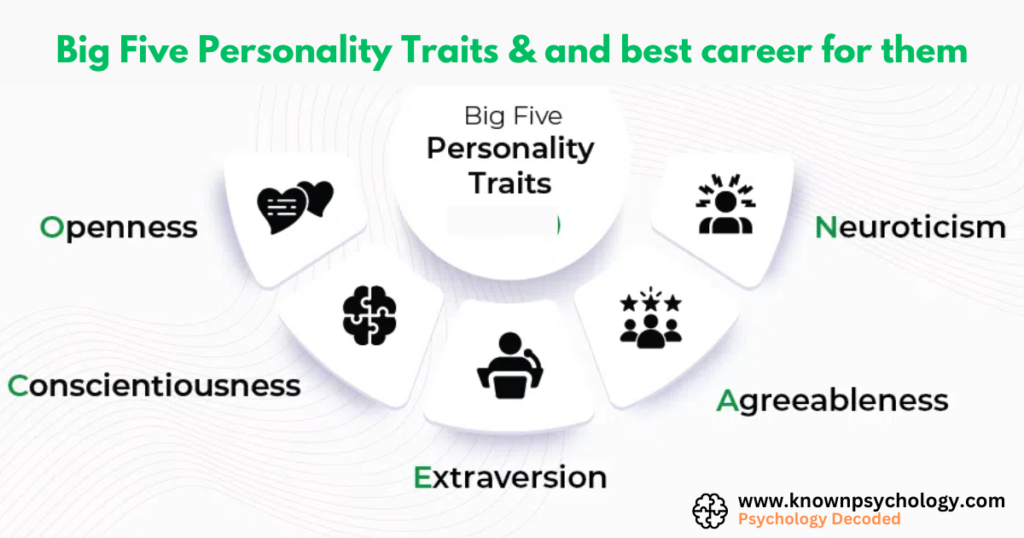
Agreeableness belongs to the Big Five personality traits, also known as the OCEAN model. The five dimensions are:
- Openness to experience: Curiosity, imagination, and interest in new ideas.
- Conscientiousness: Organization, responsibility, and self-discipline.
- Extraversion: Sociability, assertiveness, and engagement with others.
- Agreeableness: Cooperation, compassion, and consideration for other people.
- Neuroticism: A tendency to experience negative emotions such as worry, sadness, or irritability.
These dimensions describe different aspects of personality. For example, someone can be highly agreeable but introverted, or outgoing but less agreeable. One trait does not determine all the others.
To explore how these dimensions relate to your own behavior, you can take our Big Five Personality Test.
What Are the Traits of an Agreeable Person?
An agreeable person generally values cooperation, mutual respect, and positive relationships. However, agreeableness can appear differently depending on the person’s circumstances, culture, and individual experiences.
Common characteristics associated with agreeableness include the following.
1. Compassion and Consideration
People with higher agreeableness tend to consider how their words and actions affect others. They may offer emotional support, notice when someone needs help, or make an effort to understand another person’s difficulties.
For example, a colleague who notices that a teammate is struggling with a deadline might offer assistance rather than focusing exclusively on their own responsibilities.
2. Cooperation
Cooperation is a central feature of agreeableness. People who score higher on this trait often prefer finding solutions that work for everyone rather than turning every disagreement into a competition.
They may be willing to share responsibilities, listen to suggestions, and compromise when appropriate.
3. Trust in Others
Highly agreeable individuals may generally approach people with trust and assume positive intentions. They are often willing to give others the benefit of the doubt.
However, trust does not mean ignoring warning signs. Healthy relationships still require boundaries, sound judgment, and the ability to recognize when someone is behaving unfairly.
4. Altruism and Helpful Behavior
Altruism involves helping others without expecting an immediate personal reward. People with higher agreeableness may be more inclined to volunteer, share resources, or support someone who needs assistance.
For instance, a student might help a classmate understand a difficult topic even when there is no direct benefit to themselves.
5. Respectfulness and Politeness
Agreeable people often try to communicate respectfully, even when they disagree. They may avoid unnecessary hostility and consider other people’s feelings during difficult conversations.
Respectfulness does not require agreeing with everyone. A person can disagree firmly while still treating others with dignity.
What Does High Agreeableness Mean?
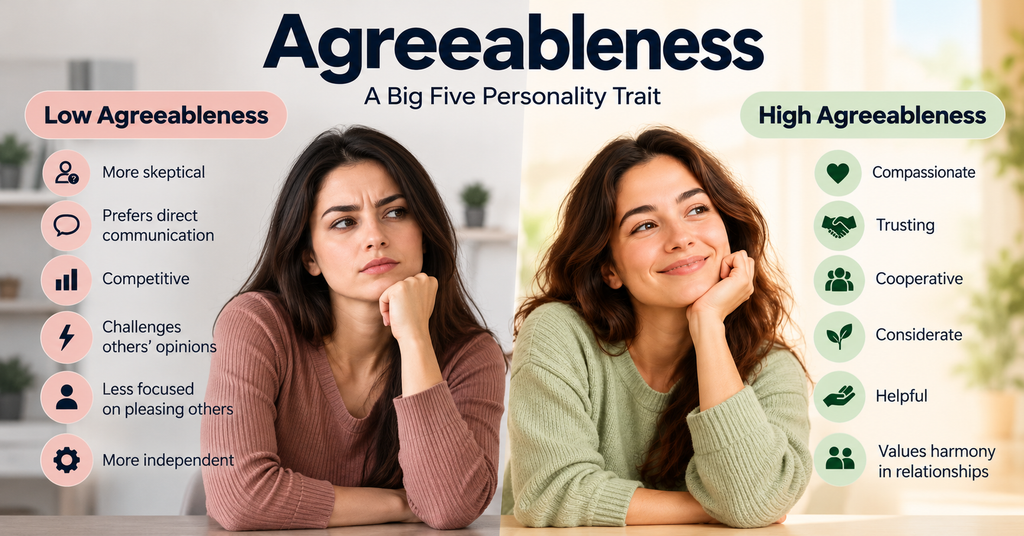
High agreeableness means a person tends to score toward the cooperative, compassionate, and considerate end of the agreeableness dimension.
People with high agreeableness may display several common patterns:
- They are willing to help others.
- They value harmony in relationships.
- They consider other people’s feelings before making decisions.
- They tend to cooperate in group settings.
- They may trust others relatively easily.
- They often prefer resolving disagreements through discussion and compromise.
Examples of High Agreeableness
Consider a few everyday situations.
At work: A team member listens to different opinions, offers support when a colleague needs help, and looks for a fair solution when responsibilities are disputed.
In friendships: A friend notices that someone is upset and checks in with them rather than dismissing their feelings.
During disagreements: A person tries to understand the other person’s perspective and finds common ground before deciding how to proceed.
These examples illustrate how high agreeableness may appear in everyday life. They do not mean that every agreeable person behaves this way in every situation.
Is High Agreeableness Always a Good Thing?
High agreeableness can support cooperation, trust, and relationship satisfaction. However, it may also create difficulties if a person consistently puts other people’s preferences ahead of their own needs.
For example, someone who agrees to every request may become overwhelmed, neglect personal priorities, or struggle to express disagreement.
The goal is not to eliminate agreeableness but to combine compassion with assertiveness. Helping others can be valuable without sacrificing your own well-being.
What Does Low Agreeableness Mean?
Low agreeableness means a person tends to score toward the more skeptical, competitive, or challenging end of the agreeableness dimension.
People with lower agreeableness may be more likely to question other people’s motives, prioritize their own goals, or express disagreement directly. They may also be less inclined to compromise when they believe their position is correct.
Common characteristics can include:
- Greater skepticism toward other people.
- A preference for direct communication.
- Comfort with competition and debate.
- A tendency to challenge assumptions.
- Less willingness to accommodate other people’s preferences.
- Greater emphasis on personal interests in some situations.
Examples of Low Agreeableness
At work: An employee directly challenges a proposed strategy because they believe it will waste resources.
In a group discussion: A person questions the majority opinion rather than agreeing simply to avoid conflict.
During a disagreement: Someone focuses on the facts of the argument and expresses their position without prioritizing emotional harmony.
These behaviors are not necessarily harmful. Directness and critical thinking can be useful in many situations. Problems are more likely to arise when disagreement becomes disrespect, hostility, or a lack of consideration for others.
Low agreeableness does not automatically mean someone is cruel, selfish, or dishonest. Personality traits exist along a continuum, and behavior depends on more than one trait.
Agreeableness Examples in Everyday Life
The following table illustrates how agreeableness may influence behavior in common situations.
| Situation | Higher agreeableness | Lower agreeableness |
| Teamwork | Emphasizes cooperation and shared goals | Emphasizes independent judgment or competition |
| Disagreement | Looks for common ground | Challenges the opposing position directly |
| Helping others | Often offers support when possible | May assess personal priorities before helping |
| Trust | May give others the benefit of the doubt | May question motives before trusting |
| Decision-making | Considers the effect on other people | May prioritize efficiency or individual goals |
These are general tendencies, not fixed rules. A person with high agreeableness can be assertive, and someone with low agreeableness can be generous and caring. Context, values, experience, and other personality traits also influence behavior.
Agreeableness vs. Empathy, Kindness, and People-Pleasing
Agreeableness is related to empathy, kindness, and people-pleasing, but these concepts are not interchangeable.
Agreeableness vs. Empathy
Empathy involves understanding or sharing another person’s emotional experience. Agreeableness is a broader personality dimension associated with cooperation, compassion, and interpersonal behavior.
A person may understand another person’s feelings but still disagree with their decisions. Similarly, someone may be cooperative without deeply sharing another person’s emotional experience.
Agreeableness vs. Kindness
Kindness refers to considerate or helpful behavior. Agreeableness describes a more general pattern of personality tendencies.
Someone who usually scores low in agreeableness can still act kindly, just as a highly agreeable person can behave inconsiderately in certain circumstances.
Agreeableness vs. People-Pleasing
People-pleasing involves repeatedly prioritizing other people’s approval or satisfaction, sometimes at the expense of personal needs and boundaries.
High agreeableness does not necessarily lead to people-pleasing. A person can be compassionate and cooperative while saying no, expressing different opinions, and protecting their time.
For example, an agreeable person might decline an unreasonable request politely rather than agreeing out of fear of disappointing someone.
Understanding these differences can help you reflect on your behavior without treating every act of kindness or conflict avoidance as a sign of one particular personality trait.
How Does Agreeableness Affect Relationships?
Agreeableness can influence how people communicate, resolve disagreements, and respond to other people’s needs.
People with higher agreeableness may find it natural to compromise, offer reassurance, and maintain a cooperative atmosphere. These tendencies can support trust and reduce unnecessary conflict.
However, healthy relationships require more than agreeableness. They also depend on honest communication, mutual respect, emotional awareness, and appropriate boundaries.
For example, avoiding every difficult conversation might preserve peace temporarily but leave important concerns unresolved. Expressing disagreement respectfully can be healthier than remaining silent to avoid discomfort.
If you want to explore how personality and behavior influence close relationships, read our Relationship Personality Test and Communication Style Test.
Can Agreeableness Change Over Time?
Agreeableness is generally considered a relatively stable personality trait, but it is not permanently fixed. Personality patterns can change gradually through life experiences, relationships, responsibilities, and deliberate efforts to develop new habits.
Someone who previously avoided disagreements might learn to communicate more assertively. Another person might become more willing to cooperate after developing trust in a team or gaining experience working with different people.
Changes in behavior do not necessarily mean that someone’s underlying personality has completely changed. People also adapt their responses to different situations.
If you want to develop healthier interpersonal habits, consider these practical steps:
- Practice active listening. Give people time to explain their perspectives before responding.
- Show consideration without assuming responsibility for everyone’s feelings. You can care about someone without solving every problem they experience.
- Learn to disagree respectfully. Explain your reasoning without insulting or dismissing the other person.
- Set clear boundaries. Practice declining requests that conflict with your needs or responsibilities.
- Reflect on recurring patterns. Notice whether you tend to avoid conflict, become overly critical, or struggle to trust others.
The aim is not to achieve a particular personality score. It is to develop behaviors that help you maintain healthy relationships while remaining true to your own values.
How Is Agreeableness Measured?
Agreeableness is commonly assessed using personality questionnaires based on the Big Five or five-factor model. These assessments ask about typical preferences, attitudes, and behaviors rather than evaluating a person through a single action.
A questionnaire may explore how often you cooperate with others, show concern for their well-being, trust people, or prioritize harmony during disagreements.
Results generally place a person somewhere along a dimension rather than assigning a permanent personality category. Scores should be interpreted in context, and a short online quiz should not be treated as a clinical diagnosis or a complete assessment of personality.
Frequently Asked Questions About Agreeableness
What does agreeableness mean in simple words?
Agreeableness means a person’s general tendency to cooperate with others, show consideration, and approach social interactions with compassion. It is one of the five major dimensions of personality in the Big Five model.
Is agreeableness a good personality trait?
Agreeableness can support cooperation, trust, and positive relationships. However, no single personality trait is always beneficial in every situation. Compassion works best when balanced with boundaries, independent judgment, and assertiveness.
What is an example of agreeableness?
An example of agreeableness is a colleague who listens to different opinions, offers help when a teammate is struggling, and works toward a fair solution during a disagreement.
What is the opposite of agreeableness?
The opposite end of the agreeableness dimension is often described as antagonism or disagreeableness. It may involve greater skepticism, competitiveness, or a tendency to challenge others. It does not automatically indicate bad character.
Is agreeableness the same as empathy?
No. Empathy involves understanding or sharing another person’s emotional experience, whereas agreeableness is a broader personality trait associated with cooperation, compassion, and interpersonal behavior.
Can a person have high agreeableness but still be assertive?
Yes. Agreeableness and assertiveness are not mutually exclusive. A person can be considerate and cooperative while expressing disagreement, setting boundaries, and making independent decisions.
What causes low agreeableness?
There is no single cause. Personality develops through a complex interaction of inherited tendencies, development, experiences, and environmental influences. A low agreeableness score alone does not establish why someone behaves a particular way.
How can I find out my agreeableness score?
A Big Five personality questionnaire can help you explore your level of agreeableness alongside openness, conscientiousness, extraversion, and neuroticism. Results are best treated as a guide to self-reflection rather than a definitive label.
Final Thoughts
Agreeableness helps explain why people differ in their willingness to cooperate, trust others, compromise, and consider other people’s needs. Higher agreeableness often involves compassion and a preference for harmony, while lower agreeableness may involve greater skepticism, competition, or direct disagreement.
Neither end of the dimension tells the whole story about a person. The most useful approach is to understand your tendencies, recognize their strengths and limitations, and adapt your behavior to different situations.
If you want to explore your personality further, take our Big Five Personality Test to learn more about the five major dimensions of personality.

Maria holds an MS in Psychology with a specialization in Social Psychology. She is a research-oriented writer with a strong academic background in psychological and behavioral sciences. Her work focuses on bridging academic research and public understanding by simplifying complex psychological theories and social dynamics. She writes about the relationship between society, mental health, and human behavior, making evidence-based ideas more accessible and practical for readers.