Mold in the home can be more than an unpleasant sight or smell. It may affect indoor air quality, trigger allergic reactions, and contribute to discomfort and worry about the safety of your living environment. If you have noticed mold near a window, on a bathroom wall, or in a damp basement, you may be wondering whether an air purifier can help.
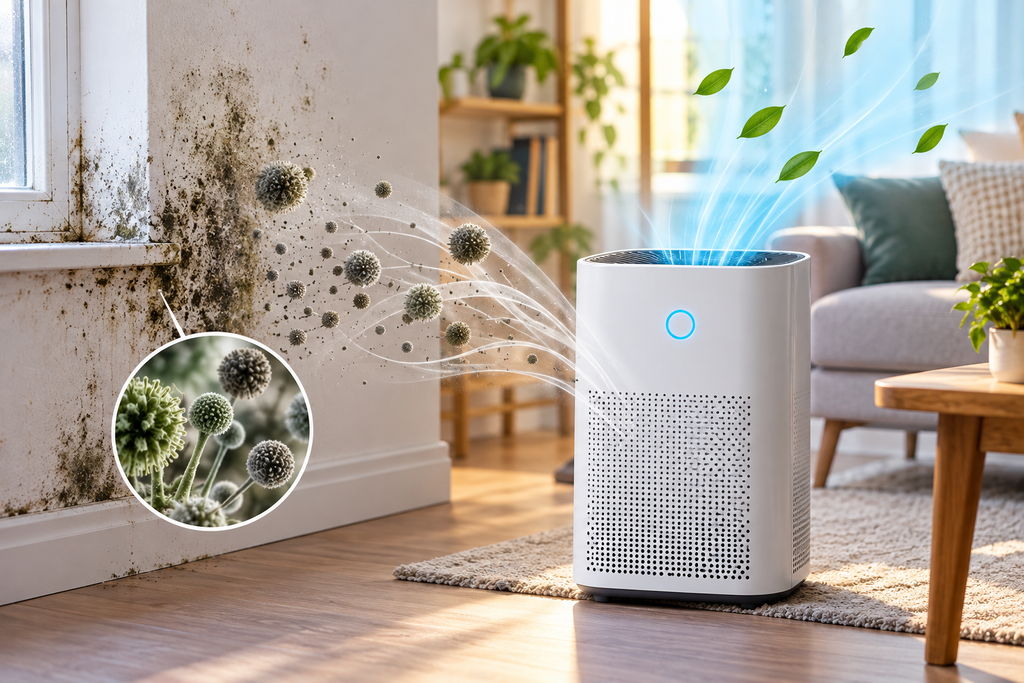
Do air purifiers help with mold? Yes, certain air purifiers can reduce airborne mold spores when properly sized and equipped with effective particle filtration. However, they cannot remove mold growing on walls, eliminate moisture, or prevent mold from returning if the underlying problem remains.
Understanding this distinction can help you make better decisions about your home environment and avoid spending money on a device that cannot solve the actual problem.
How Mold Affects Indoor Air Quality and Well-Being
Mold is a type of fungus that grows in damp environments. It can develop on drywall, wood, carpeting, fabrics, and other materials when moisture persists. Mold releases spores and other particles into the surrounding environment, and some of these particles can become airborne.
Exposure to damp and moldy environments is associated with respiratory symptoms, allergic reactions, and worsening asthma in susceptible individuals. People can respond differently depending on their sensitivity, existing health conditions, and the extent of exposure.
The effects may also extend into everyday life. A persistent musty smell, visible mold, or recurring moisture problem can make a home feel uncomfortable and create uncertainty about whether the indoor environment is healthy. Although these concerns can contribute to stress, it is important not to assume that mold exposure directly causes a particular psychological disorder.
For a fuller understanding of the environment in which people live and work, the CDC’s NIOSH occupational air quality standards resource provides information about indoor environmental quality and potential workplace exposures.
Do Air Purifiers Remove Mold Spores?
Air purifiers can capture some airborne mold spores, depending on the filtration system, airflow, room size, and how long the unit operates.
A purifier with a properly fitted HEPA filter is generally a useful option for reducing airborne particles. As air passes through the filter, particles are trapped rather than being allowed to circulate freely throughout the room.
However, there is an important limitation: an air purifier treats the air passing through the device, not the underlying source of mold. If mold continues growing behind furniture, beneath flooring, or on a damp wall, spores may continue entering the air.
This means an air purifier should be viewed as a supporting measure rather than a complete mold-removal solution.
What an Air Purifier Can and Cannot Do
| What it can help with | What it cannot do |
|---|---|
| Reduce some airborne mold spores | Remove mold growing on walls or ceilings |
| Filter other airborne particles | Repair leaks or water damage |
| Potentially reduce certain airborne odors when equipped with suitable carbon filtration | Eliminate the moisture that supports mold growth |
| Supplement a broader indoor air-quality plan | Guarantee a mold-free home |
| Help reduce airborne particle exposure while other measures address the source | Replace professional remediation when extensive mold damage is present |
The U.S. Environmental Protection Agency explains that filtration can supplement source control and ventilation, but air cleaners do not resolve mold and moisture problems. The underlying cause must also be addressed.
Which Air Purifier Features Matter for Mold?
If you are considering an air purifier for a room affected by mold, focus on filtration performance rather than marketing claims alone.
1. HEPA Filtration
A properly designed HEPA air purifier can capture airborne particles, including many mold spores. Check the manufacturer’s filtration specifications and make sure the filter is installed correctly.
Avoid assuming that every product marketed as an air purifier offers the same level of particle removal. Performance depends on the complete device, not just the wording on its packaging.
2. Appropriate Room Coverage
The purifier must be suitable for the room where you intend to use it. A small unit may struggle to clean the air effectively in a large bedroom, basement, or open-plan living area.
Look for a clean air delivery rate (CADR) appropriate to the room size. A suitable CADR, combined with adequate operating time, helps determine how much air the unit can filter.
3. Activated Carbon for Certain Odors
Some air purifiers include activated carbon to help reduce certain gases and odors. This may be useful if a room has a lingering musty smell, but odor reduction does not prove that the mold source has been eliminated.
If the smell persists, investigate possible moisture intrusion or hidden mold rather than relying on the purifier to mask it.
4. Safe Operation and Filter Maintenance
Follow the manufacturer’s instructions for replacing or cleaning filters. A poorly maintained unit may not perform as intended.
Avoid air cleaners that intentionally generate ozone. Ozone can irritate the lungs and is not an appropriate solution for an indoor mold problem.
For more context on the potential benefits and limitations of filtration devices, see the article on air purifier pros.
How to Address Mold at Its Source
If you can see mold or repeatedly notice a musty odor, correcting the moisture problem is more important than simply filtering the air.
Find and Fix the Moisture Problem
Look for leaking pipes, roof damage, condensation around windows, damp basement walls, or water-damaged materials. Repair leaks and address sources of persistent condensation.
Improving bathroom and kitchen exhaust ventilation can also help reduce moisture buildup. Where humidity remains high, a dehumidifier may be useful.
Clean or Remove Moldy Materials Safely
The appropriate cleanup method depends on the affected surface, the extent of the damage, and the source of the moisture. Small areas on suitable hard surfaces may be manageable with appropriate precautions, while extensive mold growth or contamination involving porous building materials may require professional help.
People with asthma, significant allergies, chronic lung disease, or weakened immune systems should be especially cautious about participating in mold cleanup.
Do not simply paint over mold or assume that killing it is enough. Mold and contaminated materials may still need to be removed, and the affected area must be dried properly.
Use Filtration as a Supporting Measure
Once you have addressed the source, an appropriately sized air purifier may help reduce remaining airborne particles. Keep it operating and maintain its filters according to the manufacturer’s recommendations.
Remember that a purifier cannot guarantee that all mold spores will be removed. The goal is to reduce airborne particles while preventing further mold growth.
Can Mold Exposure Affect Mental Health?
A damp or moldy home can be a source of ongoing worry, particularly when people are uncertain about possible health effects or how to resolve the problem. Concerns about children, sleep, respiratory symptoms, repair costs, and recurring property damage can add to everyday stress.
It is useful to separate two issues: the established health concerns associated with damp and moldy environments, and the psychological strain of living with a persistent home problem.
Research on indoor environmental conditions continues to develop, and individual experiences vary. Mold exposure should not automatically be treated as an explanation for anxiety, low mood, memory problems, or difficulty concentrating. Those symptoms can have many possible causes and may warrant assessment by a qualified healthcare professional.
Taking practical steps can reduce uncertainty. Identify the moisture source, arrange appropriate cleanup, improve ventilation where suitable, and use filtration as an additional measure rather than the sole intervention.
If worries about indoor air quality are becoming overwhelming or interfering with daily life, it may also help to discuss those concerns with a healthcare professional.
When Should You Seek Professional Help?
Consider consulting a qualified mold-remediation professional if mold covers a large area, returns repeatedly after cleaning, is associated with substantial water damage, or appears to be growing inside walls or other inaccessible spaces.
Seek medical advice if you develop persistent respiratory symptoms or if you have an underlying condition that makes mold exposure more concerning. Severe breathing difficulty requires urgent medical attention.
An air purifier may be part of the response, but it should not delay necessary repairs, cleanup, or medical assessment.
Frequently Asked Questions
Do air purifiers help with mold allergies?
An appropriately selected HEPA air purifier may reduce airborne mold spores and other particles that trigger symptoms. However, results vary, and filtration does not remove mold growing in the home. Addressing dampness and mold remains essential.
Will a HEPA air purifier kill mold?
No. A HEPA filter is designed to capture particles from the air passing through it. It does not eliminate mold growing on walls, furniture, or building materials.
Can an air purifier remove a musty smell?
Some models with suitable activated-carbon filtration may reduce certain odors. However, a musty smell can indicate an unresolved moisture problem, so the source should be investigated.
Is it safe to sleep in a room with mold if an air purifier is running?
An air purifier does not make a moldy room automatically safe. The appropriate response depends on the extent of mold, the moisture source, and individual health circumstances. Address the mold and moisture problem rather than relying on filtration alone.
What is the best way to prevent mold from returning?
Control moisture, repair leaks promptly, dry water-damaged areas thoroughly, and improve ventilation where needed. Clean or remove moldy materials appropriately. An air purifier may provide additional airborne particle reduction, but it cannot replace these steps.
Final Thoughts
So, do air purifiers help with mold? They can help reduce airborne mold spores when they use effective filtration and are appropriately sized for the space. However, they do not remove established mold growth or correct the damp conditions that allow it to spread.
The most effective approach combines moisture control, suitable cleanup, ventilation, and air filtration where appropriate. Understanding what each measure can realistically accomplish helps you make informed decisions about your home environment and protect your well-being without relying on a single device to solve the entire problem.

Maria holds an MS in Psychology with a specialization in Social Psychology. She is a research-oriented writer with a strong academic background in psychological and behavioral sciences. Her work focuses on bridging academic research and public understanding by simplifying complex psychological theories and social dynamics. She writes about the relationship between society, mental health, and human behavior, making evidence-based ideas more accessible and practical for readers.