For many students, school is more than a place to learn. It is also an environment where they develop socially, manage emotional challenges, and begin making decisions about their future. School counselors occupy a distinctive position within this environment, supporting students with both academic concerns and personal or emotional challenges.
Unlike professionals who focus exclusively on education or clinical mental health care, school counselors can help students navigate the connection between their well-being, school performance, relationships, and future goals. They may provide short-term support, help students identify challenges affecting their academic progress, and connect them with additional resources when they need more specialized mental health services.
This combination of academic guidance and mental health support makes school counseling an important part of a student’s overall development. In this article, we explore why school counselors occupy a distinct role between mental health support and academic guidance.
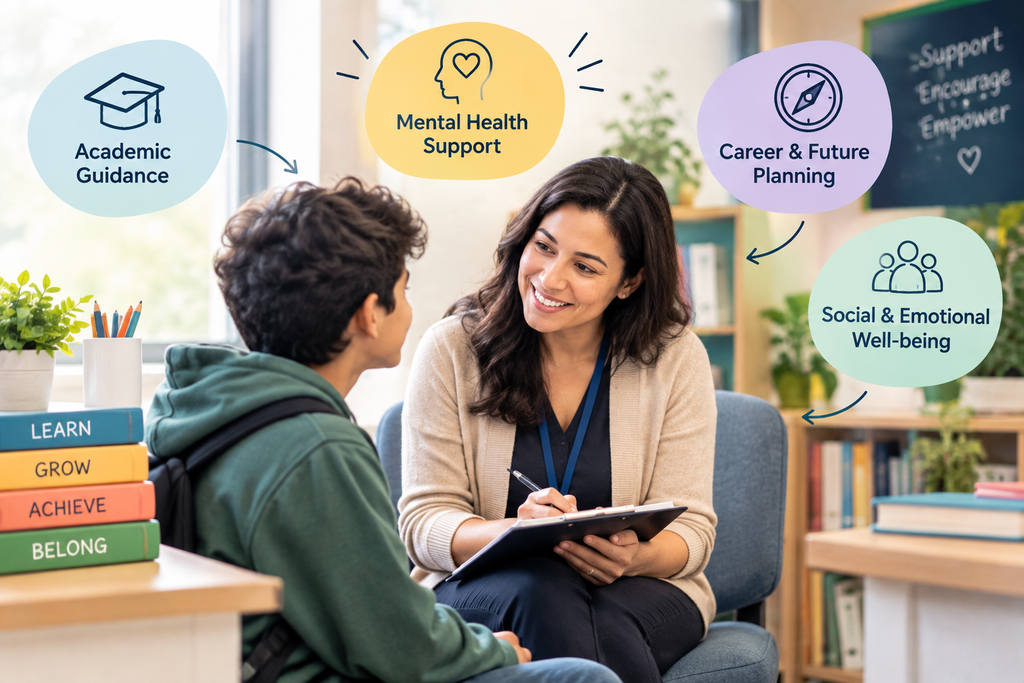
Table of Contents
What is a School Counselor?
Before exploring the broader role of school counselors, it is helpful to understand what their day-to-day responsibilities typically involve. Academic guidance is an important part of their work.
School counselors may help students select appropriate courses, explore extracurricular opportunities, prepare for college applications, identify potential career paths, and make educational decisions based on their interests, abilities, and goals.
These academic responsibilities are often the part of school counseling that students and families recognize most readily. However, the role extends well beyond course selection and college planning.
Depending on the school and its counseling program, counselors may also address social-emotional concerns, provide support when students are experiencing personal difficulties, and deliver classroom lessons on topics such as relationships, coping skills, safety, or emotional well-being. When a student’s needs extend beyond the counselor’s scope of practice, they may also help connect the student and family with appropriate mental health or community resources.
Much of this work happens quietly and may not be immediately visible to the wider school community. As a result, students may be familiar with counselors primarily as academic advisers without realizing that they can also be an important source of social-emotional support.
Understanding this broader role helps explain why school counselors occupy a distinctive position between academic guidance and student well-being.
Are Guidance Counselors Mental Health Professionals?
Strictly speaking, guidance counselors are not mental health counselors, but they have been trained to recognize signs of mental distress and take the appropriate steps to address them.
In certain cases, that may mean simply talking with a student about their problems. In many cases, schools intentionally block out hours in the guidance counselor’s schedule specifically for spontaneous student interactions.
In these cases, the guidance counselor is on hand to lend support to people who, for whatever reason, feel they need it.
This might also be leveraged in cases where a student has gotten into trouble or a simple conflict with another classmate.
What Happens When Guidance Counselors Meet with a Student Who Needs More Elaborate Support?
Because guidance counselors are not trained mental health professionals, they can’t diagnose students or officially recommend treatment paths. They can pass relevant information along to people with those capabilities.
Guidance counselors, like most people working within a school system, are considered mandated reporters. That means if they recognize signs that a student is in some sort of distress, they are legally obligated to report that information to someone who can do something about it and advance the issue in that way.
In many cases, once that handoff has taken place, the guidance counselor will continue to play a role in addressing the situation, even if that simply means checking in regularly with the student.
Guidance Counselors Have Regular Student Interactions
While guidance counselors are not mental health counselors precisely, they do have regular interactions with their students at a scale that may not be possible even for a school psychologist.
Where a school social worker or psychologist may only be able to meet monthly, or even less often, with students on their caseload, a guidance counselor generally has the flexibility to check in as often as needed.
In this way, they form a closer bond that may make students comfortable disclosing personal information or just spending time with them at school.
Mental Health Careers in School Systems
If you’re interested in a mental health career within the school system, you certainly still have options.
Becoming a school counselor is a good option for people who are interested in a diverse range of services, but it’s not the only job out there. School social workers provide a similar role with a stronger focus on student well-being.
You can also, of course, become a licensed counselor or a licensed clinical mental health counselor and work in a school setting, where the focus is on working with students and other school-aged children.
How Do You Become a Licensed Clinical Mental Health Counselor?
If you’re interested in becoming a licensed clinical mental health counselor, there are a few steps that you must take.
First of all, clinical mental health counselors must complete both federal and regional accreditation requirements. This will generally involve getting a bachelor’s degree, followed by a master’s in a CACREP-accredited program.
This will require 60 credit hours of education, followed by clinical work that involves patient interactions.
Combined, your college work may take five to seven years, during which time you’ll complete up to 600 hours of internship, followed by up to 4,000 hours of supervised clinical experience before you are qualified to work alone with patients.
You will also be required to take a standardized exam in the form of the National Clinical Mental Health Counselor Examination, or the NCMHCE.
If you’re interested in going down this road, it may be beneficial to look into the NCMHCE pass rates of students who have attended the university you’re interested in. Pass rates can vary pretty dramatically from school to school, making them worth your consideration.
Aside from the standard requirements, you should also keep in mind that the job will require a combination of patience and emotional resilience.
It’s tough work, even if also rewarding.
Conclusion
There are many ways to be of service to school-aged children. Being a counselor can be a great way to focus on a combination of educational and health-related concerns. That said, if your focus is more clinical, there are options for that as well.
Find the path that makes the most sense to you and get after it!

Maria holds an MS in Psychology with a specialization in Social Psychology. She is a research-oriented writer with a strong academic background in psychological and behavioral sciences. Her work focuses on bridging academic research and public understanding by simplifying complex psychological theories and social dynamics. She writes about the relationship between society, mental health, and human behavior, making evidence-based ideas more accessible and practical for readers.